
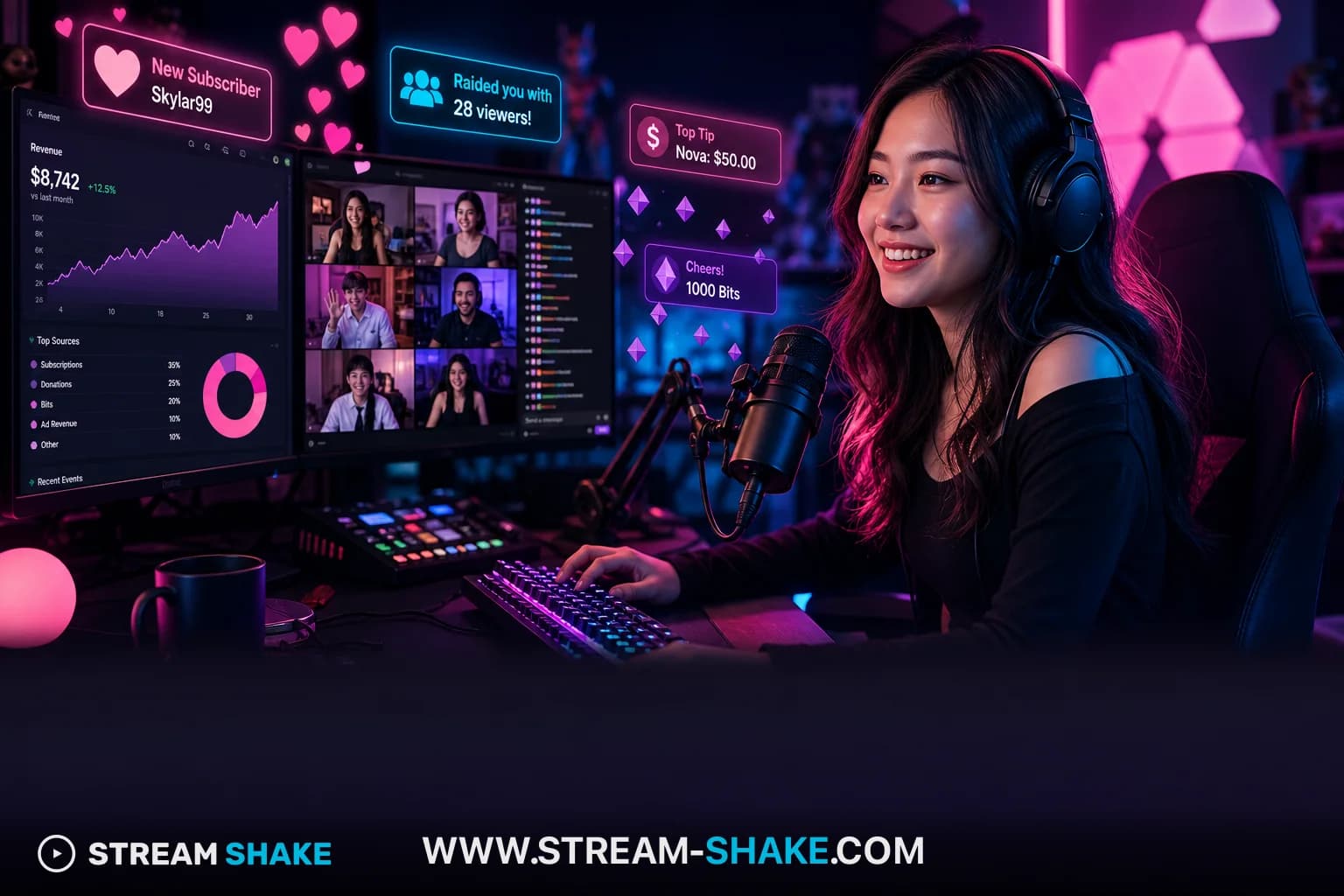
A 10,000 Twitch Bits donation translates to a $100 payout for the streamer, costing the viewer $126.00 and yielding Twitch a 20.6% margin. While offering robust chargeback protection for creators, the system remains vulnerable to sophisticated fraud, as evidenced by past money laundering scandals. Recent 2026 policy changes, including "Monetization for All" and "Spendable Balance," aim to democratize access for new streamers while tightening regulatory control over virtual currency.
The Anatomy of Twitch Bits: Valuation and Economics#
To navigate the economics of streaming, one must first decouple the jargon associated with platform-specific monetization. A **Bit** is Twitch's native virtual currency, represented by animated gem icons known as "Cheermotes". When a viewer "Cheers" using Bits in a live chat room, they are executing a micro-donation that triggers on-screen alerts, contributes to channel leaderboards, and directly compensates the broadcaster. Unlike physical currency, Bits are locked within the platform's ecosystem until they reach the streamer, at which point they are converted into fiat currency during the monthly payout cycle.
The financial architecture of a Bit is carefully calibrated to ensure platform profitability while maintaining the illusion of a one-to-one value transfer for the streamer. Regardless of how a viewer purchases Bits, the streamer is guaranteed a fixed payout of $0.01 (one US cent) per Bit cheered. Therefore, a donation of 10,000 Bits universally translates to a $100.00 payout for the creator. However, the cost to the viewer fluctuates based on volume discounts and localized markup. Twitch absorbs the payment processing fees on its end, justifying its margin through the initial purchase price.
| Bits Quantity | Viewer Cost (USD) | Discount | Cost per Bit |
|---|---|---|---|
| 100 Bits | $1.40 | No discount | $0.014 |
| 500 Bits | $7.00 | No discount | $0.014 |
| 1,500 Bits | $19.95 | 5% | $0.0133 |
| 5,000 Bits | $64.40 | 8% | $0.0129 |
| 10,000 Bits | $126.00 | 10% | $0.0126 |
| 25,000 Bits | $308.00 | 12% | $0.0123 |
Analyzing this structure reveals the underlying economic strategy. For a viewer to cheer 10,000 Bits, they must spend $126.00. Because the streamer receives exactly $100.00, Twitch retains $26.00. This equates to a roughly 20.6% platform cut on the 10,000 Bit tier. While a 20% margin might seem steep compared to direct peer-to-peer transfers, it is notably more favorable for the creator than Twitch's standard 50/50 revenue split on monthly channel subscriptions. For mid-sized streamers, encouraging Bit donations over standard subscriptions is a mathematically sound strategy to maximize net income per viewer.
It is also vital to note that pricing structures differ drastically based on the point of purchase. Due to the heavy commission fees imposed by mobile operating system marketplaces (such as the Apple App Store and Google Play Store), purchasing Bits via the Twitch mobile application is inherently more expensive. For instance, while a desktop user pays $126.00 for a clean 10,000 Bits, an iOS user navigating the Twitch mobile application is offered an alternative 11,500 Bit bundle priced at an exorbitant $199.00 USD. This equates to a staggering $0.0173 per Bit on iOS compared to the $0.0126 per Bit on a desktop browser. Savvy viewers typically utilize desktop browsers to entirely bypass these mobile surcharges.
Viewer Wallet Mechanics and Fractional Spending
When a viewer purchases a bundle of 10,000 Bits, they are not obligated to donate the entire sum in a single transaction. The $126.00 purchase credits a centralized, universal platform "wallet" linked to the viewer's account. This digital balance allows for granular, fractional spending across an unlimited number of channels. A user could choose to drop 100 Bits in 100 different broadcast rooms over the course of a year. Because the $0.01 to 1 Bit ratio is universally guaranteed, splitting the 10,000 Bits does not diminish the ultimate $100 payout pool; it merely distributes the fiat capital across a wider array of individual creators.
The 2026 Ecosystem Shift: Monetization for All and Spendable Balance#
Historically, Twitch operated under a gated monetization model. To earn a single cent from Bits or subscriptions, a creator had to qualify for the **Twitch Affiliate Program**. This required meeting strict rolling 30-day metrics: 50 followers, 8 hours streamed, 7 unique broadcast days, and an average of 3 concurrent viewers. For many aspiring broadcasters facing the platform's notorious "cold start" problem—streaming to an empty room—these thresholds represented an insurmountable barrier.
However, beginning with a US rollout and expanding globally by May 13, 2026, Twitch instituted a paradigm shift known as the "Monetization for All" initiative. The platform effectively demolished the Affiliate gatekeeping walls, granting nearly all creators immediate, day-one access to monetization tools, including Bits, subscriptions, and Channel Points.
While the ability to *receive* Bits was democratized, the ability to *extract* that fiat currency to a personal bank account remained tied to the traditional Affiliate metrics and a strict $50 minimum payout threshold. To bridge this gap, Twitch introduced the **Spendable Balance** feature.
Spendable Balance acts as an internal escrow system. If a non-Affiliate streamer receives Bits or subscription revenue, those funds are credited to their Spendable Balance on the Creator Dashboard. Because the creator cannot legally withdraw the funds without completing full tax interviews and reaching Affiliate status, Twitch allows them to spend this accrued balance *within* the platform. Streamers can utilize their earnings to purchase Bits to cheer for other creators, or to buy gifted subscriptions for their own community.
The introduction of Spendable Balance generated a highly polarized response from the streaming community. Proponents, including Twitch's executive team, framed the tool as a mechanism for community building. It allows small creators to engage in "gift matching" or to support peers without linking a personal credit card. Conversely, critics categorized the feature as a sophisticated retention mechanic designed to keep capital locked within the Amazon-owned ecosystem. If a streamer uses their $100 Spendable Balance to buy gifted subscriptions for another channel, Twitch takes a 50% cut of that secondary transaction, effectively double-dipping on the original capital. While optional, the psychological pressure to reinvest earnings into the community before a creator is permitted to "cash out" represents a profound evolution in how digital platforms manage creator liquidity.
Regulatory Enforcement: The 2026 Acceptable Use Policy Update#
As the flow of virtual currency accelerated under the "Monetization for All" initiative, Twitch recognized the need for stricter governance. On May 6, 2026, Twitch deployed its most significant overhaul to the Bits Acceptable Use Policy since 2018. This policy update introduced rigorous limitations on how creators could incentivize and manage Bit transactions, fundamentally altering the social contracts between streamers and viewers.
Furthermore, the updated policy explicitly banned the use of Bits for anything possessing off-platform or real-world monetary value. Streamers can no longer promise physical merchandise, off-platform services (like dedicated movie nights or private voice calls), or tangible goods in direct exchange for a specific amount of Bits. Bits must strictly remain a mechanism for on-platform digital interactions, such as triggering sound alerts, highlighting chat messages, or playing in-stream mini-games via Twitch Extensions.
This regulatory tightening serves a dual purpose. First, it distances Twitch from functioning as an unregulated digital marketplace or escrow service for physical goods, mitigating significant tax and liability risks. Second, it attempts to curb the rising tide of illicit financial activities by ensuring that the virtual currency remains strictly tied to social, non-monetary utilities within the platform boundaries.
The Dark Side of Microtransactions: Fraud and Money Laundering#
Wherever frictionless digital microtransactions exist, malicious actors will attempt to exploit them. While a 10,000 Bit cheer is typically a moment of joyous celebration for a streamer, anomalies in large Bit transactions have historically exposed severe vulnerabilities in platform security. The most glaring example of this vulnerability was the massive Turkish money laundering scandal that came to light in late 2021 and early 2022.
The scheme was initially exposed following a massive 125GB data leak of Twitch's internal metrics and source code in October 2021. Digital sleuths and local Turkish streamers analyzing the leaked creator payout data noticed severe mathematical anomalies: incredibly small, obscure channels—some averaging fewer than 40 or 50 concurrent viewers—were routinely cashing out between $1,800 and $2,000 per day. This volume of revenue is statistically impossible for channels of that size under normal, organic conditions.
How the Turkish Money Laundering Scheme Exploited Twitch Bits
- The Theft: Hackers acquired massive databases of stolen credit card information from random individuals globally.
- The Purchase: Criminals used these stolen cards to purchase massive bundles of Twitch Bits (such as 10,000 or 25,000 Bit packages).
- The Wash: The criminals approached complicit streamers via platforms like Discord, brokering an illegal agreement. The hackers would flood the small streamer's chat with thousands of Bits purchased with the stolen cards.
- The Kickback: Twitch, acting as an unwitting intermediary, processed the Bits and paid the streamer in clean, legitimate fiat currency during the monthly payout cycle. The streamer would then wire 70% to 80% of the cash back to the hackers' bank accounts, keeping a 20% to 30% cut for their complicity.
Because Twitch processed the initial transaction, the funds leaving the platform appeared entirely legitimate to traditional banking institutions. This digital sleight-of-hand resulted in an estimated $9.8 million to $10 million being laundered through the accounts of roughly 2,400 Turkish streamers over a two-year period. The scandal decimated public trust, leading to widespread protests by legitimate Turkish creators under the banner "#CleanTwitch," where broadcasters streamed black screens to demand platform accountability. Ultimately, the Turkish Financial Crimes Investigation Board (MASAK) intervened, and local police executed multi-province raids resulting in the detention of 40 individuals linked to the syndicate.
This historic event underscores the severe risks associated with digital currency ecosystems. While the 2026 Acceptable Use Policy updates and enhanced KYC (Know Your Customer) banking requirements for Affiliates aim to prevent a recurrence, the inherent anonymity of the internet means that sudden, massive influxes of Bits must always be viewed with a degree of critical scrutiny by both the platform and the creator.
Financial Security: The Chargeback Shield#
Despite the aforementioned vulnerabilities to macro-level money laundering, Bits offer individual streamers an incredibly vital form of financial security: absolute immunity from **chargebacks**.
A chargeback occurs when a consumer contacts their credit card provider to dispute a transaction, claiming it was unauthorized or fraudulent. In the early days of live streaming, before the introduction of Bits, viewers tipped creators exclusively using third-party payment processors like PayPal or Streamlabs. Malicious viewers—often referred to as "chargeback trolls"—weaponized this system. They would donate thousands of dollars to a streamer to elicit a massive on-screen reaction, only to silently dispute the charge with their bank weeks later. Not only would the streamer lose the donated funds, but payment processors would also slap the streamer with a chargeback penalty fee (often around $20 to $25 per dispute). A sudden wave of chargebacks could easily plunge a small streamer's bank account into the negative, causing genuine financial ruin.
Twitch Bits were engineered to eradicate this threat. When a viewer purchases 10,000 Bits for $126.00, they are conducting a transaction directly with Twitch, legally making Twitch the "merchant of record". If that viewer later attempts to initiate a chargeback with their credit card company, Twitch's corporate legal and financial teams handle the dispute entirely.
- **Zero Financial Liability:** Streamers are never subjected to chargeback processing fees for disputed Bit transactions.
- **Guaranteed Revenue:** Once a Bit is cheered in a channel, the transaction is generally considered final and non-refundable. Twitch explicitly states in its policy that Bits cannot be returned or refunded under normal circumstances.
- **Exceptions:** Refunds are only processed by Twitch Support in extreme cases, such as verifiable technical glitches, proven unauthorized account breaches, or strict regional consumer protection laws.
For this reason, financial advisors within the creator economy universally advise streamers to prioritize and incentivize Bit donations over direct PayPal tips. While a $100 PayPal tip avoids Twitch's 20% margin, it carries an extended window of chargeback liability, typically around 180 days. A 10,000 Bit cheer guarantees $100 of risk-free, irrevocable income.
Historic Milestones: Record-Breaking Bit Donations#
The spectacle of a massive Bit donation is a cornerstone of Twitch culture. Because Bits trigger progressive visual rewards—such as animated Chat Badges and placement on the channel's Top Cheerer Leaderboard—there is an inherent psychological driver for viewers to compete for the streamer's attention and communal prestige.
While a 10,000 Bit ($100) donation is considered a highly generous contribution that commands immediate on-screen acknowledgement, it is dwarfed by the historic records set in the platform's upper echelons. Examining these anomalies highlights the immense capital flowing through the ecosystem:
- **The Single-Sentence Record:** In June 2018, a streamer known as ItsLewdicolo received an astounding 549,945 Bits in a single chat message. This isolated event required the donor to spend approximately $6,900 at standard pricing, instantly injecting roughly $5,500 into the streamer's account.
- **The Christmas Miracle:** On December 24, 2021, a German intensive care nurse and part-time DJ streamer known as Anastasia Rose received a flood of Bit donations from a single user named "GamblerHH." Over the course of the broadcast, the user cheered a cumulative 1 million Bits. The purchase cost the viewer well over €10,000 (depending on the bundle sizes purchased), netting the bewildered creator $10,000 in a single evening.
- **The Corporate Mega-Donation:** The absolute ceiling of Bit donation records belongs to veteran broadcaster Benjamin "DrLupo" Lupo. During a massive charity drive for St. Jude Children's Research Hospital, DrLupo received a 100-million Bit donation. However, this was not from a rogue billionaire viewer; the donation was executed directly by Twitch's corporate account, funneling $1,000,000 into the charity pool.
These colossal events are rare, but they function as powerful marketing tools for the platform. They perpetuate the narrative that life-changing wealth is just one stream away, incentivizing the grind for millions of aspiring creators.
The Competitive Landscape: Kick, YouTube, and Alternative Economies#
By 2026, Twitch's dominance over the live-streaming sector is fiercely contested. Competitors have identified Twitch's revenue splits and strict moderation policies as potential weaknesses, launching aggressive campaigns to siphon both creators and viewers. Understanding the 10,000 Bit ecosystem requires contextualizing it against the alternatives: namely, Kick and YouTube.
| Platform | Currency Name | Viewer Cost for $100 Creator Payout | Platform Revenue Split | Chargeback Protection Status |
|---|---|---|---|---|
| Twitch | Bits | $126.00 (Desktop Web) | ~20.6% Platform Margin | Absolute Immunity |
| Kick | KICKs / Direct Subs | $105.79 (10,000 KICKs) | 95/5 (Creator/Platform) | Guaranteed via Platform |
| YouTube Gaming | Super Chats / Stickers | $142.86 | 70/30 (Creator/Platform) | Vulnerable / Mixed Protection |
Kick and the "KICKs" Currency
Emerging as Twitch's most combative rival, Kick built its brand on two pillars: highly relaxed content moderation (appealing to the "wild west" era of early internet streaming) and aggressively creator-friendly revenue splits. Kick's primary disruption is its 95/5 subscription split. While a standard $5 subscription on Twitch yields the creator $2.50, the exact same transaction on Kick yields $4.75. To combat Twitch Bits, Kick introduced its own proprietary virtual currency, aptly named **KICKs**.
- **Pricing Parity:** Like Bits, KICKs offer volume discounts. A viewer looking to make a substantial donation can purchase 10,000 KICKs for $105.79 (translating to roughly $0.0105 per unit).
- **Utility:** KICKs are used to trigger "Gifts"—animated emotes and pinned chat messages that vary in size and duration based on the number of KICKs spent (capped between 500 and 50,000 KICKs for pinned carousel messages).
- **Usage Restrictions:** Kick’s usage policy mirrors Twitch's 2026 updates, explicitly stating that KICKs hold no real-world cash value for the user, cannot be exchanged for physical items, and are non-refundable.
Frequently Asked Questions About Twitch Bits#
How much does a streamer get from 10,000 Twitch Bits?
A streamer receives $100.00 from a 10,000 Twitch Bit donation, as Twitch pays creators $0.01 USD per Bit cheered.
How much does it cost to buy 10,000 Twitch Bits?
As of 2026, 10,000 Twitch Bits cost a viewer $126.00 when purchased through a desktop web browser, with prices varying based on volume discounts and point of purchase (mobile is more expensive).
Are Twitch Bits refundable?
Generally, Twitch Bits are non-refundable once cheered in a channel. Refunds are only processed by Twitch Support in extreme cases such as verifiable technical glitches or unauthorized account breaches.
Do Twitch Bits protect streamers from chargebacks?
Yes, Twitch Bits offer absolute immunity from chargebacks. When a viewer purchases Bits, Twitch is the merchant of record, handling any disputes directly and guaranteeing the streamer's revenue.
What is Twitch's "Monetization for All" initiative?
Launched in 2026, "Monetization for All" democratized access to monetization tools, including Bits and subscriptions, allowing nearly all creators to receive earnings from day one, without first reaching Affiliate status.
What is Twitch's "Spendable Balance"?
Spendable Balance is an internal escrow system introduced in 2026 for non-Affiliate streamers. It allows them to use their accrued Bit and subscription earnings to purchase Bits for other creators or gifted subscriptions within the platform, as they cannot legally withdraw funds to a bank account yet.
Sign up for Stream Shake to achieve compliant growth and maximize your monetization potential.