
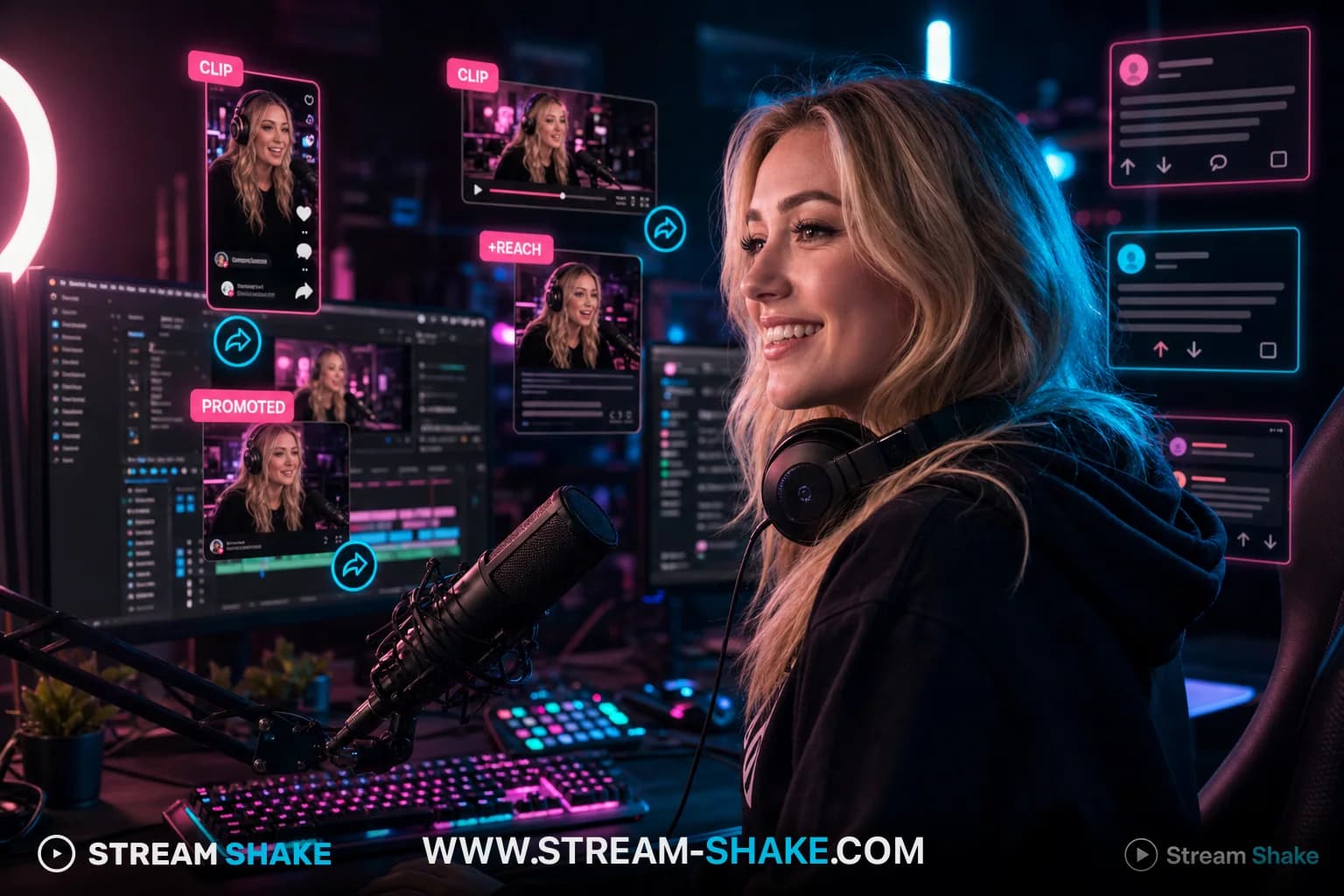
Why promotion is a systems problem, not a vanity metric
Great content in an empty room still looks like low quality to browse algorithms: no chat velocity, weak retention, fewer suggested placements. Promotion fixes the top of the funnel — people actually land on your channel — while your personality and structure fix retention. Ignore either side and growth plateaus. This page stays high-level on purpose: the linked articles below go deeper on services, tools, and common mistakes. Here you get the decision framework — enough to plan a month of promotion without wading through every long guide first — whether you are comparing agencies, testing free tactics, or pairing promotion with Affiliate goals.
Small consistent wins compound. Treat every broadcast as a test of hooks plus retention, not just hours live.
Safe vs risky Twitch promotion tactics
Stream Shake deliberately sits in the green zone: streamers trading real attention for points, not synthetic traffic pretending to be organic.
The table is blunt on purpose — promotion vendors love soft language like “engagement packages.” Translate every offer into the rows above before you spend money or hand over OAuth permissions. If a tactic cannot survive being explained to your moderators in one sentence, it is probably not worth the reputational risk, no matter how many screenshots of dashboards the salesperson sends.
| Tactic | Risk / outcome |
|---|---|
| Mutual viewing, raids, co-streams, Stream Shake | Real humans; supports engagement when used honestly alongside content. |
| Short-form clips + link-in-bio funnels | Organic discovery; platform-native. |
| Transparent paid ads (meta, short-form boosts) | Costly; needs creative testing — but not inherently against Twitch if traffic is real. |
| View bots, fake chat, “guaranteed average viewers” | High enforcement risk; hollow metrics; long-term brand damage. |
Legitimate mutual viewing vs bot packages and mystery traffic
Mutual viewing communities reward honest participation: real accounts, contextual chat, schedulable windows when browse traffic evaluates your stream. Bot sellers optimise for a number on screen — not retention, not raids, not clip-worthy moments — and they rarely survive basic vetting questions.
When answers feel evasive, walk away — your channel’s reputation is worth more than a temporary rank bump. Combine transparent mutual viewing with the organic promotion articles linked below; that stack is boring but reproducible.
Vetting promotion services: seven questions before you pay
- Where do viewers come from — embed farms, botnets, or real accounts?
- Will chat messages look human and contextual, or copy-paste spam?
- Can you pause or refund if retention collapses after day one?
- Does the contract mention compliance with Twitch’s Community Guidelines?
- Do they promise impossible averages overnight? (Usually a lie.)
- Can you speak to another streamer who used them for 30+ days?
- Are metrics reported with timestamps so you can correlate spikes with real events?
If you pass services through those filters and still want paid amplification, pair it with clips and schedule discipline — paid reach amplifies what already works; it rarely invents retention from thin air.
Spendable points — predictable fuel inside Stream Shake
Think of Stream Shake as infrastructure for the opening minutes of a show: you earn points by showing up as a real viewer for peers, then spend points to schedule concurrent viewers when directories and new clicks decide whether to stay. Points are transparent — no undisclosed traffic sources — and they complement (not replace) titles, thumbnails, and community habits.
- Earn honestly: Watch peers, participate in chat with intent, and respect rate limits — quality beats spam volume.
- Spend strategically: Schedule viewers for the window when browse traffic matters most — usually the first act of a flagship stream.
- Compound outward: Close the loop with raids, Discord follow-ups, and clip exports so first-time viewers get a reason to return.
How Stream Shake fits a modern Twitch promotion plan
Mutual viewing is promotion insurance: it prevents the worst failure mode — chatting into a void while Twitch tests whether anyone cares. It does not replace charisma, game knowledge, or storytelling; it buys you the minutes you need to prove those traits to cold traffic.
The three layers of Twitch promotion (and what each one optimises)
- Layer 1 — On-Twitch discovery: Category choice, tags, title hooks, and custom thumbnails control click-through from people already browsing Twitch. This layer costs no cash but demands iteration: keep a swipe file of competitor titles, A/B your art every month, and retire hooks that never survive past minute five of your VOD.
- Layer 2 — Owned and social amplification: Discord scheduled posts, pinned X threads, Instagram stories, and YouTube community tabs remind warm audiences to show up. These channels do not violate Twitch rules when you avoid spam patterns and disclose paid partnerships clearly. They are essential because Twitch browse alone rarely fills a calendar for micro-channels in saturated games.
- Layer 3 — Partnerships and paid media: Sponsorships, influencer raids, and occasional paid placements can accelerate spikes, but they require creative alignment and measurement. If a paid promotion vendor refuses to explain traffic sourcing in plain English, treat that as a red flag — legitimate providers can walk you through the viewer journey without buzzwords.
Run the Stream Shake loop when discovery is on the line
- Sign up: Create your Stream Shake account and connect your Twitch channel.
- Earn points: Watch peers — chat quality matters more than raw volume.
- Spend points: Schedule viewers for the window when browse traffic evaluates your stream.
- Close the loop: Follow up with raids, Discord reminders, and clip exports so first-time viewers have a reason to return.
Think of this loop as glue between Layer 1 hooks and Layer 2 owned channels — it keeps your room alive long enough for real viewers to notice.
Raids, hosts, and collabs — the human promotion engine
Automated tools can seed concurrent viewers, but humans still move the biggest blocks of attention on Twitch. A well-timed raid introduces hundreds of pre-qualified viewers who already enjoy live content. Prepare a thirty-second welcome segment for raids: recap who you are, thank the raider by name, and offer one immediate interactive prompt so the wave does not instantly tab out. Hosts matter less for raw numbers but keep friendships warm between go-lives — promotion is relationship maintenance, not only announcements.
Collabs double promotion reach when both sides promote the same calendar slot across their social graphs. Agree ahead of time who clips which moment, who posts first, and how you will split follow-up DMs to moderators. Chaos collabs look fun on day one but waste cross-audience potential if neither channel captures short-form replays.
Free vs paid promotion — how budgets should evolve as you scale
Early on, sweat equity dominates: titles, thumbnails, clip editing, Discord hygiene, and Stream Shake points. Once you have proof of concept — repeatable peak viewers, clip CTR data, and a narrow niche — selective paid boosts can amplify what already works. Never buy paid reach to compensate for a broken hook; you will simply pay to show strangers a stream they bounce from in thirty seconds. Fix the first-minute experience first, then widen the funnel. Seasonal events (game launches, esports finals, charity drives) are natural windows to stack both organic and paid promotion because intent spikes. Plan those windows two weeks ahead: line up collaborators, queue clips, and schedule mutual viewing for the first hour when directory competition is fiercest. Promotion sits between raw concurrent viewers and long-term channel systems — pair this hub with the Twitch viewers hub and the grow your Twitch channel hub linked below when you need adjacent playbooks.
Building a 30-day promotion calendar without spamming your audience
Calendars sound corporate, but streamers who wing it every Monday burn creative energy on logistics instead of performance. Start with a single spreadsheet row per stream: date, primary hook, backup hook, thumbnail note, clip idea, Discord ping copy, and whether Stream Shake covers the opening block. Colour-code high-investment shows versus maintenance streams so you know where to push promotion hardest. After thirty days you will see which hooks repeat well and which titles you should retire — data beats memory.
Cadence matters more than intensity. Five mediocre announcement posts equal noise; two sharp posts with screenshots and timestamps earn clicks. Treat social promotion like a trailer editor would: tease a moment, promise a payoff, and link once. Inside Twitch, rotate raid targets so you are not always dumping the same community into channels that never reciprocate — lateral networking is promotion that costs nothing but attention.
What to measure each week
- Click-through proxy: Note peak concurrent viewers in the first fifteen minutes vs your thirty-day median — big gaps usually mean thumbnail or title wins.
- Chat messages per minute: Not vanity — it correlates with retention when the messages are on-topic.
- Clip saves or shares: Even rough counts show which jokes or plays travel off-platform.
- Return chatter names: If the same people appear across multiple streams, your promotion plus show quality is compounding.
Brand safety, multilingual audiences, and stalled growth experiments
Desperation leaks into tone faster than people think — repetitive “please follow” loops, guilt-tripping lurkers, or aggressive self-links in strangers’ chats all signal low status to new viewers. Confident promotion sounds like an invitation to a specific experience: “Speedrun PB attempts tonight, first attempt at 8:05pm” beats “I am live again please come.” Confidence also protects you when experimenting with mutual viewing; you are not apologising for growth tactics, you are explaining the value of an active chat to people who just arrived. Disclosure matters when money changes hands. If you run a sponsored segment, say so early and clearly; if you test a paid promotion vendor, log it privately so you can unwind partnerships that feel sketchy. Transparency with your core community builds long-term promotion leverage — those fans become multipliers who share clips without you asking. If you stream in a non-English language or bilingual format, mirror your promotion copy: pin both languages in Discord, subtitle key clips, and pick raid targets whose chat culture matches yours. Directory language filters already help discovery; your external promotion should not accidentally funnel English-only traffic into a stream they cannot follow. Time zones are a promotion constraint, not an excuse. Schedule posts when your target regions wake up, and consider a second mini-stream for another region only if you can do it without destroying sleep. Stream Shake sessions can be aligned to whichever go-live you treat as your “primary” promotion window so points are not wasted on test broadcasts. Flat graphs tempt streamers to reinvent everything at once — new game, new schedule, new avatar, new Discord — which destroys learning signal. Instead, run controlled promotion experiments: change only the thumbnail for two weeks while titles stay stable, then swap titles while thumbnails stay stable. If neither move peak viewers, the bottleneck may be category placement or stream length, not art. Document each experiment with a start date so you do not confuse correlation with causation when a random viral clip spikes numbers. Another under-used experiment is promotion density: some channels benefit from announcing every show twice (once twelve hours out, once sixty minutes out), while others fatigue their audience with reminders. Test one cadence for a month, read Discord open rates if available, and adjust. Pair density tests with Stream Shake only on the streams where you need directory proof — otherwise you will not know whether chat picked up because of reminders or because mutual viewers arrived early. Finally, audit outbound promotion: if you spend hours in other streams but never convert friendships into raids, you are doing community theatre, not promotion. Set a numeric target — for example two genuine raids out per week — and track completion like any other KPI.
If after eight weeks of disciplined experiments you are still flat, revisit fundamentals: audio intelligibility, face cam framing, and whether your niche sentence fits what actually happens on stream. Promotion cannot fix a product viewers do not understand in sixty seconds.
Topic hub — guides, hubs, and deeper reads
The articles below go step by step on paid services, free tactics, tools, common mistakes, and growing when you are stuck at low viewers. Open them when you want more depth than we had room for in the sections above. Further down this page there is also a compact FAQ if you prefer quick questions and answers in one place. If you stream or promote on other platforms too, each guide below focuses on that platform first — same clear numbered layout, but examples and titles match YouTube, Trovo, GOODGAME, WASD, TikTok LIVE, Kick, Facebook Gaming & Instagram Live. At the end of each post you will find links back to the Twitch viewers hub and to the step-by-step “10 Twitch promotion strategies” guide when you want your main channel on Twitch to stay the priority.
Stream Shake community & channels
Glossary — promotion vocabulary worth memorising
- Concurrent viewers (CCV)
- How many people watch your live broadcast at the same moment — the metric Twitch browse surfaces alongside thumbnails.
- Average concurrent viewers (ACCV)
- Rolling averages Twitch uses for Affiliate milestones — distinct from raw views or VOD impressions.
- CTR (click-through rate)
- How often people click your thumbnail versus impressions — the fastest signal that titles and art are working.
- Raid
- Sending your live audience to another channel at the end of a stream — one of the largest human-driven acquisition spikes on Twitch.
- Host
- Parking your channel on someone else’s broadcast between go-lives — lighter than raids but keeps relationships warm.
- Mutual viewing
- Structured communities where streamers watch each other honestly to earn scheduling credits — legitimate audiences when disclosed and moderated.
- View bot
- Automated or fraudulent viewers meant to inflate CCV without real engagement — violates Twitch rules and risks enforcement.
- Embed farm
- Low-quality traffic sources that park streams in hidden embeds — ask vendors directly how they avoid this pattern.
Frequently asked questions
- What counts as “Twitch promotion” in 2026?
- Anything that helps new people discover your live channel or return for the next show: thumbnails and titles, clips on Shorts/TikTok, Discord reminders, raids, collaborations, paid ads, and legitimate mutual viewing communities like Stream Shake. The goal is real viewers who can chat — not hollow viewer counts.
- Are Twitch promotion services safe?
- It depends entirely on the method. Services that deliver real humans watching and chatting within Twitch’s rules can be safe. Services that sell bot traffic, fake chat, or misleading embeds put your channel at risk. Always ask how traffic is sourced, whether chat is organic, and whether the provider can explain Twitch’s Community Guidelines in plain language.
- How is Stream Shake different from a promotion agency?
- Stream Shake is a mutual viewing platform: streamers earn points by watching others and spend points to receive viewers on their own broadcasts. There is no mystery traffic source — it is peer streamers. Agencies may bundle multiple tactics (sometimes including risky ones); Stream Shake focuses on one transparent lever you control.
- Should I buy viewers to rank higher?
- Buying fake viewers is one of the fastest ways to damage your channel’s trust and risk enforcement. Directory ranking also cares about engagement, not just a number on screen. If you need early concurrent viewers, use legitimate mutual viewing, raids, and short-form clips instead of bots.
- Do I still need clips if I use promotion tools?
- Yes. Promotion tools help the cold start on Twitch; clips feed TikTok, Shorts, and Reels — often the largest top-of-funnel discovery. The strongest channels stack both: short-form brings strangers, mutual viewing helps the live room feel alive when they arrive.
- How long until promotion efforts show results?
- Hooks and thumbnails can change click-through within days. Audience habits (regulars, Discord growth, Affiliate averages) usually take several weeks of consistent streaming. Treat promotion as a weekly system, not a one-day spike.
- Can I promote Twitch on other platforms?
- Absolutely — X/Twitter, Instagram, YouTube community posts, and Discord are standard. Follow each platform’s rules on spam and disclosure. Cross-posting clips with a clear “live now” or “schedule pinned” CTA is usually safer than dumping raw channel links everywhere.
- Where should I start?
- Fix your schedule and thumbnail first, then add Stream Shake for the first 30–60 minutes of your main weekly show, and publish one clip per week. Read our hub articles below for deeper playbooks.
Keep reading