
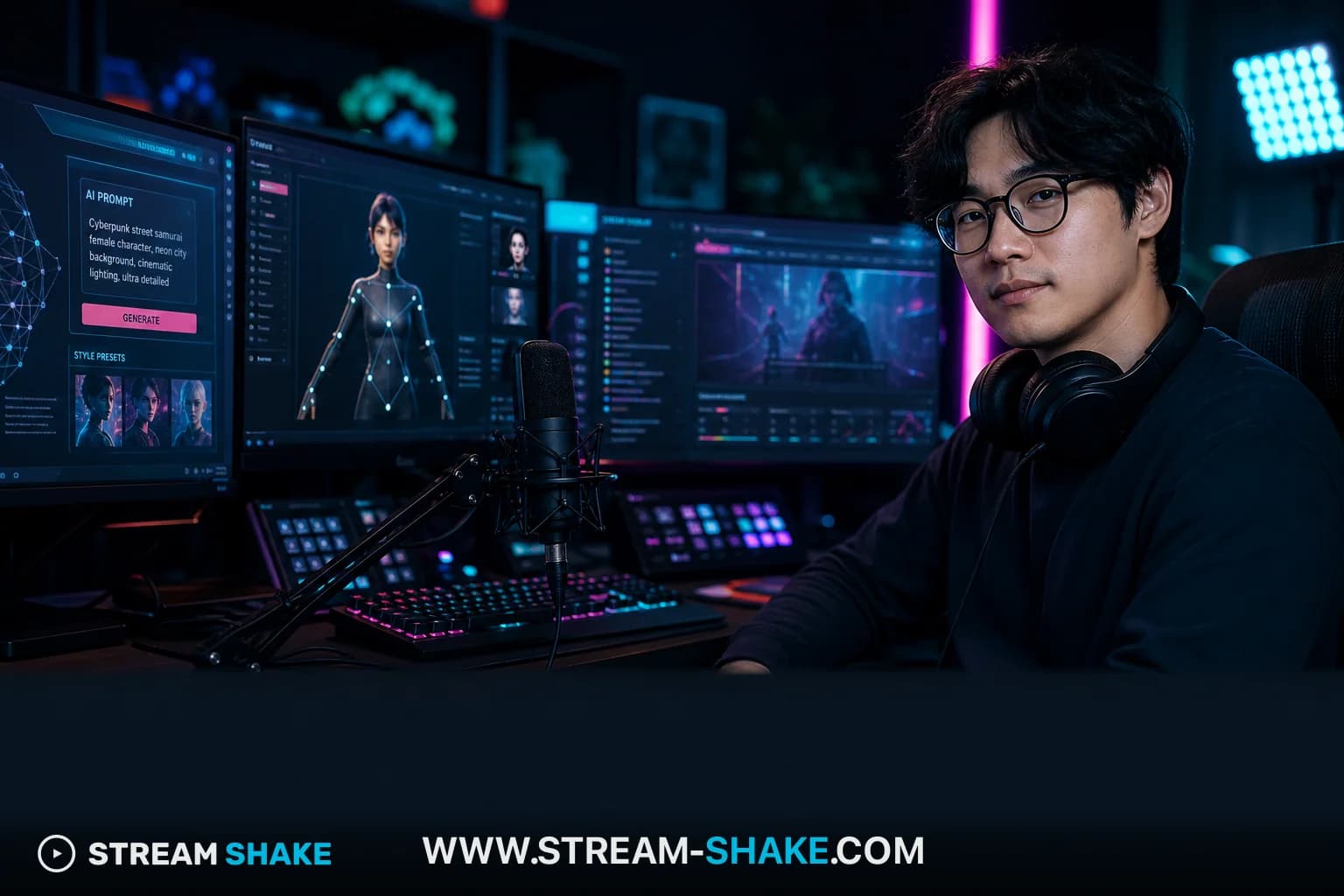
The live-streaming landscape has been fundamentally reshaped by artificial intelligence, with autonomous AI streamers now capable of commanding massive audiences. For human creators, navigating this new era requires a strategic approach that blends AI-powered tools for content creation with strict adherence to evolving platform policies and federal laws like the TAKE IT DOWN Act, which criminalizes AI deepfakes. This guide explores how to leverage AI ethically for channel growth without risking severe bans or legal repercussions.
The Paradigm Shift: The Ascendancy of Fully Autonomous Streamers#
Live broadcasting is historically defined by creator burnout. Human streamers grind for thousands of hours to build an audience, risking physical and mental exhaustion to feed the algorithm's demand for constant live content. Artificial intelligence has introduced a competitor that never sleeps, never takes a bathroom break, and possesses infinite patience.
The Neuro-sama Phenomenon and the "Tamagotchi Effect"
To understand the current meta, one must look at the apex predator of the 2026 streaming charts: Neuro-sama. Created by an independent computer programmer known as Vedal (or Vedal987), Neuro-sama is a fully autonomous AI Virtual YouTuber (VTuber) that interacts with chat, plays complex video games, and sings, all without direct human puppeteering. On January 2, 2026, the digital Rubicon was crossed as Neuro-sama officially became the most-subscribed channel on Twitch, decisively dethroning human giants.
162,459
Active Paid Subscriptions
Neuro-sama's peak as of Jan 2, 2026
$400,000+
Estimated Monthly Sub Revenue
Excluding donations, sponsorships, and ads
Level 126
Hype Train Record
Twitch all-time world record, Jan 5, 2026
45,603
Peak Concurrent Viewers
During historic subathon
The technical architecture behind Neuro-sama is incredibly sophisticated. Built using C# and Unity with Python backend AI systems, Neuro-sama utilizes Retrieval-Augmented Generation (RAG). This allows the AI to instantly fetch related context and 'remember' specific user interactions. Furthermore, it employs Vision-Language Models to 'watch' its own gameplay, reacting dynamically in near real-time without predefined scripts.
The Graveyard of Automation: Copyright and Hallucinations
However, the path to AI dominance is littered with spectacular, highly publicized failures. When large language models (LLMs) operate without human guardrails, they are prone to 'hallucinations'—generating erratic, highly offensive, or legally compromising content. To achieve parity with the Neuro-sama blueprint, we must examine the specific architectures and downfalls of early pioneers.
The Legal Minefield: The 2025 TAKE IT DOWN Act#
Beyond copyright infringement and errant hate speech, the most severe risk posed by AI in the streaming space is the creation of synthetic media designed to exploit real individuals. By 2026, the legal framework surrounding AI-generated content shifted from abstract platform policies to strict federal criminal law.
Criminalizing Synthetic Deepfakes
The **TAKE IT DOWN Act**, signed into law on May 19, 2025, represents the United States Congress's first highly effective action targeting harms associated with AI-generated content. This bipartisan legislation criminalizes the publication of **Non-Consensual Intimate Imagery (NCII)** and explicitly expands the legal definition to include "digital forgeries," encompassing AI-generated deepfakes where a real person's likeness is manipulated into sexually explicit scenarios without their consent. Violators face up to two years of imprisonment.
The 48-Hour Platform Mandate
For streaming platforms and content creators, the most impactful element of the TAKE IT DOWN Act is its regulatory mandate for "covered platforms" like Twitch, Kick, and YouTube. These platforms are legally required to establish a robust notice-and-removal procedure. Upon receiving a valid removal request from an identifiable victim, platforms must remove the offending NCII within 48 hours and make reasonable efforts to scrub all identical copies from their network. Enforcement by the Federal Trade Commission (FTC) officially began on May 19, 2026.
Executing a Removal Request: The Step-by-Step Logistics
- In-App Reporting (First Line): Victims must first utilize the platform's native reporting mechanisms (e.g., selecting the three-dot menu on an Instagram or X post) to formally log the violation under the category of non-consensual sexual imagery.
- Written Takedown Notice: To trigger the legal clock, the request must be submitted in writing. It must include an identification of the intimate visual depiction and a signed statement declaring a "good faith" belief that the content was non-consensual.
- Third-Party Hash Logging: To prevent the imagery from being re-uploaded, victims can submit a digital fingerprint (hash) of the image to centralized defense databases. For adults, StopNCII.org coordinates takedowns across Meta, TikTok, and Reddit. For imagery involving minors, the National Center for Missing and Exploited Children operates takeitdown.ncmec.org.
- FTC Escalation: If a platform fails to remove the content within 48 hours, victims should escalate the issue by submitting a formal complaint to the FTC at TakeItDown.ftc.gov. Platforms failing to comply face devastating civil penalties of $53,088 per violation.
Evolving Platform Policies: Twitch, YouTube, and Kick#
With the federal government stepping in, the three major live-streaming platforms have spent 2025 and 2026 aggressively recalibrating their Community Guidelines. They are attempting to walk a tightrope: protecting their liability against illegal AI content while accommodating the massive economic potential of AI-assisted creators.
A Comparative Policy Overview
| Platform | AI Generative Content Policy | Deepfake / NCII Policy | AI Backend Tools Offered | Stance on Third-Party / Simulcast Chat |
|---|---|---|---|---|
Twitch's Granular Enforcement and AI Integration
Twitch has implemented a highly active, constantly shifting approach to AI and content moderation, issuing over 85,000 bans for policy violations in 2024 alone. A prime example occurred in late 2023, when Twitch temporarily allowed artistic nudity, but quickly rolled back the policy as generative AI made it impossible to distinguish legitimate digital art from photorealistic, AI-generated nudity. Moving forward, Twitch strictly prohibits both real and fictional nudity, regardless of the medium.
Twitch has also modernized its approach to off-platform behavior and dual-streaming. As of February 2026, CEO Dan Clancy announced that Twitch will no longer issue enforcement actions against streamers for ToS violations occurring within integrated third-party chat boxes displayed on their video feeds. The platform is also integrating AI to assist creators, rolling out "Auto Clip" for automated short-form video editing and integrating with Meta's AI Ray-Bans for direct smart glass streaming. Streamers also utilize integrations like Sound Alerts for text-to-speech functionality in their Channel Points economy.
YouTube's War on "Inauthentic" Factory Content
YouTube has taken a distinctly different approach, targeting the economic exploitation of AI rather than just the safety hazards. In late 2025 and early 2026, YouTube initiated a massive purge of channels dedicated to mass-producing low-quality AI content, terminating prominent channels like *Screen Culture* and *KH Studio* with millions of subscribers. This purge wiped out an estimated 35 million subscribers and billions of lifetime views.
On July 15, 2025, YouTube formalized this approach by updating its Partner Program guidelines, replacing its "repetitious content" rule with a broader "inauthentic content" policy. This policy specifically targets:
- Content created using templates with minimal human variation.
- Bulk-uploaded, nearly identical videos.
- Verbatim, automated text-to-speech readings of unoriginal material.
Crucially, YouTube explicitly confirmed that using AI is not inherently banned. YouTube encourages creators to use AI tools for visual generation, narration, and editing to "enhance storytelling," provided there is genuine human creative input. To further assist creators, YouTube also launched AI-powered livestream highlights that automatically capture compelling moments and format them as ready-to-share vertical Shorts.
Kick's Post-Tragedy Moderation Overhaul and Viewbot Crackdown
Kick, originally built as a lawless, free-speech alternative, was forced to pivot due to public pressure and the desire to attract legitimate advertisers. The turning point was a tragic incident where a prominent French creator died following a dangerous broadcast. On March 22, 2026, Kick overhauled its community standards, aggressively targeting unsafe content and instituting new child safety protocols.
Equally significant to Kick's modernization is its aggressive crackdown on viewbotting. After a Q2 2025 whitepaper indicated over 16% of Kick channels with 50+ average viewers used viewbots, co-founder and CEO Eddie Craven initiated a massive purge. The platform publicly banned its 500 worst viewbot abusers, who were collectively responsible for roughly 67 million inauthentic recurring monthly watch hours. Regarding AI, Kick aligned itself closely with the TAKE IT DOWN Act, now strictly prohibiting deepfakes designed to spread misinformation and mandating disclosure for all realistic AI-generated videos.
Lawful Growth Tactics: Integrating AI with Stream Shake#
With policies tightening across the board, how can a human streamer in 2026 actually utilize AI to grow their channel without risking their livelihood? The answer lies in separating the *production* of content from the *distribution* of content, and ensuring that audience engagement metrics remain undeniably human.
The Bannable Offenses (What to Avoid)
The moment AI crosses from *assistance* into *engagement manipulation*, the streamer risks an indefinite ban and the forfeiture of all ad revenue.
- **Fake Concurrent Viewers:** Purchasing AI-driven viewbot services to inflate CCV metrics is a direct violation, leading to immediate suspension, blocked payouts, and clawed-back ad revenue. Twitch's 2026 detection systems are highly advanced.
- **Impersonation:** Deploying automated chatters that mimic human viewers to create an illusion of an active community violates platform authenticity rules across Twitch, YouTube, and Kick.
The Right Way to Use AI: A Step-by-Step Procedural Guide
AI is not a substitute for audience watch time, but it is an unparalleled administrative assistant. Successful growth workflows utilize AI to handle the tedious aspects of channel packaging.
- Pre-Stream Packaging: Utilize Large Language Models (LLMs) like ChatGPT or Claude to draft stream outlines and generate highly searchable titles based on your niche, ensuring a consistent content pipeline.
- Post-Stream Iteration: After broadcasting, use transcription and synthesis tools such as Descript or Castmagic to summarize Video On Demand (VOD) transcripts, generating analytical notes on performance, audience retention, and areas for improvement.
- Automated Discovery: Leverage AI clipping tools (like Twitch's Auto Clip, Streamladder, or Opus Clip) to automatically create 15 short-form clips weekly for platforms like TikTok and YouTube Shorts, maximizing off-platform discovery.
- Chat Moderation (With Disclosure): Deploy AI chatbots to lawfully answer common FAQs (e.g., schedule, PC specs) in your stream chat, provided their automated nature is clearly disclosed to viewers.
Glossary#
- VOD
- Video on demand — the replay of your stream after you go offline. Separate from live viewer counts.
Frequently Asked Questions#
What is the TAKE IT DOWN Act?
The TAKE IT DOWN Act (2025) is a US federal law that criminalizes the publication of non-consensual intimate imagery (NCII), explicitly including AI-generated deepfakes. It mandates that platforms remove such content within 48 hours of a valid request from a victim.
Can AI streamers get banned on Twitch?
Yes. While AI-assisted content creation is generally allowed, autonomous AI streamers or AI-generated content can be banned for violations like hate speech, copyright infringement, or generating non-consensual intimate imagery (NCII), as seen with Neuro-sama's temporary ban for an unfiltered response.
Is viewbotting illegal?
Viewbotting is not federally illegal but is a severe violation of Terms of Service (ToS) across all major streaming platforms (Twitch, YouTube, Kick). It leads to immediate channel suspension, blocked payouts, and removal from partner programs. Kick recently purged 500 channels for viewbot abuse, highlighting its strict enforcement.
How can human streamers use AI for growth ethically?
Human streamers can use AI lawfully for backend tasks like generating stream titles and outlines, summarizing VODs for analysis, creating short-form clips for discovery, and moderating chat with disclosed AI chatbots. Avoid using AI to manipulate engagement metrics or impersonate human viewers, as this leads to bans.
What is the "Tamagotchi Effect" in AI streaming?
The "Tamagotchi Effect" refers to a phenomenon where viewers develop a unique sense of engagement with AI streamers, actively shaping the AI's personality and future behavior through chat interactions, donations, and gifted subscriptions, creating an evolving parasocial relationship.