
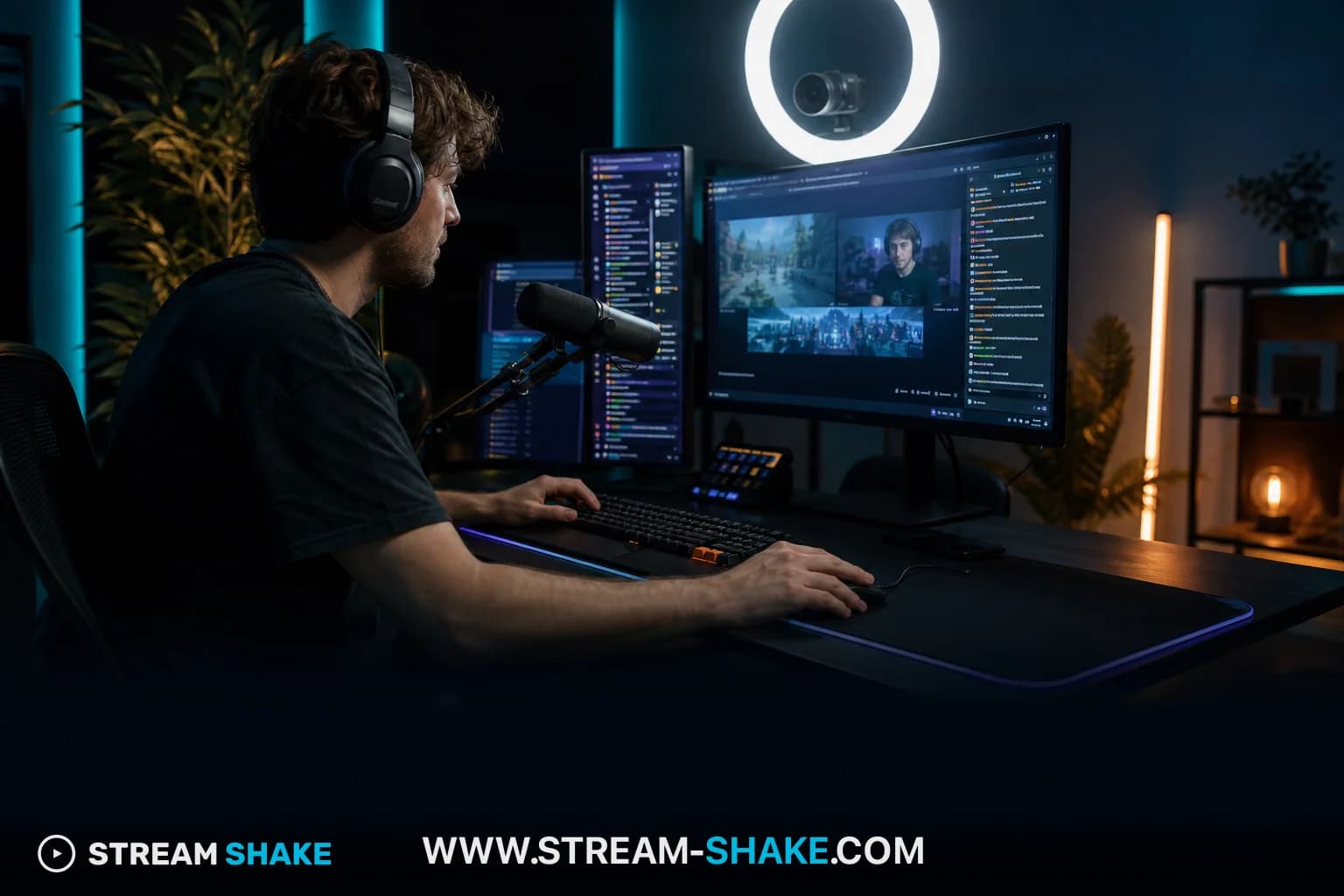
The 2026 live streaming landscape is a complex, multi-billion-dollar ecosystem. While the technical barrier to entry has never been lower, achieving sustainable success as a Twitch streamer is increasingly challenging. Creators must now navigate intense competition, evolving platform policies, and significant personal risks beyond just broadcasting content.
For example, a highly viable, basic streaming setup in 2026 costs only between $100 and $150. Creators can launch a broadcast-ready operation using a budget PC, a Fifine K669B or AM8 microphone ($26), a Neewer 10-inch Ring Light ($26), and an industry-standard Logitech C920 webcam ($65). While professional elite setups scale past $2,000, the base technical requirements no longer prevent entry.
Today’s creators are not merely broadcasting gameplay; they are managing multifaceted digital businesses that require expertise in community management, technical infrastructure, and psychological boundary-setting. This report provides a comprehensive examination of the modern streaming ecosystem, exploring statistical realities, paradigm shifts in Terms of Service (ToS) and monetization, inherent risks, and lawful growth tactics required to survive and thrive.
The State of Twitch in 2026: Statistics and Market Share#
To comprehend the realities of being a Twitch streamer in 2026, one must first understand the sheer mathematical scale of the platform. Twitch has transitioned from a niche gaming hub into a mainstream entertainment behemoth, but this maturation has brought severe market saturation.
Viewership and Creator Demographics
Twitch currently boasts over 240 million Monthly Active Users (MAUs) globally, with approximately 35 million Daily Active Users (DAUs) logging in to consume content. Despite these staggering viewer numbers, the creator-side metrics reveal a highly top-heavy ecosystem.
| Metric | Estimated 2025 / Early 2026 Data | Implications for Streamers |
|---|---|---|
| Monthly Active Streamers,~7.3 to 11.4 million,Extreme competition; organic discovery purely by going live is statistically improbable. | ||
| Average Concurrent Viewers,~2.05 to 2.55 million,While the audience is vast, viewership is concentrated heavily among the top 1% of creators. | ||
| Total Hours Watched (Annual),~19.2 billion (2025),A slight year-over-year decline (down ~8.9%), indicating a cooling off from pandemic-era highs. | ||
| Zero-to-Five Viewer Reality,Over 55% of creators,The majority of streamers broadcast to five or fewer concurrent viewers, struggling to break the initial discoverability hurdle. |
The synthesis of this data points to a harsh reality: Twitch is no longer a place where you *find* an audience; it is a place where you *convert* and *host* an audience you have built elsewhere. Furthermore, non-gaming content has grown to represent 22% of total watch time, with the 'Just Chatting' category dominating at nearly 3.8 billion hours watched annually, indicating a shift towards personality-driven, parasocial engagement.
Competitors and Alternatives: The "Big Three" Rivalry#
For over a decade, "Twitch" was synonymous with "live streaming." In 2026, this monopoly has fractured. Twitch's market share of total hours watched dropped from over 70% in 2023 to roughly 53-54% entering 2026. This redistribution of viewership has empowered creators to choose platforms that best align with their financial and community goals.
Kick: The High-Revenue Challenger
Kick, backed by the founders of the crypto-gambling platform Stake.com, emerged in 2022 and has rapidly secured roughly 11% to 12.4% of the gaming streaming market. Kick's primary disruption is its aggressive creator monetization model, offering a permanent 95/5 revenue split, meaning the creator retains 95% of subscription income.
$250
Creator Earnings on Twitch (50/50 split)
100 subs at $5 tier
$475
Creator Earnings on Kick (95/5 split)
100 subs at $5 tier
However, the trade-off is audience scale. Kick's user base, while growing past 100 million registered users, still pales in comparison to Twitch's daily traffic, making brand-safe sponsorships and massive organic reach more difficult to secure.
YouTube Live: The Discoverability Engine
YouTube Gaming has capitalized on its parent platform's unmatched search engine architecture, capturing approximately 24.3% of the live-streaming market. Unlike Twitch, where a broadcast disappears into a difficult-to-navigate Video on Demand (VOD) archive, YouTube live streams immediately convert into searchable, indexable videos that can accrue views and revenue for years.
YouTube Live relies on multiple monetization layers that blend recurring support with impulse spending. For Super Chats and Super Stickers, YouTube applies a 70/30 revenue split (creator retains 70%). For standard advertisements, creators receive a 55/45 split. Channel memberships require meeting YouTube Partner Program (YPP) requirements, though lower tiers exist.
The "Big Three" Comparison Matrix
| Feature | Twitch | Kick | YouTube Live |
|---|---|---|---|
| Primary Revenue Splits,50/50 Subs (up to 70/30),95/5 Subs, 100% direct tips,70/30 Super Chats, 55/45 Ad Revenue | caution,safe,safe | ||
| Market Share (2026),~53-54%,~11-12.4%,~24.3% | |||
| VOD / Archive Life,Poor (Expires after 14-60 days),Poor (Limited discovery),Excellent (Evergreen Search Engine) | |||
| Chat Culture & Ecosystem,Deeply integrated, emote-driven,Highly lenient, aggressive,Broad, generalized audience |
Platform Policies: The 2026 Simulcasting Revolution#
Historically, Twitch weaponized its market dominance through strict exclusivity clauses, prohibiting its Affiliates and Partners from streaming to competitor platforms simultaneously. This dynamic has completely reversed, representing the most significant policy shift for streamers in 2026.
The End of the Unified Chat Ban
Simulcasting (or multistreaming) is the practice of broadcasting a single live feed to multiple platforms—such as Twitch, YouTube, and Kick—at the same time. While Twitch began allowing simulcasting in late 2023, they maintained a highly controversial rule: streamers were strictly prohibited from displaying a "merged" or "combined" chat overlay on their Twitch stream.
Following intense community backlash, Twitch CEO Dan Clancy officially suspended enforcement of the combined chat ban during a February 2026 *Patch Notes* broadcast. The implications of this reversal are massive:
- Unified Communities: Creators can now build a single, cohesive community on-screen, regardless of which platform a viewer uses to watch.
- Liability Remains: While displaying the chat is allowed, the streamer remains entirely responsible for moderating third-party chat messages that appear on their Twitch broadcast. If a Kick viewer types a ToS-violating slur, the streamer’s Twitch account is liable for suspension.
Tools for Simulcasting and Unified Chat
Modern creators leverage specific software infrastructure to achieve unified simulcasting and chat management. The following tools dominate the market:
- **Restream:** A browser-based cloud platform capable of streaming to 30+ destinations. Offers free and premium tiers with custom branding and integrated unified chat.
- **Aitum Multistream (OBS Plugin):** The most popular free local option in 2026, integrating directly into OBS Studio for unlimited RTMP endpoints and independent bitrates, requiring a robust CPU and strong internet.
- **Social Stream Ninja:** A free, open-source unified chat aggregator using peer-to-peer VDO.Ninja SDK, combining messages from Twitch, YouTube, Kick, and Facebook into one OBS Browser Source overlay.
- **sheepChat:** Another widely used, free, open-source multi-chat desktop application designed for streamers to read and moderate cross-platform messages in a single unified window.
The Twitch Plus Program and Payout Standardization
In response to Kick's aggressive 95/5 revenue split, Twitch revamped its monetization structures via the Twitch Plus Program. Designed to democratize access to higher revenue tiers, the program operates on a points system based on recurring subscriptions (Tier 1 = 1 point, Tier 2 = 2 points, Tier 3 = 6 points).
- **Level 1:** Accumulating 100 points for three consecutive months unlocks a 60/40 revenue split.
- **Level 2:** Accumulating 300 points for three consecutive months unlocks the highly coveted 70/30 split.
Once qualified, the streamer retains this elevated split for 12 months, even if their point total temporarily drops, providing much-needed financial stability.
Modernized, Feature-Specific Enforcements
Another vital 2026 policy update is Twitch's shift toward targeted enforcement. Previously, even minor infractions resulted in blanket account suspensions. Under the modernized system, Twitch issues feature-specific bans. For instance, if a user violates rules strictly within a chat room, they may receive a "chatting suspension" (losing the ability to type in chats) while still retaining the ability to broadcast on their own channel. This nuanced approach aims to penalize bad actors without immediately destroying a creator's livelihood over minor offenses.
The Inherent Risks of Live Streaming: Mental, Physical, and Digital Hazards#
The allure of playing video games or chatting for a living often obscures the severe occupational hazards of being a streamer. Unlike traditional media, streaming requires creators to project authentic, live vulnerability for up to eight hours a day.
The Mental Health Toll: Burnout and Parasocial Relationships
The most pervasive risk to a Twitch streamer is psychological burnout. The platform's algorithmic realities demand brutal consistency; taking a single day off can result in a measurable loss of subscribers and discoverability. An alarming 68% of full-time streamers report experiencing severe burnout within their first two years. This pressure frequently leads to "ghost streams"—instances where creators abruptly quit mid-broadcast due to panic attacks or emotional exhaustion.
Compounding this exhaustion is the phenomenon of Parasocial Relationships—one-sided emotional bonds where a viewer believes they share a reciprocal friendship with the creator. Because streamers respond to viewers in real-time, the boundary between "performer" and "friend" dissolves. This dynamic frequently manifests in toxic objectification and entitlement, as seen in cases like Imane "Pokimane" Anys, who publicly addressed the relentless male gaze and disrespect she faced, highlighting the grueling mental toll.
Physical Dangers: Swatting and Convention Assaults
The digital footprint required to be a successful streamer often leads to terrifying physical risks, most notably Swatting and Doxxing. Doxxing involves malicious actors mining public records, IP addresses, and social media to expose a creator's real name, home address, and financial data. Swatting is the act of using this doxed information to make a false, high-stakes police report, forcing heavily armed SWAT teams to raid the creator's home live on stream. Swatting is a lethal cybercrime that has resulted in fatalities and severe trauma.
Physical dangers extend into the real world during community events. At TwitchCon 2025, popular streamer Emiru was physically assaulted during a meet-and-greet when an attendee bypassed barriers, grabbed her face, and attempted to kiss her. This incident prompted major creators to boycott the event, citing the platform's inability to protect creators from parasocially obsessed fans in unprotected, IRL (In Real Life) settings.
Digital Risks: The Realities of Twitch Bans
Maintaining a Twitch channel requires flawless adherence to complex, occasionally subjective community guidelines. Suspensions can abruptly sever a creator's primary income stream. Real-world case studies demonstrate that Twitch enforces these rules across all tiers of popularity:
- **Hasan Piker (Political and Content Escalations):** Frequently penalized for crossing the line during heated debates, Piker received a 3-day ban in January 2026 for using the phrase "Zionist pigs," and previous bans for hyperbolic language and "Improper Handling of Terrorist Propaganda."
- **Darren "IShowSpeed" Watkins Jr. (IRL and E-Date Hazards):** Faced an indefinite Twitch ban from December 2021 to October 2023 following aggressive, sexually coercive comments on an "e-date" stream. Also, in May 2026, he was allegedly sexually assaulted while broadcasting in the Dominican Republic.
- **LowTierGod / Dale Wilson (Repeat Offenses and Evasion):** Has accumulated a staggering 11 Twitch suspensions, including multiple short bans in late 2025 and early 2026, illustrating Twitch's escalating penalty system for repeat violations.
- **Amouranth (Boundary Testing):** Known for sexually suggestive content, Amouranth has sustained numerous bans, including a temporary ban in 2023, an indefinite ban following her move to Kick, and a week-long ban in April 2024. Despite this, she returned to Twitch after claiming to extract a $38 million fortune from Kick.
Lawful Growth Tactics: Building an Audience in a Saturated Market#
Given the market saturation, the mental health risks, and the strict platform policies, how does a new or mid-tier streamer grow in 2026? The methodology has shifted from brute-force streaming to strategic audience funneling and ethical community collaboration.
The Ecosystem Funnel: Distributed Granularity
Because Twitch's internal algorithm heavily favors creators who already have thousands of viewers, attempting to gain an audience simply by clicking "Start Streaming" is futile. Modern streamers operate as "media houses." The lawful, optimized growth funnel dictates utilizing distinct short-form platforms for specific strategic purposes before pushing audiences live:
- **TikTok (Viral Reach):** With a 10-minute maximum video length (ideal 15-60 seconds), TikTok possesses the most aggressive algorithm for pushing content to strangers globally, making it the best engine for rapid, viral discovery.
Glossary of Key Streaming Terms#
- VOD
- Video on demand — the replay of your stream after you go offline. Separate from live viewer counts.
Frequently Asked Questions About Being a Twitch Streamer#
What is the current state of Twitch in 2026?
In 2026, Twitch remains the largest streaming platform with over 240 million monthly active users. However, it faces significant market saturation, with over 55% of streamers broadcasting to five or fewer viewers, and growing competition from platforms like Kick and YouTube Live.
Which platforms are Twitch's main competitors?
Twitch's main competitors are Kick and YouTube Live. Kick attracts creators with a 95/5 subscription revenue split, while YouTube Live offers unparalleled evergreen discoverability due to its integration with YouTube's search engine, converting live streams into permanent, searchable VODs.
What are the biggest policy changes on Twitch in 2026?
The most significant policy change in 2026 is Twitch's official allowance of simulcasting with unified chat overlays, reversing a previous ban. Streamers can now broadcast to multiple platforms simultaneously while displaying a single merged chat, though they remain responsible for moderating third-party content.
What are the mental health risks for Twitch streamers?
Twitch streamers face severe mental health risks, including burnout due to demanding consistency, and the psychological toll of managing parasocial relationships. These one-sided emotional bonds can lead to viewer entitlement, objectification, and profound emotional exhaustion for creators.
How can a new streamer grow their audience lawfully in 2026?
Lawful audience growth in a saturated market requires a strategic approach. Streamers should utilize short-form content platforms like TikTok and YouTube Shorts for viral discovery, building an audience off-platform, and then funneling them to Twitch. Ethical mutual viewing communities like Stream Shake also offer ToS-compliant growth avenues.