
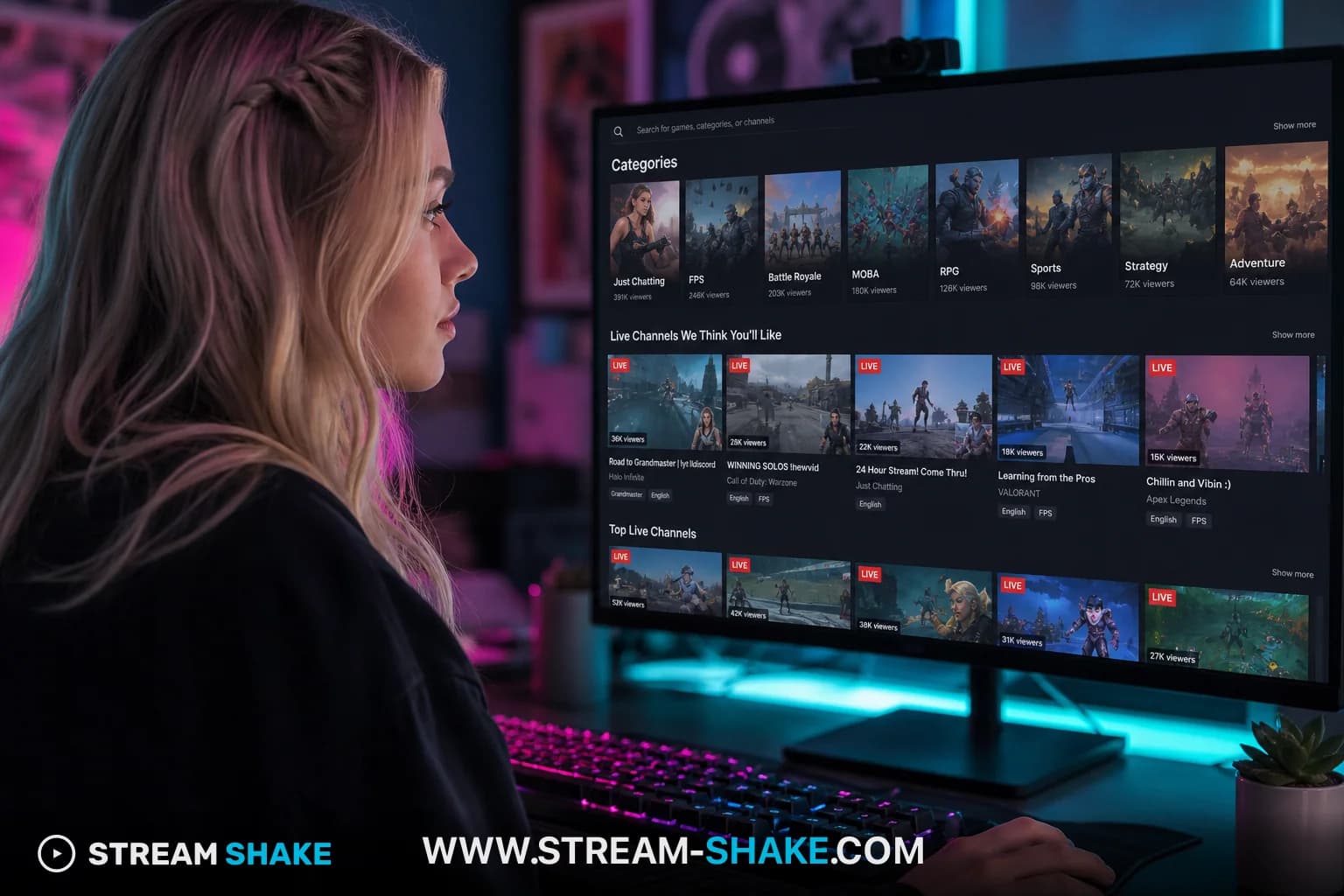
Understanding how to find Twitch streamers—and how streamers capture attention—is essential in 2026. The livestreaming economy has undergone profound structural changes, driven by shifting consumer habits, intense competition from short-form video, and internal economic pressures. Twitch now operates as a complex, multi-layered ecosystem, making a clear understanding of its mechanics a prerequisite for both audiences and creators.
The 2026 Livestreaming Landscape: Statistics and Platform Economics#
To truly grasp how viewers discover Twitch streamers and how creators build a sustainable audience, it’s vital to examine the quantitative reality of the platform. The attention economy in 2026 is highly fragmented, yet Twitch retains a significant, though evolving, foothold.
Demographic and Engagement Benchmarks
Twitch’s sheer scale remains formidable, reflecting a maturing market rather than the explosive growth seen in the early 2020s.
240M+
Monthly Active Users
Globally
35M
Daily Active Users
Daily logins
7.3M
Active Channels
Per month
2.55M
Avg. Concurrent Viewers
Globally
The user base skews heavily towards younger demographics, with 72% of users under 34, and remains predominantly male at 65%. The United States is the largest market, accounting for over 37.2 million users and approximately 23.67% of total global viewership. Other significant markets include Brazil, Germany, the United Kingdom, France, and Russia.
The Top-Heavy Nature of Twitch
Despite these impressive aggregate numbers, the distribution of viewership reveals severe systemic inequality. While roughly 29.45 billion hours of live content were consumed across major platforms in Q3 2025, the vast majority of Twitch's viewership is concentrated among the top 1% of creators.
The Discovery Feed and the Vertical Revolution#
In response to stagnant organic discovery and threats from short-form video platforms, Twitch fundamentally overhauled its mobile user experience. The algorithmic Discovery Feed and Dual-Format vertical streaming represent the most significant shift in how viewers find Twitch streamers in 2026.
The Algorithmic Discovery Feed
Launched in 2024 and fully integrated by 2026, the Discovery Feed is a mobile-first, vertical scrolling experience designed to surface personalized content. Unlike the legacy directory, it uses machine learning to curate live stream snippets and recorded clips based on user interests (games, creators, clip interactions).
Twitch's algorithm heavily favors "Featured Clips" within this feed, with creators publishing mobile-friendly, vertical highlights experiencing a 40% higher tap-through rate. "Subfeeds," a horizontal scrollable shelf, allow viewers to filter by specific categories or collections, blending algorithmic serendipity with user intent.
Dual-Format Broadcasting
Recognizing that horizontal (16:9) video appears suboptimal on mobile, Twitch rolled out "Dual-Format" vertical streaming in partnership with software like OBS and Aitum Vertical. This allows creators to transmit two discrete video feeds simultaneously.
Desktop viewers receive the traditional 16:9 landscape layout, while mobile app users get a specialized 9:16 vertical layout. This format prioritizes the creator's camera and core gameplay, stripping away cluttered alerts and widening the chat interface, which significantly boosts mobile viewer retention and interaction.
The Mechanics of Organic Growth: The 2026 Playbook#
Given the structural realities of the platform, the traditional advice to "go live and grind" is obsolete. Finding an audience on Twitch in 2026 requires creators to view their channel not as the top of the discovery funnel, but as the bottom—the final destination for an audience cultivated elsewhere.
Leveraging Off-Platform Funnels
To overcome Twitch's native discovery limitations, successful creators utilize a multi-platform content engine. The most reliable growth path for small-to-mid-sized channels involves leveraging the aggressive, discovery-focused algorithms of YouTube Shorts, TikTok, and Instagram Reels.
Real Examples: The CPAWS Growth Funnel Case Study
Cody (CPAWS) exemplifies the "Clip-First" approach. Struggling with Twitch's native discoverability, he implemented a strict multi-platform strategy using Nexus Clips. By broadcasting horizontally for Twitch/Kick and producing a dedicated vertical layout for YouTube Shorts/TikTok, he captured audiences where organic algorithmic reach is highest.
CPAWS successfully funneled short-form viewers to his long-form Twitch broadcasts by using simple visual cues like placing a Twitch logo and handle directly in the vertical TikTok feed. This tactical bridging helped his channel escape the sub-300 viewer purgatory, proving active off-platform cultivation is mandatory for on-platform success.
Algorithmic Optimization on Twitch
Once a viewer arrives on the channel, creators must satisfy specific metrics the Twitch algorithm tracks to boost the stream within the traditional "Browse" directory. The 2026 algorithm heavily weights three primary signals:
- **Average Concurrent Viewers (CCV):** A higher, stable CCV pushes a channel up the category ladder.
- **Chat-to-Viewer Ratio:** The algorithm evaluates chat interaction density. A stream with 50 viewers and constant chat activity frequently outranks a stream with 100 idle viewers.
- **Schedule Regularity:** Twitch's recommendation engine favors predictability. A fixed schedule is a reliable predictor of returning viewers.
Navigating Platform Policies: The Risks of Fake Engagement#
As creators aggressively seek metrics for algorithmic discovery, the temptation to use shortcuts has fueled a massive black market of fake engagement. Twitch has adopted an aggressive, highly punitive stance against these practices, making compliance critical for broadcasters.
Defining Fake Engagement and Viewbotting
Twitch's Terms of Service define fake engagement as "artificial inflation of channel statistics, such as views or follows, through coordination or 3rd party tools." This includes incidental or duplicitous views, automated scripts, or coordinated manipulation.
- **Viewbotting:** Deploying illegitimate scripts or bot networks to flood a channel with fake viewers, artificially inflating the Concurrent Viewer (CCV) count. These bots do not subscribe, purchase, or engage organically.
- **Follow-Botting:** Mass influx of fake accounts following a channel, usually in scripted batches. Twitch routinely purges these accounts, as seen in a 2021 action that eliminated over 7.5 million bot accounts.
- **Illicit Coordination (F4F / L4L):** Twitch explicitly prohibits "Follow 4 Follow" (F4F), "Lurk 4 Lurk" (L4L), or "Host 4 Host" (H4H) networks that create a mirage of engagement.
The May 2026 Enforcement Update: CCV Caps
The arms race between bot developers and platform moderation culminated in a major policy shift. In May 2026, Twitch CEO Dan Clancy announced a radical new penalty for channels guilty of persistent viewbotting: the Concurrent Viewer (CCV) Cap.
Rather than relying solely on outright bans, Twitch began artificially capping the displayed viewer count of offending channels. The algorithm analyzes historical, legitimate traffic data and hard-codes a ceiling on their CCV across all Twitch surfaces. This is designed to destroy the financial and algorithmic incentive of viewbotting.
The Threat of Malicious Weaponization
The primary counter-argument against CCV caps is the risk of "weaponized suspicion." Malicious viewbotting, where an attacker intentionally floods a rival streamer’s channel with bots to trigger a platform penalty, has long been a tactic used by internet trolls.
The Lawful Mutual Viewing Model: The Stream Shake Approach#
Strict policing of fake engagement creates a paradox for new streamers: the algorithm demands concurrent viewers for visibility, but new streamers often have zero viewers, making visibility impossible. This is known as the "cold-start" problem.
How Lawful Networks Differ from Illicit Schemes
The distinction between a prohibited "Lurk 4 Lurk" scheme and a lawful mutual viewing platform lies in user intent, automation, and authentic engagement. Twitch's guidelines permit users to freely choose to lurk or watch streams, provided they are not coerced, using automated scripts, or opening hidden tabs to falsify data. Stream Shake operates strictly within these boundaries by facilitating a decentralized marketplace of real streamers watching other real streamers.
The system operates on a reciprocal "Points Economy": creators earn points by actively watching peers and then spend these points to receive real concurrent viewers when they go live. To prevent idle tab-farming, Stream Shake incentivizes active participation, offering bonus points for meaningful chat activity with enforced rate limits.
The Mechanics of View Verification: Muted and Minimized Tabs
A critical question for mutual viewing participants is whether Twitch counts a viewer if the browser tab is muted or minimized. According to official Twitch documentation and 2026 platform mechanics, a user *does* count as a viewer even if the stream is muted, provided the live video is actively playing.
However, modern browsers increasingly use efficiency modes that pause inactive tabs. If the browser pauses video playback, the view ceases to count. Therefore, to ensure views register flawlessly during a Stream Shake session, participants should keep the tab active or leave the stream volume at 1% to prevent auto-pause mechanisms from triggering.
Stream Shake Pricing, Availability, and Anti-Use Cases
Stream Shake is globally accessible via its web portal (stream-shake.com) and is built heavily upon a "Free with optional paid top-ups" model. There are no mandatory monthly subscription fees; however, creators can optionally purchase point top-ups if they lack time to earn points organically.
Procedural Guide: Executing a Stream Shake Campaign
As your channel organically scales past an average of 20 to 30 concurrent viewers, reliance on the mutual viewing network naturally diminishes, having successfully fulfilled its purpose of overcoming the initial algorithmic barrier.
Cross-Platform Approaches and the Competitor Ecosystem#
While Twitch remains a cultural epicenter of live broadcasting, the broader creator economy in 2026 is highly competitive. Twitch's realization that it no longer holds an absolute monopoly has forced significant adaptations. Platforms like YouTube Live, TikTok Live, and Kick now offer vastly superior revenue splits (e.g., Kick's 95/5 model) and more robust algorithmic discovery engines, making multi-platform simulcasting a standard practice.
Key Streaming Terms: Glossary#
Frequently Asked Questions About Finding Twitch Streamers#
How do Twitch viewers find new streamers in 2026?
In 2026, Twitch viewers primarily find new streamers through the mobile-first Discovery Feed, which uses machine learning to surface personalized vertical content. Many also discover streamers via external platforms like TikTok and YouTube Shorts, which funnel audiences to Twitch.
What is Twitch's Discovery Feed?
The Discovery Feed is a vertical scrolling, mobile-first experience on Twitch that shows users curated live stream snippets and clips based on their viewing habits. It removes pre-roll ads and prioritizes mobile-friendly, vertical content for better discoverability.
What is the 'Clip-First' growth strategy?
The 'Clip-First' strategy involves structuring Twitch streams to generate high-quality, short-form video content. These clips are then distributed on platforms like TikTok and YouTube Shorts to leverage their aggressive discovery algorithms, driving new audiences back to the live Twitch channel.
Is using mutual viewing platforms like Stream Shake allowed by Twitch?
Yes, lawful mutual viewing platforms like Stream Shake operate within Twitch's Terms of Service. They facilitate genuine human viewers (real streamers watching other real streamers) without automation or coercion, helping new channels overcome the 'cold-start' problem by providing authentic baseline engagement.
What is Twitch's CCV Cap penalty?
The Concurrent Viewer (CCV) Cap, introduced in May 2026, is a new Twitch penalty for persistent viewbotting. Instead of outright bans, Twitch artificially caps an offending channel's displayed viewer count based on its legitimate historical traffic, effectively destroying the algorithmic incentive of fake engagement.
Sign up for Stream Shake and get real human viewers to boost your discoverability.