
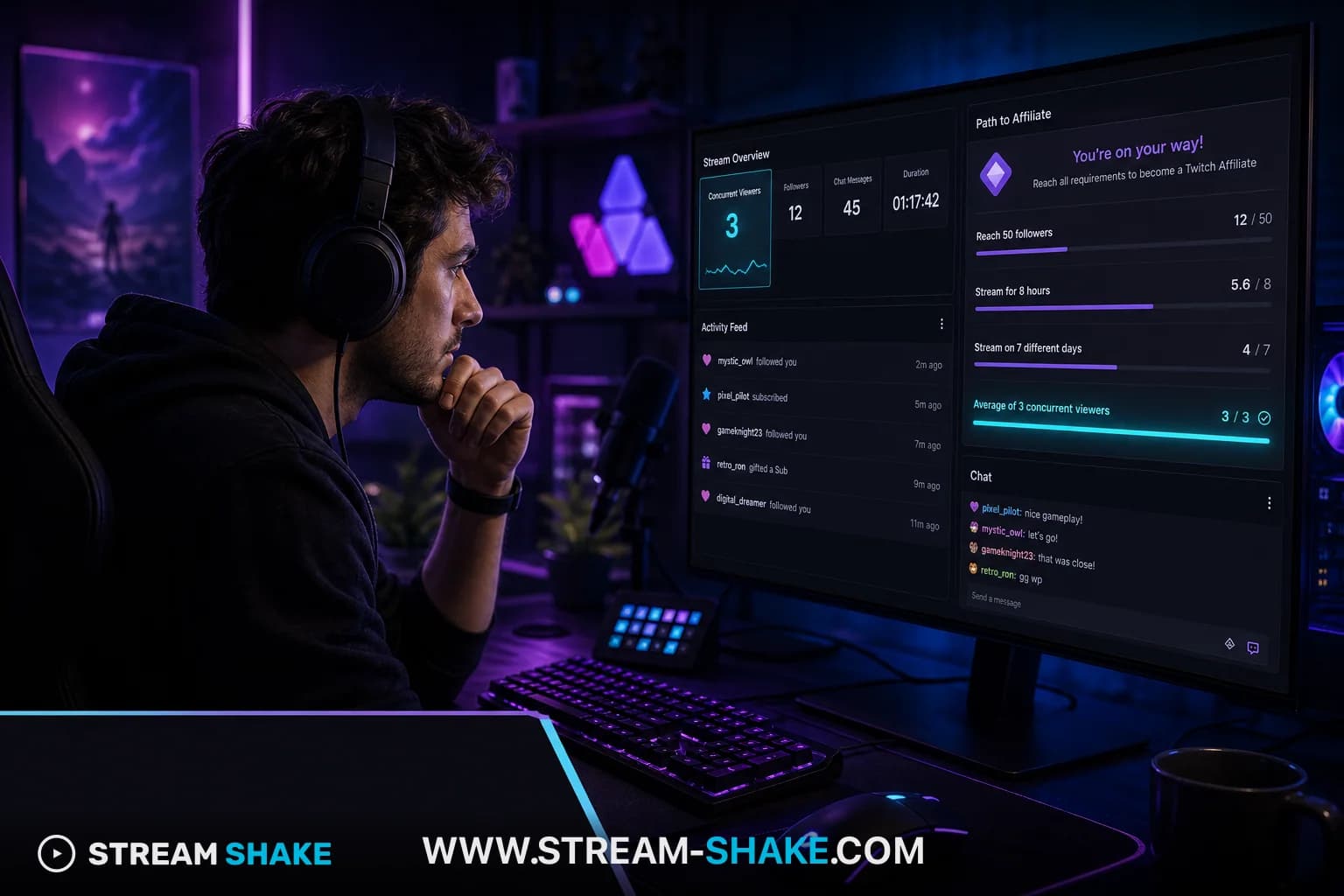
To get 3 average viewers on Twitch for Affiliate, you need a stable concurrent viewer floor across your eligible streams — not a single lucky raid. Most streamers who miss Affiliate already have enough followers; they fail ACCV because they start at zero CCV, stream too short, or never notify anyone. The playbook below stacks schedule, session length, and real opening viewers without viewbots.
| Requirement | Typical threshold | What counts |
|---|---|---|
| Followers | 25 | Unique followers on the channel |
| Stream time | 4 hours | Within the evaluation window |
| Stream days | 4 different days | At least one session per day |
| Average viewers | 3 ACCV minimum | Concurrent viewers averaged across eligible streams |
What does “average of 3 viewers” mean on Twitch?#
Twitch looks at concurrent viewers across your live sessions in the evaluation window. Short spikes help less than a stable floor across the whole stream.
How do I stack schedule, length, and opening CCV?#
- Stream 3+ hours when possible — late joiners need time to arrive.
- Start on time every week — regulars are free concurrent viewers.
- Use Stream Shake at go-live to avoid starting at zero.
Why does Stream Shake help this metric without bots?#
Because Stream Shake sends real people, your average can rise the same way it would from organic raids — without the risk of bot traffic that can disqualify or ban your channel.
The Statistical Reality: Deconstructing the 10-Viewer Milestone#
The perception of success on Twitch is often wildly distorted by the immense visibility of the platform's top creators. A streamer observing titans with tens of thousands of viewers might view an audience of 10 as an insignificant failure. Statistically, the opposite is true.
Percentiles and the Broad Viewership Distribution
Understanding the true distribution of Twitch's viewership requires decoupling visible success from statistical averages. Research and aggregate platform data consistently reveal a highly skewed, logarithmic distribution curve where a microscopic percentage of creators command the vast majority of human attention.
80%
Stream to 0-1 Viewers
Of all content creators on Twitch
70%
Affiliates at 0-5 CCV
Of Twitch Affiliates
1-5%
Top Tier (10+ CCV)
Of all active broadcasters
The Psychological Reality and Burnout of the 0-Viewer Trap
Beyond metrics, the '0-viewer trap' exacts a severe psychological toll. Striving endlessly for the 10-viewer mark often triggers profound creator burnout. Streamers investing money in hardware and dozens of hours into a performative broadcast—only to speak to complete silence—frequently experience feelings of rejection, imposter syndrome, and exhaustion. The algorithmic void exacerbates these feelings, as creators realize that raw effort on Twitch does not correlate with visibility. Acknowledging this mental health implication is crucial; sustainable growth requires treating streaming as a paced media enterprise rather than an exhausting, isolating marathon.
The Financial Implications of a Small Audience
Reaching 10 average viewers is not merely a vanity metric; it is the foundation of early monetization. While revenue varies dramatically based on audience generosity, geographic location, and ad-blocker usage, conservative estimates provide a baseline for what a creator can expect.
Platform Policies: The 2026 Crackdown on Fake Engagement#
The immense difficulty of organically escaping the 0-viewer trap has driven a massive underground market for artificial engagement. Streamers desperate to trigger the Twitch algorithm or achieve Affiliate/Partner status frequently resort to illicit shortcuts. In response, Twitch has escalated its war against these practices, implementing sophisticated policies and punitive measures in 2026.
Viewbotting and Algorithmic Countermeasures
Viewbotting is defined by Twitch as the practice of artificially inflating a live view count using illegitimate scripts, virtual machines, or third-party tools to make a channel appear more popular than it is. This practice steals organic exposure from legitimate broadcasters and defrauds advertisers.
How Twitch Combats Viewbotting in 2026
- Twitch introduced **Concurrent Viewer (CCV) Caps** in May 2026 for channels identified as persistent viewbotters by real-time machine learning algorithms.
- The CCV cap is calculated based on the streamer's historical, non-viewbotted organic traffic, effectively freezing their public viewership at this baseline.
- Twitch explicitly refuses to publicize the exact technical parameters or timing of these enforcements to prevent viewbot providers from circumventing detection.
The Prohibition of Coordinated Exchange (F4F and L4L)
Artificial engagement is not limited to software scripts. Twitch's Terms of Service strictly prohibit human-coordinated artificial inflation, specifically targeting 'Follow 4 Follow' (F4F), 'Host 4 Host' (H4H), and 'Lurk 4 Lurk' (L4L) communities.
| Scheme | Description | Twitch Policy |
|---|---|---|
| Follow 4 Follow (F4F) | Streamers exchange follows purely to inflate metrics without genuine interest. | Explicitly a ToS violation; results in hollow numbers with no actual engagement. |
| Lurk 4 Lurk (L4L) | Organized groups open each other's muted streams to artificially boost CCV. | ToS violation; accounts have been suspended as this damages the legitimate community. |
Malicious Viewbotting and Risk Mitigation
One of the most complex risks in the streaming ecosystem is 'malicious viewbotting'—when a third party deploys viewbots against a streamer without their consent. Twitch explicitly states that it will not punish a user for the actions of another, meaning a creator will not be banned if they are the victim of a targeted bot attack. If you notice an unnatural spike in viewers with a dead chat, remain calm, avoid discussing it on stream, and file a user report with evidence.
Lawful Momentum: Stream Shake and Mutual Viewing#
If viewbotting results in a CCV cap and L4L communities result in account suspensions, how can a streamer lawfully escape the algorithmic penalty of broadcasting to an empty room? The answer lies in compliant, active mutual viewing networks. As highlighted by the platform Stream Shake, the key differentiator between a ToS-violating scheme and a legitimate growth tool is authentic human attention.
The Mechanics of Ethical Mutual Viewing
Stream Shake operates as a real-viewer promotion network designed specifically to combat the 'cold start' problem for beginner streamers. The system relies on a transparent points economy rather than mandatory paid premium tiers, making it highly accessible.
Getting Started with Stream Shake for Lawful Growth
- Navigate to the official Stream Shake web application and authenticate your channel using the secure Twitch API login.
- Earn points by actively watching the broadcasts of your peers. Stream Shake incentivizes actual engagement, awarding additional points for meaningful chat activity.
- Once you have earned points, spend them to receive live viewers when you go live on your own channel. This is highly effective during the first hour of a stream to establish foundational CCV.
- Combine mutual viewing with high-quality broadcasting to convert visiting peers into long-term community members.
ToS Compliance and Ecosystem Value
Because Stream Shake relies exclusively on real human beings making conscious decisions to view and interact with content, it bypasses the definition of a viewbot. The viewers delivered are legitimate; they count toward Twitch Affiliate metrics safely and authentically. Crucially, platforms like Stream Shake are positioned as catalysts, not crutches. They provide the initial human traffic necessary to make a stream visible, but the streamer's underlying content must be compelling to retain those viewers.
Case Studies: Real Examples of Growth (0 to 10+ Viewers)#
Analyzing the journeys of creators who successfully bridged the gap from zero to double-digit average viewers provides actionable insights into what works—and what routinely fails.
Case Study A: The Saturated Category Trap (Krehbielscott)
In a documented month-long case study, streamer Krehbielscott encountered massive hurdles when attempting to stream in heavily populated categories. When broadcasting highly saturated games, they generated exactly zero organic viewers. Without an existing audience, their stream was buried. The primary takeaway: relying solely on Twitch's internal browse features in top-tier categories is statistically futile for a new creator.
“Relying solely on Twitch's internal browse features in top-tier categories is statistically futile for a new creator.”
Case Study B: Off-Platform Funneling (Yamakiller)
Conversely, the case study of a *Magic: The Gathering* streamer named Yamakiller demonstrates the power of external discoverability. Yamakiller grew his audience from 0 to over 100 consistent concurrent viewers in just a few months by shifting his strategy to YouTube. He packaged his streams into highly structured, educational 'guides' for specific *Magic* decks, creating evergreen content with high search value. Viewers found his videos, appreciated the expertise, and subsequently migrated to his live Twitch broadcasts.
Case Study C: Niche Networking and Value Creation
Another creator successfully grew from 0 to an average of 10-15 CCV by becoming a subject-matter expert in a specific niche. Instead of 'grinding' 12-hour streams to an empty room, this creator spent time in dedicated Facebook groups and Discord communities. They answered questions, provided value, and established authority *before* they ever went live. When they finally launched their stream, they immediately averaged 8 concurrent viewers because they had already cultivated a warm audience off-platform.
Competitor Approaches: Twitch vs. Kick (The 2026 Landscape)#
As streamers fight for those critical 10 viewers, the question of *where* to stream has become as important as *how* to stream. Since its launch, Kick has emerged as the most formidable competitor to Twitch, offering a radically different economic and regulatory philosophy.
The Economics: 95/5 vs. 50/50
The most heavily debated distinction between the two platforms is the subscription revenue split. Kick offers a flat 95/5 revenue split on all subscriptions, meaning a streamer retains approximately $4.74 from a standard $4.99 subscription. Twitch typically operates on a 50/50 split for Affiliates, yielding only about $2.50 to the creator, though the Partner Plus program can elevate this to 70/30 at high subscription goals.
Monetization Thresholds
The barriers to entry for monetization also differ significantly. Kick offers a lower barrier to entry for base monetization but has equally demanding top-tier requirements compared to Twitch.
| Requirement | Twitch Affiliate | Kick Affiliate | Twitch Partner | Kick Partner |
|---|---|---|---|---|
| Followers | 50 | 75 | N/A (higher metrics apply) | 250 |
| Hours Streamed | 8 hrs / 7 unique days | 5 total hrs | 25 hrs / 12 unique days (30-day period) | 30 hrs / 30 days |
| Avg CCV | 3 (30-day period) | None | 75 (30-day period) | 75 (30-day period) |
| Active Subs | N/A | N/A | N/A (focus on CCV) | 25 |
Scale, Retention, and Discoverability
If Kick's economics are vastly superior, why does Twitch remain the dominant force in 2026? The answer lies in market scale and retention psychology. Twitch commands the lion's share of global live-streaming viewership, maintaining a massive baseline of roughly 15 million Daily Active Users (DAU). Kick, while growing explosively (100 million+ registered users by April 2026), has a smaller live concurrent saturation. Consequently, a streamer's potential ceiling is exponentially higher on Twitch, while Kick offers immediate financial gratification from a small, dedicated core.
| Specification | Twitch | Kick |
|---|---|---|
| Subscription Revenue Split | 50/50 (Standard Affiliate) | 95/5 (Universal) |
| Affiliate Requirements | 50 Followers, 8 Hrs, 7 Days, 3 CCV | 75 Followers, 5 Hrs |
| Partner CCV Requirement | 75 Avg CCV | 75 Avg CCV |
| Simulcasting Allowed? | Yes (With Quality Parity constraints) | Yes |
| Audience/Market Scale | Massive (Historical ~15M DAU) | Rapid Growth (~100M+ Total Users) |
The Simulcasting Loophole: Streaming to Both
With Kick offering better payouts and Twitch offering a larger total audience, the next logical question for a 2026 creator is: "Why not stream to both platforms simultaneously to combine viewership?" As of October 2023, and continuing through 2026, Twitch explicitly removed its exclusivity restrictions, allowing both Affiliates and Partners to simulcast (multistream) to competing platforms like Kick, YouTube, and Facebook. However, this is governed by strict, closely monitored guidelines.
Frequently Asked Questions#
How many viewers does the average Twitch streamer have?
The vast majority of Twitch streamers (upwards of 80%) broadcast to an audience of zero or one concurrent viewer. Even among Affiliates, around 70% average between 0 and 5 CCV.
Is getting 10 viewers on Twitch good?
Yes, absolutely. Consistently maintaining an average of 10 concurrent viewers places a streamer in the top 1% to 5% of all active broadcasters on Twitch. It's a significant milestone that puts you ahead of most creators.
Can I get banned for viewbotting on Twitch?
While direct bans for viewbotting still occur, Twitch's 2026 policy primarily employs Concurrent Viewer (CCV) Caps. This means if you're caught viewbotting, Twitch's algorithms will cap your public viewer count to your organic baseline, rendering viewbotting useless and flagging your account.
What is the difference between F4F/L4L and mutual viewing platforms?
F4F (Follow 4 Follow) and L4L (Lurk 4 Lurk) are considered Terms of Service violations by Twitch because they involve artificial, unauthentic engagement. Mutual viewing platforms like Stream Shake, conversely, facilitate genuine human interaction and active watching, making them ToS-compliant and effective for legitimate growth.
Can I stream on both Twitch and Kick at the same time?
Yes, as of October 2023, Twitch removed its exclusivity restrictions, allowing Affiliates and Partners to simulcast to other platforms like Kick. However, you must adhere to 'quality parity' guidelines, meaning the video quality must be comparable across all your simultaneous streams.
Frequently asked questions
Will Stream Shake viewers drop my average when they leave?
Plan campaigns for the segments of your stream where you need the floor most — typically the first 60–90 minutes. Combine with Discord notifications for organic viewers.
How long should I stream to hold 3 average viewers?
Aim for 3+ hours when possible so late arrivals and raids have time to lift your session average; 90-minute streams rarely average 3 unless you already have a loyal core.
Do VOD views count toward the 3 viewer average?
No — Affiliate ACCV is based on live concurrent viewers during streams, not VOD or total view counts.
Can I get Affiliate with only followers and no average viewers?
Not if you miss the ACCV requirement. Followers are necessary but not sufficient — concurrent viewer floor is the stat most small channels fail.
Are viewbots a shortcut to 3 average viewers?
They violate Twitch ToS, risk channel action, and do not build the retention signals you need after Affiliate. Use raids, community, and mutual viewing instead.