
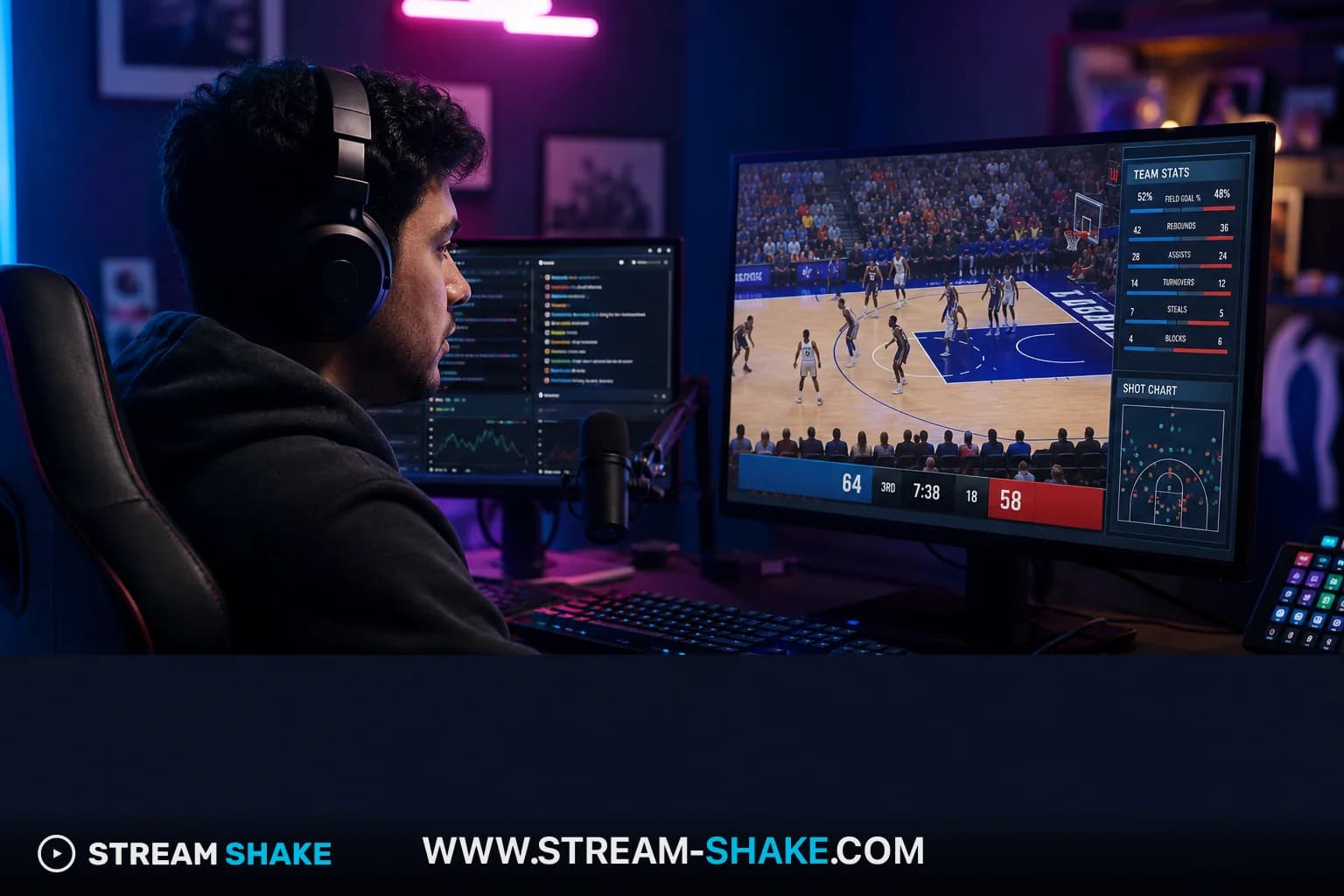
The convergence of professional basketball and live streaming has transformed digital sports, with athletes becoming creators and *NBA 2K26* dominating streaming. However, stringent copyright enforcement and market saturation demand lawful growth tactics and strict adherence to platform policies for channel survival.
The intersection of professional sports and digital broadcasting represents one of the most dynamic shifts in modern entertainment. As traditional television viewership for sports experiences gradual attrition, interactive livestreaming platforms have emerged as the primary arena for younger demographics to consume basketball content. This comprehensive report explores the multifaceted ecosystem of NBA-related broadcasting on Twitch. From professional athletes building their personal brands to grassroots gamers grinding the ranks of *NBA 2K26*, the "digital hardwood" is fraught with both unprecedented opportunity and severe regulatory risk.
The Cultural Convergence: Professional Athletes and Digital Creators#
The modern professional athlete is no longer just a physical competitor; they are a distinct digital brand. This transformation was radically accelerated by global events in 2020, which forced the suspension of traditional sports and catalyzed a mass migration of professional athletes to Twitch. The platform effectively removed the sanitized, public-relations barrier between the superstar and the supporter, offering an intimacy that linear television fundamentally cannot replicate.
The Athlete as the Streamer: Real Examples
To understand the cultural impact of NBA players on Twitch, one must examine the raw, unscripted moments that have defined the genre. A profound example occurred in March 2020 with Phoenix Suns All-Star Devin Booker (broadcasting under the Twitch channel `DBook`). While livestreaming *Call of Duty: Warzone*, Booker's Twitch chat rapidly filled with news that Utah Jazz center Rudy Gobert had tested positive for COVID-19, prompting the immediate suspension of the NBA season. Booker processed this historical collapse of sporting normalcy live in front of thousands of viewers, creating one of the most surreal and authentic recorded responses to the pandemic. This event demonstrated the unique value of Twitch: unfiltered, real-time access. Booker has since maintained a massive presence, utilizing it for entertainment and charity.
Other notable figures include Karl-Anthony Towns, who bridges the gap between traditional sports fans and the "Zoomer" streaming demographic by collaborating with massive influencers. Streaming under the handle `KarlTowns`, Towns utilizes gaming as a genuine escape from pressure, frequently streaming late into the night before achieving double-doubles on the physical court. The roster of actively streaming athletes has dynamically expanded across different gaming categories, with highly specific audience niches:
- **Luka Dončić:** Operates `doncic99`, focusing on *Fortnite*.
- **Paul George:** Broadcasts under `YGtrece`, preferring competitive shooters like *Call of Duty: Warzone* and *NBA 2K*.
- **De'Aaron Fox:** Streams on `swipathefox`, showcasing a diverse gaming portfolio including *Call of Duty*, *Dragon Ball FighterZ*, and *Fortnite*.
- **Alex Caruso:** Streams *Fortnite* on `Acfresh21`, with a significant off-platform presence on TikTok.
These profiles prove that a Twitch channel is now a standard component of a modern athlete's portfolio.
The Grassroots *NBA 2K* Community
Parallel to the real-life athletes is the massive ecosystem of *NBA 2K* simulation streamers. These creators focus heavily on competitive gameplay, archetype building, and community tournaments. A prime example is Josh "Choc" Humphries, who amassed over 850,000 Twitch followers through high-level *NBA 2K* gameplay. Choc's trajectory highlights the high stakes of digital basketball: after being controversially left out of the inaugural NBA 2K League draft pool, he utilized his Twitch platform to critique the league's selection process and eventually became a massive independent brand. This illustrates that in 2026, a streamer does not need the backing of official esports leagues if they possess a sufficiently loyal, independently cultivated audience backed by elite mechanical skill.
The Statistical Landscape of NBA Streaming in 2026#
To formulate an effective streaming strategy, one must analyze the current metrics governing the *NBA 2K26* category. The data reveals a highly engaged but incredibly top-heavy ecosystem. In May 2026, *NBA 2K26* continues to hold a stable position within the middle tier of Twitch's most popular categories. Understanding these metrics is vital for managing growth expectations.
5,350
Average Concurrent Viewers
Over a standard 30-day period in early 2026 for NBA 2K26.
15,728
Peak Viewers
Highest concurrent viewership in a 30-day period for NBA 2K26.
2.37M
Total Watch Hours
Generated from over 502,000 stream hours in the category.
1,129
Average Live Streamers
Broadcasting NBA 2K26 at any given time.
Platform Policies, Copyright Law, and the DMCA Minefield#
For content creators in the sports sector, intellectual property law is the single greatest existential threat to their channels. The Digital Millennium Copyright Act (DMCA), a 1998 United States law, provides copyright holders with the legal tools to force online service providers to remove infringing content. Twitch's enforcement of the DMCA is absolute; accumulating three copyright strikes results in a permanent account termination.
The Push for "Instantaneous" Takedowns
Historically, a major loophole in sports piracy was the natural delay in DMCA processing. The NBA, NFL, and UFC petitioned the U.S. Patent and Trademark Office (USPTO) to modernize the DMCA, demanding that "expeditiously" be redefined as "instantaneously or near-instantaneously." The leagues claim that live streaming piracy costs the global sports industry up to $28 billion annually. For Twitch streamers in 2026, this signifies that attempting to illegally broadcast content carries immediate and severe consequences.
Background Audio and Promotional Infringement
The strictness of copyright law extends beyond video feeds into background audio. Twitch's content recognition systems proactively scan Video on Demand (VOD) recordings; if copyrighted music is detected, the audio is automatically muted, and repeated infractions result in account strikes. This issue is so severe that even official NBA teams have been sued by independent music publishers for using copyrighted music in promotional videos without licenses.
The Lawful Path: Co-Streaming Allowlists
To combat piracy while satisfying the audience's desire for community watch parties, Twitch formalized a systemic solution: the Co-Streaming Allowlist. This feature, initially tested with the NBA G League, allows a creator to share another channel's video feed while providing their own custom commentary. In late 2025, Twitch launched a comprehensive update allowing "Main Broadcasters" (such as sports leagues) to strictly manage who is approved to co-stream via an official allowlist. Broadcasters not on this allowlist who attempt to rebroadcast the content face immediate DMCA claims.
Procedural Configuration: How to Co-Stream Officially
- Navigate to Stream Manager: Within the Twitch Creator Dashboard, locate and click the "Edit Stream Info" panel (if missing, it must be added via the drop-down menu).
- Enable Co-Streaming: Under the Co-Stream Section, toggle the "Enable Co-Streaming" button so that viewership analytics actively aggregate with the Main Broadcaster.
- Manage Your Allowlist: To control who can rebroadcast your feed, click the "Edit" button next to "My Allowlist" within the same panel, then explicitly add trusted user accounts.
Independent creators frequently ask: "How exactly do I apply for this allowlist, and what are the specific minimum viewership or content requirements to be accepted?" Currently, precise public application URLs, forms, or concrete minimum viewership thresholds required by the NBA or major broadcast networks are completely unavailable. This explicit absence indicates that the allowlist process is highly restrictive, heavily guarded, and likely operates on an invite-only basis or is facilitated directly through internal Twitch partner managers rather than an open public application.
Lawful Growth Tactics vs. The Viewbotting Epidemic#
Faced with a highly saturated market, new streamers are often tempted by illicit growth strategies. Viewbotting—the use of automated scripts to artificially inflate concurrent viewership numbers—is a severe violation of Twitch's Terms of Service and is heavily punished.
The Stream Shake Alternative: Lawful Mutual Viewing
Institutional Support: The Sports Accelerator Program and Drops
Beyond community networking, streamers should leverage Twitch's internal systems designed to foster the sports category. Recognizing the massive growth potential of sports talk, Twitch introduced the **Sports Accelerator Program**. To qualify, Affiliates must broadcast a minimum of 20 hours per month exclusively in the "Sports" category with interactive, live content. This program provides financial incentives and best-practice education to help smaller creators optimize their broadcasts.
Furthermore, streamers should actively participate in **Twitch Drops** campaigns. Game publishers, such as 2K Sports, routinely offer exclusive in-game items—such as *NBA 2K26* Locker Codes, XP coins, or MyTEAM packs—to viewers who watch "Drops-Enabled" channels for a set number of hours. By enabling drops on their channel, a streamer provides a tangible, monetary incentive for viewers to click their thumbnail over a competitor's, dramatically increasing audience retention.
Technological Edge: 1440p (2K) Broadcasting
In 2026, viewer expectations for visual fidelity are higher than ever. Twitch's roll-out of the 1440p (2K) streaming beta, utilizing "Enhanced Broadcasting" multitrack streaming in OBS 31.0 and above, offers a distinct competitive advantage. Streamers who upgrade their hardware to broadcast *NBA 2K26* in true 1440p receive a specialized badge on their channel. This visual indicator immediately communicates high production value to a potential viewer browsing the directory, increasing click-through rates.
Competitor Platforms and Revenue Realities: Twitch vs. YouTube vs. Kick#
While Twitch remains the cultural epicenter of live streaming, its monopoly has fractured. For an NBA streamer in 2026, choosing a platform is a complex calculation involving discoverability, community features, and revenue splits. To clarify the highly contested platform wars, the following matrix compares the core functionalities of the three dominant streaming avenues for an independent creator:
| Feature Specification | Twitch | YouTube Gaming | Kick |
|---|---|---|---|
| Baseline Revenue Split (Creator/Platform) | 50/50 (Standard) | 70/30 (Universal) | 95/5 (Universal) |
| Premium Revenue Split | 60/40 or 70/30 (Via 'Partner Plus' thresholds) | N/A (Standard 70/30 applies) | N/A (Standard 95/5 applies) |
| Discoverability Engine | Directory-based (Category Browsing) | Algorithmic (Search & Video Recommendation) | Directory-based (Category Browsing) |
| VOD Lifespan & Value | Ephemeral (Deletes after 14-60 days) | Permanent (Generates passive AdSense revenue) | Ephemeral |
| Payout Frequency | Monthly (Standard Net-15) | Monthly | Same-Day / Instant |
Twitch: Community and Stagnant Splits
Twitch's primary advantage is its entrenched culture. The platform boasts the most interactive community features, established chat emotes, and a dedicated viewer base conditioned to watch live content. However, Twitch has faced heavy criticism regarding its revenue distribution. For years, Twitch operated on a standard 50/50 revenue split for subscriptions. Following massive pushback from creators, Twitch introduced the "Partner Plus" program, allowing select streamers to unlock a 60/40 or 70/30 revenue split by maintaining a high threshold of recurring subscriptions. Despite these concessions, the baseline reality is that the vast majority of emerging streamers remain locked into the 50/50 split. For an *NBA 2K* streamer with 50 subscribers, Twitch is the least profitable platform per viewer, offset only by the higher sheer volume of traffic the site provides.
YouTube Gaming: Discoverability and VOD Longevity
YouTube Gaming offers a compelling alternative, particularly for creators who excel at producing edited, highly structured content. YouTube universally offers a 70/30 split for channel memberships, applying to all creators who qualify for the Partner Program without the complex tier requirements of Twitch. YouTube's greatest advantage, however, is its algorithmic discoverability, allowing well-optimized content to reach new audiences long after the live broadcast has ended.
Glossary of Streaming Terms#
Frequently Asked Questions#
Can NBA players stream live games on Twitch?
NBA players and streamers can only legally broadcast live NBA games on Twitch by securing explicit permission and using the platform's official Co-Streaming Allowlist feature. Attempting to stream without authorization is a severe DMCA violation.
Is it safe to play copyrighted music in the background of my Twitch stream?
No, playing copyrighted music without explicit licensing or using royalty-free alternatives is extremely risky. Twitch's content recognition systems can mute VODs or issue DMCA strikes, leading to account penalties or even termination.
What is viewbotting, and why is it bad for my Twitch channel?
Viewbotting involves using automated scripts to artificially inflate viewer counts. It violates Twitch's Terms of Service, often results in shadowbans that destroy discoverability, and damages your reputation with real viewers.
How does Stream Shake help *NBA 2K* streamers grow their audience lawfully?
Stream Shake uses a reciprocal, point-based economy where streamers earn points by engaging with other creators' streams. These points are then spent to feature their own broadcasts to real, human users, providing legitimate concurrent viewership and boosting organic visibility without violating ToS.
What are the key differences between Twitch, YouTube Gaming, and Kick for streamers?
Key differences include revenue splits (Twitch 50/50 baseline, YouTube 70/30, Kick 95/5), discoverability (Twitch directory, YouTube algorithmic), VOD longevity (YouTube permanent, others ephemeral), and payout frequency (Kick offers same-day payouts).