
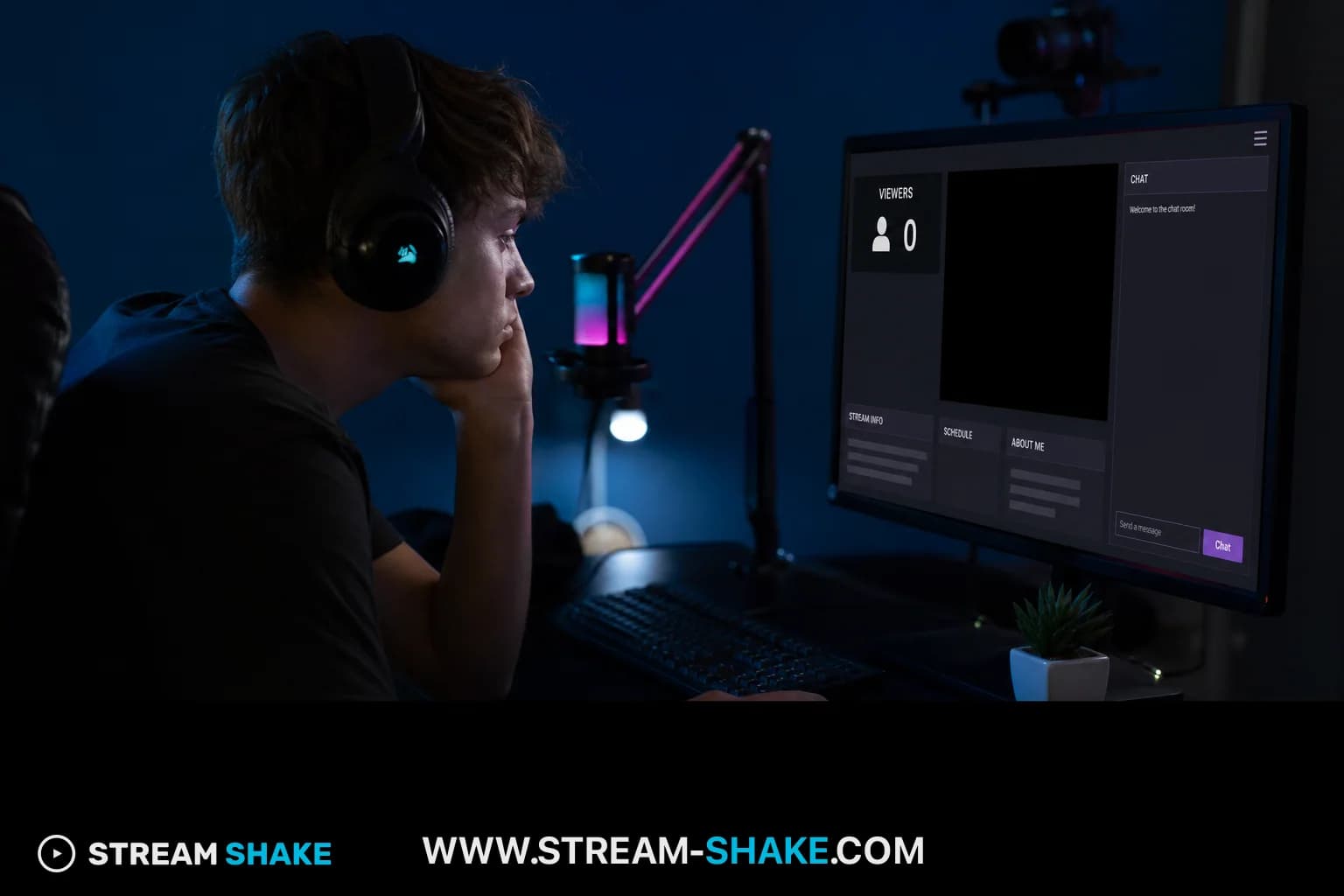
Broadcasting to zero viewers is a common and often disheartening experience for new streamers on Twitch, stemming from intense platform saturation and discoverability challenges. This guide dives into the 2026 landscape, offering lawful strategies and policy insights to help you navigate the zero-viewer trap and organically grow your channel without resorting to risky, Terms of Service-violating tactics.
The Statistical Reality of the Zero-Viewer Trap#
To understand the zero-viewer phenomenon, one must first explode the mathematical reality of the modern streaming landscape. The struggle for viewership is not necessarily an indictment of a creator's quality, but rather a symptom of platform saturation and interface design.
The Saturation of the Broadcasting Market
The sheer volume of broadcasters on platforms like Twitch makes organic discoverability nearly impossible without external intervention. In recent years, Twitch has sustained an average of over 6.9 to 7.3 million unique broadcasters streaming live content each month. Concurrently, the platform hosts approximately 2.3 to 2.5 million concurrent viewers at any given moment.
When these two metrics are juxtaposed, the crisis of discoverability becomes mathematically stark. If viewers were distributed evenly, every streamer would have a fractional audience. However, viewership adheres to a **Pareto distribution**, a phenomenon where a small minority of the population hoards the vast majority of resources or attention, leaving the remainder to fight over a fractional margin.
Key Term
- Pareto Distribution
- Also known as the 80/20 rule, this statistical distribution indicates that a small percentage of a population (e.g., streamers) accounts for a disproportionately large share of a resource (e.g., viewership).
Consequently, industry data indicates that roughly 88% of all active streamers have an average concurrent viewership ranging between zero and five viewers. Achieving just five concurrent viewers places a broadcaster in the top 5% to 7% of the entire platform.
6.9-7.3M
Average Broadcasters (Monthly)
Unique streamers on Twitch
2.3-2.5M
Average Concurrent Viewers
Viewers at any given moment
88%
Streamers with 0-5 CCV
The majority of active Twitch channels
The Algorithmic Burial
Compounding the issue of market saturation is the architectural design of the Twitch directory itself. The platform's default sorting mechanism is designed to prioritize established success over nascent potential.
Twitch's directory defaults to sorting streams from "High to Low" based on real-time viewership. For a new streamer broadcasting to zero viewers, this means their channel is physically buried at the very bottom of a list containing thousands of competitors. This user interface choice creates an aggressive "rich get richer" dynamic.
Furthermore, Twitch relies heavily on pre-roll advertisements to satisfy its revenue models. For a casual viewer attempting to "channel surf" through the bottom of the directory, being immediately confronted with an unskippable advertisement before evaluating a zero-viewer stream acts as a massive deterrent. Twitch's internal data has historically revealed that pre-roll ads induce an average bounce rate of over 30%, actively suffocating organic discovery for channels that cannot afford to lose a single click. Ultimately, the platform's infrastructure is optimized to retain viewers in high-retention, established channels rather than distributing them equitably among newcomers.
The Lure of Artificial Engagement and the 2026 Policy Crackdown#
Faced with algorithmic invisibility, many streamers experience severe demoralization. This desperation creates a lucrative market for bad actors peddling artificial growth services, commonly known as viewbotting. However, Twitch’s 2026 policy updates have transformed this illicit shortcut into a highly penalized trap.
Defining Artificial Engagement
Before examining the penalties, it is necessary to decouple the terminology surrounding artificial channel inflation and Terms of Service (ToS) violations. Twitch defines fake engagement as the "artificial inflation of channel statistics, such as views or follows, through coordination or 3rd party tools." This behavior is primarily categorized into two vectors:
Forms of Artificial Engagement
- View-botting
- The utilization of illegitimate scripts or automated tools to simulate concurrent viewers, making a channel appear artificially popular.
- Follow-botting
- The deployment of automated, computer-controlled accounts to mass-follow a channel, inflating its perceived authority.
- Headless Scripts
- Programs running invisibly in the background without a graphical user interface, designed to simulate human behavior for illicit activities like botting or falsified engagement.
Furthermore, Twitch outlaws coordinated, automated rings operating under the guises of "Follow 4 Follow" (F4F) or "Lurk 4 Lurk" (L4L) when they involve headless scripts or the viewing of multiple unrelated embedded streams specifically designed to falsify engagement. These automated networks are deemed damaging because the "viewers" do not contribute to a healthy, interactive ecosystem.
The May 2026 Concurrent Viewer (CCV) Cap Implementation
Historically, Twitch combated viewbots through massive, sweeping bans. However, because viewbotting companies constantly adapt their algorithms to evade detection, Twitch leadership introduced a radical new enforcement mechanism. In May 2026, Twitch CEO Dan Clancy announced the implementation of a **Concurrent Viewer (CCV) cap** for channels identified as persistent viewbotters.
Rather than simply banning the suspected bot accounts—which are immediately replaced by the providers—Twitch now applies a hard, algorithmic limitation on the offending streamer's visible concurrent viewership across all platform surfaces. This CCV cap is mathematically calculated using historical data regarding the creator's legitimate, non-viewbotted traffic. For example, if a streamer naturally averages two viewers but uses a bot to inflate to 500, the platform will forcibly cap the public-facing metric to reflect only the legitimate traffic. Repeated violations result in exponentially longer penalty durations.
The strategic brilliance of the CCV cap lies in its economic neutralization of the viewbot industry. By artificially capping the number, Twitch ensures that the offending streamer cannot climb the High-to-Low directory rankings, effectively rendering the purchased bots useless for discoverability.
The Risks of the Black Market
The risks associated with viewbotting extend far beyond the newly instituted CCV caps. Engaging in ToS violations carries severe, cascading consequences for a creator's career.
Beyond the immediate loss of organic discoverability through CCV capping, streamers face the permanent loss of their channels via indefinite suspension. Furthermore, artificial inflation severely damages a creator's relationship with potential sponsors. Advertisers utilize sophisticated metrics to track engagement; a channel boasting 1,000 viewers with an entirely silent chat room is immediately flagged as fraudulent, leading to a total loss of monetization opportunities. Twitch has also historically pursued aggressive legal action, successfully suing the developers of viewbot software. Finally, creators are warned that simply discussing viewbotting live on stream—even jokingly—can attract the scrutiny of platform moderators, potentially resulting in account flags or bans.
Real-World Interventions: The Grassroots "Zero-Viewer" Movement#
The psychological toll of streaming to an empty room is profound. In response to the algorithmic neglect of small creators, independent developers have historically leveraged the Twitch Application Programming Interface (API) to create grassroots platforms designed specifically to connect audiences with zero-viewer streams.
The Rise of the Lonely Stream Directories
The isolation experienced by the bottom 88% of Twitch spawned a unique genre of web applications designed to invert the traditional sorting algorithm.
In 2020, programmer Jack Kingsman launched **Nobody.live**. Kingsman noted that the project was born from a desire for intimate, uninterrupted human conversation, creating a dynamic where a single viewer could fundamentally alter a creator's day. Similarly, **Twitch Roulette**, developed by Alan Love, operates on a similar premise, allowing users to spin a virtual wheel to be randomly dropped into a zero-viewer broadcast, often likened to a sanitized version of Omegle or Chatroulette.
To fully understand these tools, streamers must recognize their specific functional scopes and anti-use cases:
- **Nobody.live:** Continuously scans the Twitch API to exclusively curate and present streams operating with exactly zero viewers. It is 100% free and ad-free. While great for morale, it's not a primary growth strategy as traffic is highly transient, composed primarily of "channel surfers."
- **Twitch Roulette:** Injects a gamified element into discovery, allowing users to spin a wheel and be randomly deposited into low-viewer streams. Also 100% free and accessible via web browsers. Streamers focused on strict brand safety should be cautious, as the Omegle-style mechanics can occasionally attract unpredictable internet trolls.
While these platforms represent a beautiful exercise in community empathy, they highlight a systemic failure. The fact that third-party tools are required to find the vast majority of Twitch's user base proves that relying on the platform's native discoverability is a strategic error.
Competitive Ecosystems: Analyzing the Alternatives#
Given the immense difficulty of breaking through the zero-viewer threshold on Twitch, many creators look to alternative platforms. In 2026, the primary competitors offer distinct architectural differences, though none provide a frictionless path to fame.
Kick: Lower Competition and Higher Payouts
Kick emerged as the most aggressive direct competitor to Twitch, offering a fundamentally different economic proposition to creators. Kick’s primary allure is its unprecedented **95/5 revenue split**, allowing creators to keep 95% of their subscription earnings from their very first day, compared to Twitch's standard 50/50 split for Affiliates.
Furthermore, Kick’s barrier to monetization is significantly lower; creators only need approximately 75 followers to begin earning, whereas Twitch's barrier has historically trapped millions in the zero-viewer phase indefinitely. Because Kick is a younger platform with fewer overall broadcasters, the internal competition within specific gaming categories is vastly reduced. A new streamer has a mathematically higher probability of being noticed in Kick's directory than Twitch's.
However, this comes with inherent compromises. Kick's total audience size remains a fraction of Twitch's, and its algorithmic recommendation systems are equally rudimentary. Additionally, Kick is heavily backed by the founders of the crypto-gambling site Stake.com, leading to a much higher prevalence of mature and gambling-related content, which may conflict with the brand safety requirements of certain creators.
YouTube Live: The Algorithmic Funnel
Unlike Twitch and Kick, which operate primarily as live broadcasting directories, YouTube treats live streams as a component of a massive, interconnected content engine. The core advantage of YouTube Live is its algorithmic discoverability. YouTube does not merely sort by current live viewers; it actively pushes live streams to users' home pages based on their historical viewing habits, integrating live content alongside traditional Video on Demand (VOD) and short-form content (YouTube Shorts).
Crucially, when a stream ends on YouTube, it instantly becomes a permanent VOD that continues to be recommended and monetized indefinitely. Furthermore, the **YouTube Partner Program (YPP) in 2026** boasts a highly formalized, multi-tiered monetization structure that offers distinct financial splits:
- **Monetization Barriers:** YouTube utilizes a two-tier system. "Tier 1" (Early Access) requires 500 subscribers, 3 public uploads in 90 days, and either 3,000 public watch hours in the past 12 months or 3 million Shorts views in 90 days. "Tier 2" (Full Ad Revenue Access) requires 1,000 subscribers and either 4,000 watch hours or 10 million Shorts views.
- **Revenue Splits:** For live streamers, YouTube maintains a 55/45 split for standard ad revenue (the creator keeps 55%). For direct fan-funding mechanics like Super Chats and Channel Memberships, creators retain an aggressive 70%, while YouTube takes 30% (though creators should note that transactions processed via Apple iOS devices may incur an additional 30% Apple App Store fee before the split occurs).
However, YouTube's live chat culture is notably less developed than Twitch's. Viewers on YouTube are more prone to passive "lurking" rather than active chat engagement, which can make community building feel disjointed for a streamer accustomed to the rapid-fire interaction of Twitch culture.
| Feature | Twitch (2026) | Kick | YouTube Live |
|---|---|---|---|
| Standard Sub/Fan Revenue Split | 50/50 (Base Affiliate) | 95/5 | 70/30 (Super Chats/Memberships) |
| Ad Revenue Split | Variable (often 50/50 or Plus tier) | N/A (Subsidized by Stake) | 55/45 |
| Monetization Barrier | 25 Followers, 3 Avg CCV, 4 Hrs, 4 Days | 75 Followers, 5 Hrs streamed | 500/1000 Subs + Watch Hour/Shorts thresholds |
| Discoverability Engine | Directory (High-to-Low) | Directory (High-to-Low) | Algorithmic Recommendation Feed |
| Primary Risk/Drawback | Saturation & CCV Caps | Brand Safety / Gambling Ties | Passive Chat Culture |
Strategic Mastery: Lawful Growth Tactics for the Zero-Viewer Streamer#
Escaping the zero-viewer trap requires abandoning the archaic notion that simply "going live" will attract an audience. Modern streaming requires a disciplined, multi-faceted approach to marketing, psychological resilience, and lawful networking.
The Psychology of the Broadcast: Hiding the Metrics
The most insidious threat to a zero-viewer streamer is their own user dashboard. Staring at a fluctuating viewer metric actively degrades broadcast quality. When a creator constantly monitors their live viewer count, their emotional state becomes tethered to an arbitrary number. If a streamer sees the count drop from two to zero, their energy naturally plummets, resulting in silence and lethargy. If a new viewer happens to click the stream during this depressive lull, they are met with "dead air" and will immediately leave, reinforcing the negative feedback loop.
The "What, How, Why" Framework
Maintaining continuous dialogue without an active chat is a daunting prospect. To facilitate continuous engagement, creators should utilize the "What, How, Why" narrative framework.
- **What:** State exactly what is happening on screen (e.g., "I am moving to the next objective.")
- **How:** Explain the methodology (e.g., "I'm equipping the sniper rifle to maintain distance.")
- **Why:** Provide the overarching context (e.g., "Because if we lose this point, our economy is ruined for the next round.")
The contrast between the "No-Commentary" pitfall and the "Educational Speedrunner" perfectly illustrates this framework. An average creator playing a complex game like *Elden Ring* to zero viewers often falls into total silence, waiting for chat to ask a question. Conversely, a streamer executing the same game but strictly adhering to the "What/How/Why" framework acts as an impromptu instructor, detailing exact button inputs, lore implications, and boss mechanics out loud. When a random viewer eventually clicks in, the latter stream feels like a high-production, active tutorial rather than a depressing, lonely waiting room, dramatically increasing the probability of retaining that viewer and converting them into a subscriber.
The Necessity of the External Funnel
Because native discoverability on Twitch is virtually non-existent for new accounts, growth must be engineered externally. Streaming to zero viewers for eight hours a day is an inefficient use of a creator's time. Instead, successful modern streamers treat their live broadcasts as raw material generation.
To succeed in 2026, creators must adhere to a strict, procedural extraction workflow:
Procedural Extraction Workflow for Streamers
- Identify the Hook: During your live stream, proactively note timestamps of high-energy reactions, clutch gameplay moments, or humorous failures.
- Clip and Extract: Utilize specialized software tools like *Nexus Clips*, *Streamladder*, or Twitch's native clipping tool to isolate the vertical segment.
- Edit and Pace: Import the raw clip into editing suites such as *CapCut* or *DaVinci Resolve*. Ruthlessly remove all "dead air" using jump cuts to ensure continuous audio/visual momentum.
- Add Dynamic Captions: Because a massive percentage of short-form content is consumed silently on mobile devices, use AI-generated dynamic text overlays (keeping them clear of the bottom 20% safe zones) to retain attention.
- Distribute Strategically: Export the optimized file and push it across the algorithms of the major short-form networks like TikTok, YouTube Shorts, and Instagram Reels.
However, treating all platforms equally is a fatal error. Streamers must optimize for the distributed, granular metrics demanded by each specific algorithm in 2026:
- **TikTok:** The algorithm is ruthless regarding retention. In 2026, a video generally requires a massive **70% completion rate** to go viral. The ideal video length sits between 30 and 60 seconds, but the absolute "sweet spot" for hooks is 7 to 21 seconds. Posting frequency should target 3 to 7 times per week.
- **YouTube Shorts:** Can be up to 3 minutes long. Focus on educational content or quick highlights.
- **Instagram Reels:** Optimize for 7-15 second reach, aiming for quick, engaging visuals.
Frequently Asked Questions#
Why do new streamers typically start with 0 viewers on Twitch?
New streamers often start with zero viewers due to extreme platform saturation and Twitch's default directory sorting, which prioritizes channels with high concurrent viewership. This pushes new, smaller channels to the bottom of the list, making organic discovery very difficult.
What is Twitch's CCV cap and how does it affect viewbotting?
The Concurrent Viewer (CCV) cap, implemented in May 2026, is an algorithmic limitation Twitch applies to channels identified as viewbotters. Instead of simply banning bot accounts, Twitch caps the visible viewer count to reflect only legitimate traffic, rendering purchased bots useless for discoverability and making viewbotting economically unviable.
Are there safe alternatives to Twitch for new streamers?
Yes, platforms like Kick offer lower competition and a more favorable 95/5 revenue split. YouTube Live provides strong algorithmic discoverability by integrating live content with VODs and Shorts, actively recommending streams to users based on their viewing habits, which can be a significant advantage for new creators.
How can I maintain my energy and engagement without an active chat?
Veteran streamers recommend physically hiding your viewer count to avoid demoralization. Adopt the "What, How, Why" framework by continuously narrating your actions, explaining your methodology, and providing context for your gameplay or activity. This keeps your energy high and makes your stream engaging even when chat is quiet.
Connect with real viewers and grow your channel the right way.