
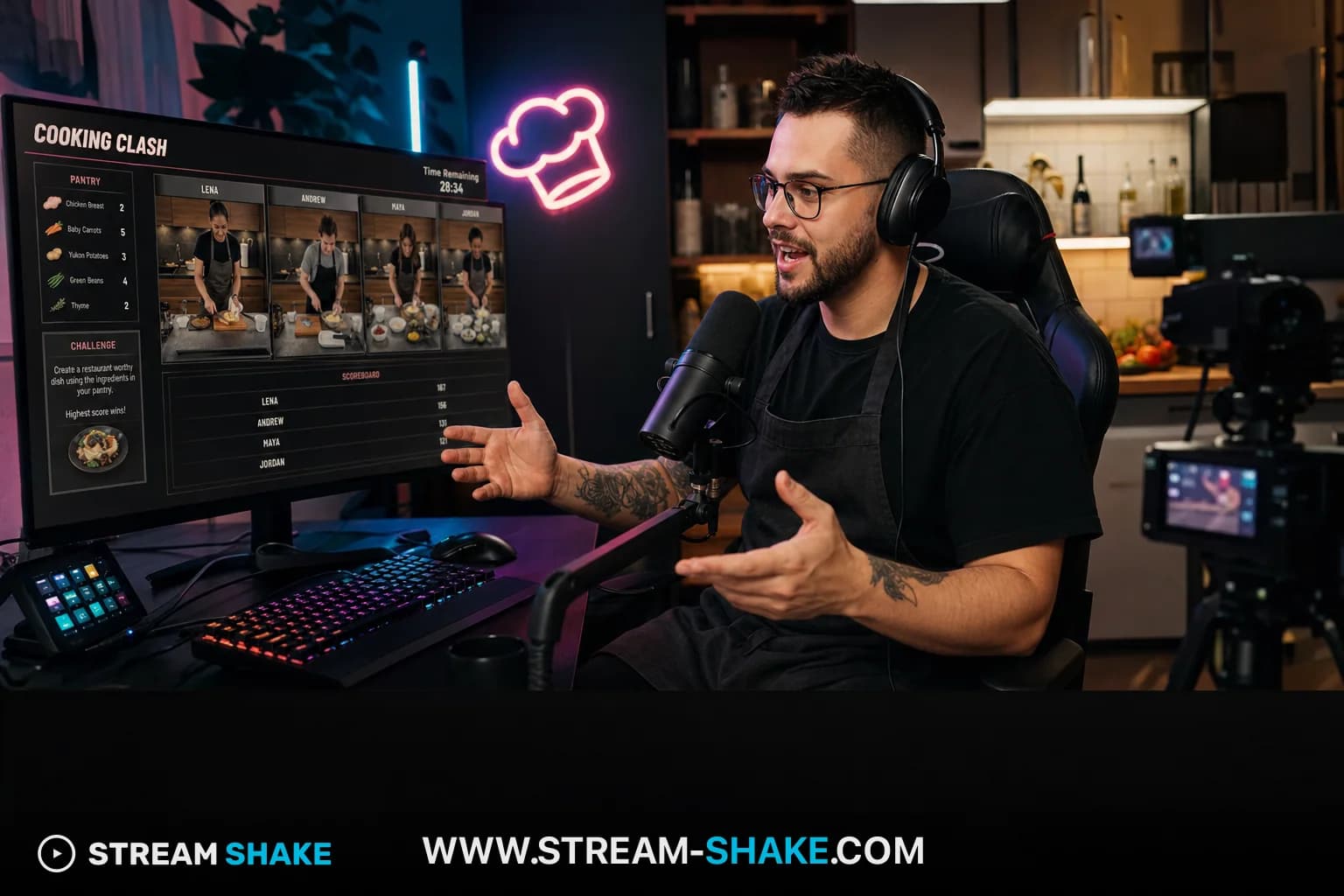
In 2026, the intersection of Twitch streaming and traditional television offers unprecedented opportunities for digital creators. Tricia Wang's journey on Fox's *Next Level Chef* exemplifies how authentic expertise and a deep understanding of evolving platform policies are crucial for achieving mainstream recognition and sustainable growth.
The Evolution of the "Food & Drink" Category#
To understand the current ecosystem for culinary streamers, it is necessary to examine the historical trajectory of non-gaming content on Twitch. The platform’s expansion beyond gaming began in earnest with the introduction of its "Creative" category, which famously launched with a marathon broadcast of Bob Ross's *The Joy of Painting*, drawing 5.6 million viewers and signaling a profound shift in audience appetite. This eventually gave rise to the **In Real Life (IRL)** and "Food & Drink" categories.
Statistical Trajectory and Audience Demographics
The global COVID-19 pandemic served as a massive catalyst for livestreaming as a whole, with Twitch's total hours watched surging by 67% between March and May of 2020. The "Food & Drink" category specifically saw immense organic growth as global populations, confined to their homes, turned to digital platforms for culinary inspiration and parasocial connection.
67%
2020 Twitch Hours Watched
Growth between March-May 2020
132%
Food & Drink Category
Year-over-year hours watched growth by Aug 2020
51.2%
Channels 1K-10K Followers
Approx. share in Food & Drink (2022 est.)
1,172
Avg. Concurrent Viewers
Food & Drink category (March 2026)
The synthesis of this data suggests that while the "Food & Drink" category is no longer experiencing the volatile hyper-growth of the lockdown era, it has cemented itself as a sustainable, core pillar of Twitch's non-gaming ecosystem. The high density of creators in the 1,000 to 10,000 follower range indicates a highly competitive environment. To break into the upper echelons of visibility, creators must offer unique value propositions—such as elite professional expertise or compelling cross-media integration.
Real-World Case Study: Tricia Wang on "Next Level Chef"#
The maturation of Twitch’s culinary community reached a mainstream inflection point with the premiere of Fox’s *Next Level Chef* in January 2022. Hosted by culinary icon Gordon Ramsay, alongside mentors Richard Blais and Nyesha Arrington, the program featured a unique format: 15 contestants ranging from professional line cooks to social media influencers competing across a three-story set with varying qualities of kitchen equipment.
Bridging the Digital and Traditional Divide
Among the competitors was Tricia Wang, known professionally on Twitch as `triciaisabirdy`. Wang exemplifies the modern, multi-faceted digital creator. Born in Alaska to Chinese immigrant parents and raised in Texas, Wang initially pursued a career in finance before pivoting to the culinary arts. She trained at Le Cordon Bleu in Tokyo, specializing in Classical French and Traditional Japanese Washoku cuisine, and previously worked at a two-Michelin-starred restaurant.
Wang began streaming on Twitch in 2020 at the onset of the pandemic to teach friends how to cook during quarantine, eventually expanding into gaming streams. Her presence on *Next Level Chef* generated one of the most significant viral crossover moments in recent digital history.
“"What the f*ck is Twitch?" – Gordon Ramsay, genuinely bewildered by Tricia Wang's profession on *Next Level Chef*, inadvertently sparking a viral internet moment that resonated across both digital and traditional media.”
The Amplification of Organic Viral Marketing
The cultural impact of this brief interaction serves as a masterclass in organic, cross-platform marketing. Rather than ignoring the moment, both traditional and digital entities capitalized on the viral momentum. Official Twitch social media accounts temporarily updated their biographies to reference Gordon Ramsay, while Ramsay himself updated his profile. Top Twitch personalities, such as Félix "xQc" Lengyel and Hasan "HasanAbi" Piker, publicly engaged, driving their massive audiences toward the television program.
Wang successfully translated this mainstream television exposure back to her digital community. She leveraged Asian-American social media groups to share the clip and subsequently streamed herself recreating the scallop dish live on Twitch. Despite the high-pressure environment of the show—which famously resulted in Wang accidentally setting her workstation on fire—she performed admirably, ultimately ranking 7th in the competition.
Furthermore, her career trajectory following the show demonstrates the lucrative potential of lawful, high-quality content creation. By May 2026, Wang continued to leverage her dual expertise, hosting highly viewed sponsored broadcasts, such as an IKEA "Dream Kitchen" exploration stream that garnered 350,000 views.
This case study illustrates that mainstream networks now recognize the built-in audience retention that digital creators provide. However, crossing over requires legitimate, verifiable expertise rather than artificially inflated vanity metrics.
Navigating Platform Policies in 2026#
For content creators attempting to replicate the success of top-tier broadcasters, understanding the intricate, rapidly evolving regulatory framework of modern streaming is critical. Between 2022 and 2026, Twitch implemented several aggressive policy shifts targeting copyright infringement, cross-platform promotion, and artificial engagement.
The Demise of the "React Meta" and DMCA Risks
A pervasive trend that dominated Twitch in late 2021 and early 2022 was the "React Meta," wherein massive broadcasters would livestream themselves watching and commenting on copyrighted traditional television shows. While this resulted in explosive short-term viewership, it operated in a legally gray area that ultimately collapsed under the weight of the **Digital Millennium Copyright Act (DMCA)**.
While some creators argued their commentary constituted "Fair Use," television networks disagreed. Major creators like Pokimane and HasanAbi faced temporary bans and DMCA strikes. Ultimately, the threat of permanent channel deletion forced the streaming community to abandon the unauthorized broadcasting of traditional television. For creators in 2026, the lesson is unequivocal: streamers must generate original intellectual property, such as actual live cooking, rather than merely reacting to others doing so.
Restrictions on Cross-Platform Promotion & The Rise of Competitors
As the "streaming wars" intensified with competitors like YouTube Gaming and Kick vying for market share, Twitch significantly tightened its policies regarding off-platform promotion. Kick aggressively courted streamers by offering a flat 95/5 revenue split on subscriptions, vastly undercutting Twitch's default 50/50 split.
This policy shift profoundly impacts how creators build multi-platform empires. It forces a strategy where external platforms (like TikTok or YouTube Shorts) are used to funnel viewers *in* to Twitch, rather than using Twitch as a billboard to push viewers *out*.
The 2026 Crackdown on Viewbotting
Perhaps the most significant regulatory hurdle for upcoming streamers is the platform's war on artificial engagement. **Viewbotting** is defined as the practice of artificially inflating a live view count using illegitimate scripts, automated tools, or fake accounts to make a channel appear more popular than it is in reality.
Furthermore, Twitch has opted to keep the specifics of this enforcement mechanism private. Penalized streamers receive confidential notifications regarding their CCV caps, preventing viewbot developers from reverse-engineering the detection algorithms. Repeat offenders face increasingly lengthy penalties, heavily diminishing any perceived return on investment from purchasing illicit viewers.
The Ecosystem Risks of Illegitimate Growth#
The temptation for smaller creators to utilize viewbots is driven by a desire to break through algorithmic obscurity. However, the evidence is overwhelming that artificial inflation is deeply detrimental to a broadcasting career.
First, viewbots provide no tangible community value. False viewer growth does not contribute to a healthy, engaged chat, nor do bots purchase subscriptions, donate, or purchase sponsor products. Advertisers have become highly sophisticated in detecting "empty" metrics, and relying on fraudulent engagement compromises viewer trust and brand safety.
Second, the psychological toll on the creator is profound. Streamers utilizing viewbots often experience severe drops in viewership when the platform initiates ban waves or deploys new detection code. This creates a fragile, anxiety-inducing environment where a creator's apparent success is entirely fabricated and highly vulnerable.
Finally, malicious actors occasionally weaponize viewbots against competitors—a practice known as "malicious viewbotting"—in an attempt to trigger the platform's automated ban systems against innocent channels. Twitch's 2026 update to utilize historical baseline traffic to cap CCV rather than issuing immediate, automated permanent bans is partly a defense mechanism to protect innocent creators from these targeted attacks.
Lawful Growth Tactics and the Stream Shake Alternative#
With viewbotting rendering channels susceptible to severe algorithmic suppression, and aggressive cross-platform marketing severely restricted during live broadcasts, content creators must employ strictly lawful growth tactics. Sustainable audience development in 2026 requires an emphasis on ethical networking, genuine community building, and adherence to ToS.
Best Practices for Organic Expansion
The most resilient channels prioritize genuine engagement over vanity metrics. Research and community consensus indicate several key strategies for lawful growth. To effectively build an audience without risking platform penalties, creators should follow this structured approach:
- Prioritize Content Quality and Niche Expertise: Much like Tricia Wang's success stems from her legitimate, high-level culinary training, streamers must offer distinct value. Utilize high-quality hardware and reliable broadcast software like OBS Studio or Streamlabs to ensure a polished presentation. Excellent audio, crisp video, and structured content retain viewers far better than generic, unprepared broadcasts.
- Execute Asynchronous Content Creation: Because Twitch explicitly forbids promoting competitors during live streams, creators must build asynchronous funnels. By converting stream highlights using dedicated editing software like CapCut or Nexus Clips into short-form content for massive external platforms (TikTok, YouTube Shorts, Instagram Reels), creators can capture algorithmic discovery off-platform and funnel those users back to their live Twitch channels.
- Engage in Collaborative Networking: Participating in lawful collaborations, such as co-hosting cooking segments or engaging in multiplayer gaming with peers, allows streamers to cross-pollinate audiences naturally and ethically. Leveraging community software like Discord is essential to organize these multi-stream collaborations efficiently.
The Lawful Utility of Stream Shake
For creators seeking structured networking and visibility without violating Twitch policies, ethical mutual-viewing platforms present a viable alternative to illicit viewbots. **Stream Shake** represents this new paradigm of lawful channel promotion.
Unlike viewbot providers that use proxy IP addresses and automated scripts to simulate traffic, Stream Shake operates entirely within the boundaries of Twitch's rules by facilitating genuine, human-to-human interaction.
The platform operates on a reciprocal model: streamers earn points by actively engaging with and viewing other creators' content. These points can then be used to elevate their own channel's visibility within the Stream Shake ecosystem or be withdrawn as real currency.
Because the viewership generated through Stream Shake consists of real, authenticated Twitch users rather than automated scripts, it does not trigger Twitch's AI-driven viewbot detection systems or result in the CCV caps outlined by CEO Dan Clancy. Logistically, streamers earn points based on active watch time and verified chat participation, making the baseline time-to-reward ratio a 1:1 reciprocal exchange of time for visibility.
Glossary of Key Terms#
Frequently Asked Questions#
What is the 'React Meta' and why did it decline on Twitch?
The 'React Meta' involved streamers watching and commenting on copyrighted traditional TV shows. It declined due to aggressive DMCA enforcement by television networks, as it often violated intellectual property laws and led to channel suspensions.
How has Twitch's cross-platform promotion policy changed in 2026?
As of 2026, Twitch prohibits streamers from actively encouraging live viewers to leave the platform for concurrent broadcasts elsewhere using titles, banners, or verbal calls-to-action. Passive links in "About Me" panels are still allowed.
What are the risks of using viewbots in 2026?
Viewbotting in 2026 is highly risky due to Twitch's new CCV caps, which algorithmically suppress displayed viewer counts for channels detected using artificial engagement. This leads to no real community value, advertiser distrust, psychological toll on the creator, and potential penalties without genuine growth.
How does Stream Shake offer a lawful alternative for Twitch growth?
Stream Shake facilitates genuine, human-to-human mutual viewing within Twitch's ToS. Users earn points by engaging with other streams and can then spend those points to organically boost their own channel's visibility with real Twitch users, avoiding viewbot detection and penalties.