
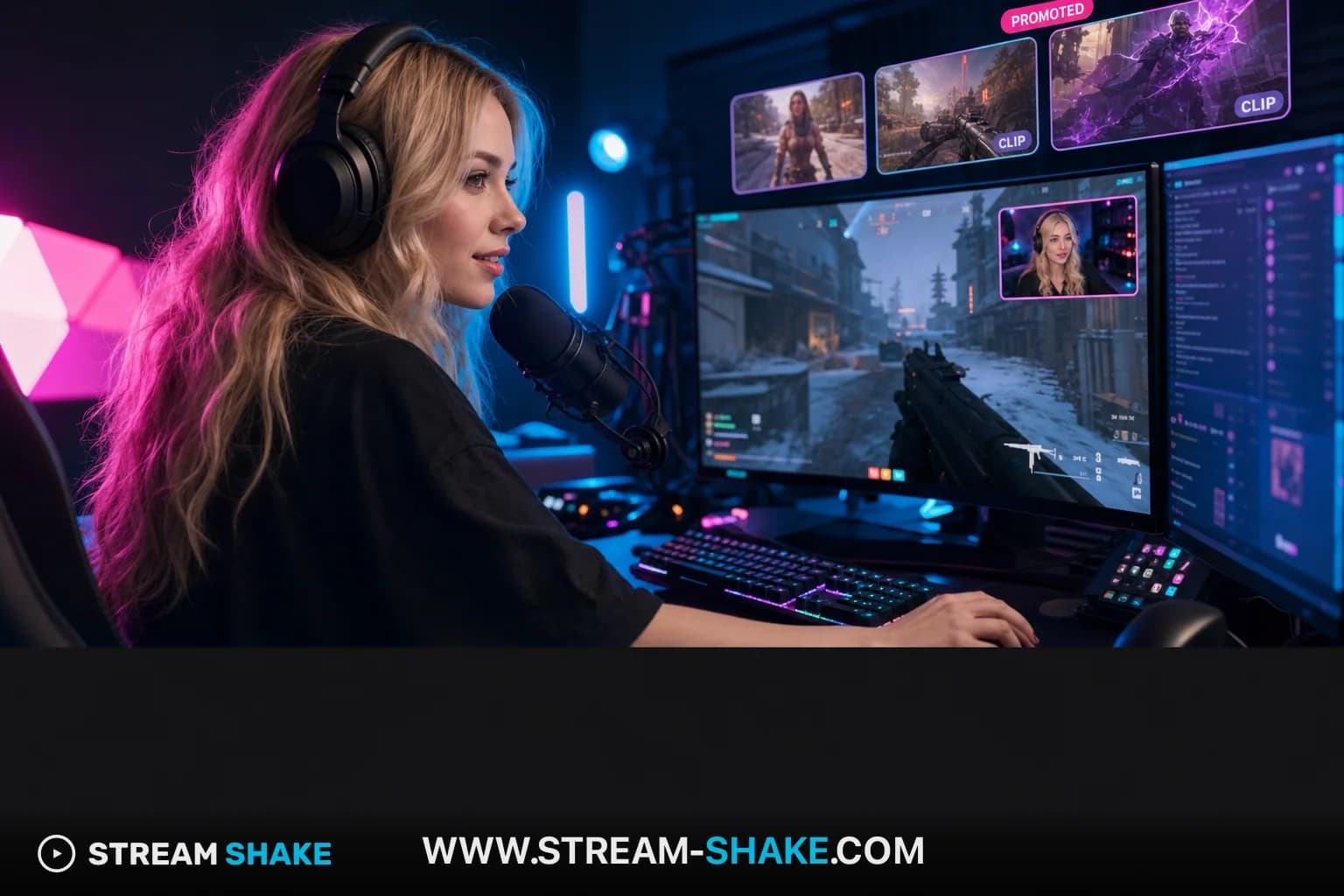
The competitive digital broadcasting landscape of 2026 forces Twitch creators to navigate between the fantasy of overnight virality, satirized by "streamer simulator" games, and the harsh reality of algorithmic obscurity. This "cold start" problem – where channels with zero viewers are buried at the bottom of platform directories – has historically fueled a black market of fake engagement tools. However, Twitch's aggressive policy updates in 2025-2026 now impose severe penalties, making the distinction between prohibited inflation tactics and lawful community-building strategies crucial for digital survival. This report explores the cultural phenomenon of streamer simulators alongside the stark realities of Twitch's policy crackdowns and the imperative for authentic channel growth.
The Streamer Simulator Phenomenon: Satire and Reality in 2026#
The streaming industry has grown so large and culturally pervasive that it has become a popular subject of parody within the very medium it relies upon: video games. The "streamer simulator" genre has evolved significantly over the last several years, transitioning from simple lifestyle management games to complex, satirical role-playing experiences that critique the modern "clout economy." To understand this cultural mirror, one must analyze the parity across the genre's most defining titles.
*Streamer Life Simulator*: The Technical Grind
Early iterations of the genre focused heavily on the mundane, logistical realities of content creation. These titles gamified the technical grind of the early platform era.
- Functional Scope: A comprehensive, open-world lifestyle and business management simulation focused on survival mechanics and hardware progression.
- Current Price/Cost: $19.99 (frequently discounted as low as $1.99 or bundled with similar titles).
- Availability: PC via Steam (Playable on Steam Deck).
- Real-World Context: Ideal for players who enjoy grinding and hardware progression. It mirrors the grueling, behind-the-scenes reality of early streaming culture, where endurance and technical setup were the primary hurdles to success.
The Core Gameplay Loop: Players start from scratch in a bad neighborhood and must actively manage their character's basic human needs. For instance, players must monitor "toilet need" and "hygiene" bars; neglecting these metrics during a simulated 12-hour subathon results in stat penalties and a loss of viewer momentum. Success requires playing the right games at the right times, engaging in side jobs to earn money, physically building custom PCs with better internet infrastructure, and migrating to wealthier in-game neighborhoods to sustain larger broadcasts.
*Nerd Simulator*: The Comedic Survival Mashup
As the genre expanded, developers began blending the rigid simulation mechanics with darker humor and RPG elements, reflecting the increasing absurdity of internet culture.
- Functional Scope: An Early Access mash-up of an RPG and an adulthood survival simulator, featuring a mix of 2D and 3D tasks, interactive rooms, and absurd mini-games.
- Current Price/Cost: $7.99 (often available in bundles lowering the cost to ~$2.30 to $2.50).
- Availability: PC via Steam (Early Access).
- Real-World Context: Aimed at players seeking dark comedy and chaotic unpredictability. It satirizes the financial desperation that often drives individuals toward internet fame as a last resort.
The Core Gameplay Loop: Players assume the role of Mervin, a 40-year-old living with his demanding mother, whose life is a literal meme. The loop centers entirely on financial desperation. Mervin must earn rent money through highly volatile, often ridiculous methods. Players must choose between slow, "honest" mini-game work (like scrubbing toilets) or high-risk internet gambles like going all-in on crypto, dancing at a strip club, or engaging in shady deals at the casino. All the while, players must manage his unpredictable sleep, hunger, and bladder mechanics, ensuring his sanity remains intact through painting or going to the gym.
*Content King*: A Deconstructive Parody of Twitch Culture
By 2026, the cultural conversation had shifted from the technical grind to the psychological and ethical dilemmas of internet fame. This shift is perfectly encapsulated by the release of *Content King* in March 2026. Developed by Usurper Studios, the game abandons mundane survival mechanics to focus entirely on the chaotic, metric-driven nature of modern streaming.
- Functional Scope: An interactive fiction, role-playing sandbox that directly simulates the volatile behavioral boundaries of live broadcasting and "brainrot" culture.
- Current Price/Cost: $11.99.
- Availability: PC via Steam (Playable on Steam Deck).
- Real-World Context: Serves as a dark comedy and deconstructive parody of platforms like Twitch, Kick, and TikTok, targeting players fascinated by the dramatic, high-risk "clout economy."
The Core Gameplay Loop: To understand how *Content King* satirizes the creator economy, one must look at its core mechanics, which actively gamify the ethical boundaries of live broadcasting.
Gamifying the 'Clout Economy'
- Players assume the role of Caden Brentley, described as a "brainrot streamer" whose entire life is broadcast via a flying drone called the "Sky Synapse."
- The primary objective is to gain viewers and climb the ranks of internet fame. Every dialogue choice, interaction, and mini-game directly impacts the live viewer count.
- The game introduces a "notoriety" system. Players are incentivized to perform risky, edgy, or socially unacceptable actions (such as vandalizing property or provoking public drama) because these actions generate massive spikes in viewership. However, pushing the edgy content too far fills the notoriety meter, resulting in a platform suspension or ban.
- In a striking parallel to real-world pressures, players in *Content King* are sometimes tempted or required to purchase in-game viewbots to bypass viewership thresholds and progress the storyline, highlighting the systemic pressure to cheat. Alternatively, players can attempt a wholesome "good ending" route, though reaching viewer thresholds organically proves drastically more difficult.
Synthesis of the Simulator Meta: The brilliance of *Content King* lies in its "Sandwich Method" approach to player morality. It sets up the player in a desperate situation (a dead stream with zero viewers), offers a meaty shortcut (vandalism, drama farming, or viewbots to spike engagement), and forces the player to synthesize the consequences (managing toxic chat moderators, declining sanity, and looming bans). The game explicitly asks a question that real-world streamers face daily: Is a temporary spike in visibility worth the long-term destruction of your reputation and mental health? In the simulation, players can simply reload a save file. On the actual Twitch platform in 2026, the consequences are permanent.
The State of Twitch in 2026: Statistics and the "Cold Start" Crisis#
To understand why streamers resort to extreme tactics—whether satirical in a game or fraudulent in reality—one must examine the sheer scale and competitiveness of the Twitch platform in 2026.
2026 Viewership and Creator Demographics
Despite increasing competition from platforms like YouTube Gaming and Kick, Twitch commands a staggering share of the global live-streaming market.
240-250M+
Monthly Active Users (MAU)
Twitch's total active user base.
35M+
Daily Active Users (DAU)
Users engaging with Twitch daily.
2.09-2.55M
Concurrent Viewers (CCV)
Average live viewership at any given moment.
7.3M+
Monthly Broadcasters
Unique individuals streaming each month.
93,200-97,200
Simultaneous Channels Live
Average number of channels broadcasting at once.
19.2-20.9B hours
Total Watch Time (2025)
Aggregate hours of content consumed.
Synthesis of the Data: While these numbers reflect a thriving platform, they also reveal a terrifying mathematical reality for new creators. With over 93,000 channels live concurrently and only 2.5 million viewers to go around, the average viewership per channel is mathematically low. However, viewership on Twitch is not distributed evenly; it is heavily skewed toward the top 1% of creators. Twitch’s directory ranks channels primarily by their concurrent viewer count. A channel sitting at zero or one viewer is buried beneath thousands of others, rendering it practically invisible to organic discovery. This structural bottleneck is the primary driver behind the black market of fake engagement.
The Viewbot Epidemic: Mechanics of Fake Engagement#
Desperate to escape the zero-viewer trap and secure prime placement in the Twitch directory—often referred to as "King Maker Slots"—many creators turn to viewbots.
Defining Artificial Engagement
A Twitch viewbot is a software tool or script designed to send automated, non-human viewer sessions to a live stream, artificially inflating the channel's concurrent viewer count. Modern fraudulent services offer an entire ecosystem of fake engagement, including:
- Viewbots: Inflating live concurrent viewership numbers.
- Chatbots: Sending automated, pre-written messages to simulate an active community.
- Followbots: Delivering automated account follows to make a channel appear established.
The rationale behind purchasing these services is entirely psychological and algorithmic. A channel with 50 to 100 viewers appears credible, triggering a "social proof" effect that encourages real viewers browsing the directory to click, stay, and engage. Furthermore, inflated numbers are often used to deceive potential brand sponsors, leveraging fake metrics to negotiate lucrative advertising deals. Independent industry calculators estimate that an organic creator in the 50 to 100 CCV tier can command sponsorship rates of $50 to $300 per hour. Fraudulent actors utilize viewbots to artificially mimic this tier and steal advertising dollars.
The Scale of the Problem
The prevalence of viewbotting has reached alarming levels. A Q2 2025 whitepaper published by the analytics firm Streams Charts revealed the staggering scope of artificial engagement across the industry.
10%+
Twitch Accounts with Viewbots
Of accounts averaging 50+ quarterly viewers showed persistent viewbotting signs.
30M+ hours
Fake Watch Time (Twitch, Q2 2025)
Generated by suspicious Twitch streams in one quarter.
1 in 6
Kick Streamers with Viewbots
Of streamers with 50+ average viewers utilized viewbots.
20M hours
Fake Watch Time (Kick, Q2 2025)
Produced by inflated watch time on Kick in the same period.
Synthesis of the Epidemic: The presence of viewbots does not merely hurt advertisers who pay for fake impressions; it fundamentally corrupts the creator ecosystem. As independent analysts note, viewbotting undermines trust across the entire platform, making it exponentially harder for honest, organic streamers to gain visibility. When cheaters artificially occupy the top directory slots, legitimate creators are pushed further down into obscurity.
The Empire Strikes Back: Twitch’s 2025–2026 Policy Crackdowns#
For years, Twitch relied on periodic, massive purges to eliminate bot accounts. However, bot providers continuously adapted, utilizing rotating proxy IP addresses and advanced behavior simulation to bypass basic detection. In response, Twitch fundamentally overhauled its enforcement strategies in two distinct phases between 2025 and 2026.
Phase 1: The August 2025 Algorithmic Purge
In late July and August of 2025, Twitch rolled out a revolutionary update to its real-time detection algorithms, officially declaring total war on artificial view inflation. Rather than simply counting IP connections, the new multi-layer traffic verification system began evaluating each viewer across dozens of behavioral parameters in real time. The algorithm learned to identify non-organic activity by analyzing:
- Join/Leave Timing: Mass connections at the start of a stream and sharp drop-offs at the end were flagged, as real human audiences join and leave gradually.
- Player Interactions: The system verified if users were actually interacting with the video player (e.g., altering volume, entering fullscreen). Bots typically show zero player interaction.
- Chat-to-Viewer Ratios: Anomalously low ratios—such as a stream boasting 1,000 viewers but only featuring two or three active chatters—were immediately categorized as bot-like behavior.
The impact was immediate and seismic. The platform officially modified its source code to better identify headless browsers and fraudulent accounts, unleashing the purge on August 21, 2025. At peak impact between August 22 and August 24, site-wide viewership plummeted by a staggering 23% to 24%, marking a multi-year low for the platform as tens of millions of fake viewer sessions were vaporized. Overall, Twitch experienced an 8.9% year-over-year decline in total hours watched in 2025, directly attributed to this massive viewbotting crackdown.
Phase 2: The May 2026 CCV Cap Enforcement
Despite the success of the 2025 purge, sophisticated bot developers continued to mutate their software to mimic human behavior more closely. Acknowledging the ongoing "cat-and-mouse" game, Twitch CEO Dan Clancy announced a radical new policy on May 7, 2026: Concurrent Viewership (CCV) Capping.
Historically, Twitch either banned viewbotters or simply ignored the fake traffic if it could not definitively prove the streamer purchased the bots themselves (protecting creators from malicious third-party attacks). The May 2026 policy shifted the paradigm from mere detection to visible, structural punishment.
Mechanics of the CCV Cap
- For channels identified as persistently viewbotting, Twitch actively applies a hard cap to the streamer's displayed concurrent viewer count across all Twitch surfaces.
- The cap is calculated based on historical data regarding that specific creator's legitimate, non-viewbotted traffic.
- Repeated violations result in longer penalty durations. Streamers are privately notified of the enforcement and allowed to appeal, but Twitch refuses to publicly name the penalized channels to prevent bot developers from reverse-engineering the detection limits.
Synthesis of the Policy Shift: This policy represents a brilliant, albeit controversial, maneuver by Twitch. Think of this like a bouncer at a nightclub artificially stopping the counter at the door; even if the streamer pays for 5,000 bots to flood the entrance, the bouncer only tells the directory they have 15 people inside, rendering the hype completely invisible. By artificially capping the CCV, Twitch completely neutralizes the primary motivation for viewbotting: directory placement. Furthermore, because the enforcement is kept private, viewers are left to wonder if a streamer's low numbers are due to a natural decline or a shadowban penalty, deeply damaging the credibility of suspected cheaters.
The Federal Trade Commission (FTC) Intervention
Compounding the platform's internal crackdowns are immense external legal risks. In August 2024, the United States Federal Trade Commission (FTC) issued a final ruling that officially banned "fake social media indicators," which explicitly includes viewbotting and follower inflation. This ruling empowers the FTC to levy massive financial fines against content creators and talent agencies who purchase fake views for commercial purposes—such as fluffing their numbers to secure or negotiate sponsored streams. While U.S. law does not classify viewbotting as a criminal offense resulting in jail time, the threat of civil FTC fines adds a severe legal deterrent to an already risky practice.
Real-World Consequences and Community Backlash#
The enforcement of these policies has resulted in highly visible, career-damaging moments for creators caught manipulating their metrics. The risks extend far beyond algorithmic caps; they threaten the fundamental trust between a creator and their community.
The Exposure of "QueenGloriaRP"
One of the most tangible examples of the viewbotting epidemic occurred in March 2025, involving a smaller Twitch streamer known as QueenGloriaRP. During a live broadcast, the streamer accidentally tabbed out of her game, exposing a third-party viewbotting control panel on her screen. She quickly restarted her broadcast, attempting to blame the glitch on an OBS (Open Broadcaster Software) update, but the moment was clipped and rapidly circulated across social media by industry commentators like Jake Lucky. Despite having only 3,600 followers and seemingly using the bot to add a humble 20 fake viewers to her stream, the community backlash was severe. Users slammed the creator for cheating the platform, and Twitch banned her account mere hours after the clip went viral. This incident sparked widespread paranoia among audiences: if a micro-streamer is willing to risk a ban for 20 fake viewers, how much of the audience of a 10,000-viewer streamer is actually authentic?
Top-Tier Scrutiny and "Hate Raids"
The suspicion of fake engagement reaches the very top of the platform. Prominent streamers such as xQc, Asmongold, and Mizkif all experienced notable, highly publicized drops in viewership during the August 2025 bot purges. For example, Asmongold's alternative account, zackrawrr, saw its viewership drop from an average of nearly 50,000 down to 29,000–30,000 (a 20-30% decline). Similarly, Mizkif experienced a steep plunge from his three-month average of 17,126 concurrent viewers to 9,142 viewers in the same period. While these streamers are often victims of "hate raids" (where malicious actors send bots to intentionally harm a channel), the community often remains skeptical, eroding trust even for top creators.
Lawful Growth: Overcoming the "Cold Start" Problem Authentically#
With the risks of fake engagement escalating and organic discovery increasingly difficult, streamers must adopt legitimate, sustainable growth strategies. The goal is to build genuine communities and ensure visibility without violating platform policies or risking legal action.
Stream Shake: A Mutual Viewing Solution
Platforms like Stream Shake offer a TOS-compliant alternative to overcome the initial viewer hump. By connecting streamers who genuinely want to support each other, Stream Shake facilitates mutual viewing, ensuring that new channels have real, human viewers to jumpstart their discoverability. This approach aligns with Twitch’s policies by fostering authentic interaction and community building, rather than artificial inflation.
Frequently Asked Questions About Streamer Simulators and Twitch Growth#
What is a Twitch streamer simulator game?
A Twitch streamer simulator game is a video game genre that parodies or simulates the life of a content creator, often focusing on the challenges, ethical dilemmas, and quest for fame within the streaming ecosystem. Titles like *Content King* highlight the pressures of metric-driven growth and the temptation to use illicit shortcuts.
Are viewbots illegal or just against Twitch's Terms of Service?
Viewbots are explicitly against Twitch's Terms of Service and can result in account bans, viewership caps, and other penalties. Furthermore, for commercial purposes (e.g., securing sponsorships), using fake social media indicators like viewbots is illegal under U.S. law, with the FTC imposing civil penalties of over $53,000 per violation.
How does Twitch detect viewbotting in 2026?
Twitch employs advanced real-time detection algorithms that analyze behavioral parameters beyond simple IP connections. These include join/leave timing, player interactions (e.g., volume changes), and chat-to-viewer ratios. Since May 2026, Twitch also implements a CCV capping system for channels identified as persistently viewbotting.
What is the 'cold start' problem for new Twitch streamers?
The 'cold start' problem refers to the difficulty new Twitch channels face in gaining visibility. Because Twitch's directory ranks channels by concurrent viewer count, streams with zero or very few viewers are buried, making organic discovery almost impossible. This drives some creators to seek artificial or lawful methods to gain initial traction.
What are lawful alternatives to viewbotting for Twitch growth?
Lawful alternatives include focusing on consistent, high-quality content, engaging with your community, collaborating with other streamers, and cross-promoting on social media. Platforms like Stream Shake offer TOS-compliant mutual viewing solutions, helping streamers overcome the 'cold start' problem with real human engagement.