
The era of going live and simply waiting to be discovered is definitively over. As we navigate the complex live streaming landscape of 2026, the definition of a "good Twitch streamer" has fundamentally shifted. They are no longer just skilled gamers or entertaining broadcasters; they are digital strategists, community architects, and cross-platform marketers. This guide provides an exhaustive analysis of the modern streaming ecosystem, synthesizing the latest market statistics, high-profile case studies, and platform policy shifts—particularly Twitch's aggressive new stance on viewbotting—to serve as a comprehensive roadmap.
The 2026 Live Streaming Landscape: A Market in Transition#
To understand how to succeed as a streamer, one must first understand the battlefield. For the better part of a decade, "Twitch" was completely synonymous with live streaming in the Western world. However, data from late 2025 and early 2026 indicates that the platform war has ceased to be a one-sided affair. The overall market is not shrinking—in fact, the 36.4 billion hours watched in 2025 represents a 6% year-over-year (YoY) growth, pushing the industry back toward its pandemic-era peaks. What is changing is where viewer attention is ultimately landing.
Market Share and Viewership Statistics
Understanding raw viewership data is critical for streamers deciding where to invest their time and for advertisers deciding where to allocate their budgets.
52.8-54%
Twitch Market Share (2025)
19.2 billion hours watched, 8.9% YoY decline, lowest Q4 viewership since 2020.
~24%
YouTube Gaming Market Share (2025)
8.8 billion hours watched, 12% YoY increase, fastest-growing major platform.
11-12.4%
Kick Market Share (2025)
4.5 billion hours watched, 131% YoY growth, 100 million registered users in early 2026.
Platform Comparison Matrix (2026)
To fully grasp the strategic differences between the platforms, creators must evaluate them across key business metrics.
| Platform | Market Share (2025) | Base Revenue Split | Monetization Thresholds | VOD Shelf-life | Native Discoverability Rating |
|---|---|---|---|---|---|
| Twitch | ~53% | 50/50 | 50 followers, 8 hours, 7 unique days, 3 average CCV | Low (14-60 days) | Poor (Requires external funnels) |
| YouTube Gaming | ~24% | 70/30 | 500 subscribers, 3,000 watch hours (or 3M Shorts views) | Permanent (Indexed in global search) | Excellent (Algorithmically recommended) |
| Kick | ~12% | 95/5 | 75 followers, 5 hours streamed, No CCV requirement | Medium (Up to 30 days) | Moderate (High internal cross-pollination) |
Parity in Demographics and Consumption Habits
The way viewers consume content has evolved significantly, with usage patterns differing uniquely across the three major platforms.
**Twitch Demographics & Usage:** As of 2025, Twitch averages roughly 140 million Monthly Active Users (MAUs) and hosts around 7.1 to 7.3 million active channels per month. The platform boasts 35 million daily active users who spend an average of 95 minutes per viewing session, vastly outperforming traditional on-demand video. Mobile usage accounts for 41% of traffic. The core demographic remains young, with 72% of Twitch users under the age of 34, and a gender split historically sitting at 63% male to 37% female (though 2026 projections suggest the female share is rising toward 42%).
**YouTube Gaming Demographics & Usage:** YouTube boasts an immense global scale of roughly 2.7 billion overall MAUs, with YouTube Gaming specifically cultivating 2.8 million unique active live channels. Sessions are highly variable due to the platform's blur between live broadcasts and long-form "edutainment" VODs. The 18–34 age bracket constitutes the vast majority of the core audience, with a staggering 63% of total views occurring on mobile devices.
**Kick Demographics & Usage:** Kick has rapidly scaled to roughly 50 million MAUs by late 2025 and supports 1.8 million unique active channels. The platform's audience skews distinctly younger and more male-dominated than its competitors, with 70% of viewers under 25 and a gender demographic of 74.22% male to 25.78% female. Furthermore, Kick viewers demonstrate immense retention, averaging 45-minute watch sessions, heavily outperforming the 30-minute industry average for similar emerging platforms.
Defining the "Good Twitch Streamer": Content, CTR, and Real Examples#
What exactly makes a streamer "good" in the current era? It is a combination of niche selection, relentless consistency, data-driven optimization, and the ability to manufacture "event-level" hype.
The Dominance of "Just Chatting" and Top 5 Categories
In 2025, the non-gaming sector of Twitch grew to 22% of the platform's total content. The undisputed king of all categories is "Just Chatting," which amassed an incredible 3.8 billion hours watched overall, reflecting Twitch's evolution into a personality-driven space where viewers show up for the creator's commentary rather than the specific pixels on the screen.
3.8 billion
Just Chatting
hours watched globally, #1 category.
1.4 billion
Grand Theft Auto V
hours watched globally, #2 category.
1.19 billion
League of Legends
hours watched globally, #3 category.
804 million
Valorant
hours watched globally, #4 category.
539 million
Fortnite
hours watched globally, #5 category.
Curiosity-Driven Titles and the Click-Through Reality
On Twitch, the stream title is the equivalent of a YouTube thumbnail. Labels like "Playing Ranked" are notoriously ineffective. Good streamers leverage the "curiosity gap"—creating a title that provokes enough intrigue that the viewer must click to resolve the mystery (e.g., "Stream won't end until I beat X" or "24h stream? Chat decides").
Real Examples: The Titans of 2026
Analyzing the absolute top echelon of creators provides a standardized blueprint for what is mathematically possible when a streamer masters community engagement and event marketing.
**Kai Cenat:** In 2025, Kai Cenat was the #1 most-watched streamer globally with 134.4 million hours watched. Primarily focused on Just Chatting, his growth is fueled by massive, high-production subathons like "Mafiathon 3," which shattered platform records by surpassing 1 million paid subscriptions. He logs monumental airtime during events, reaching 811 hours in Q3 2025 alone.
**Ibai Llanos:** Ibai Llanos amassed 186 million hours watched across the trailing year. His content is primarily Just Chatting and Special Events. His primary growth tactic involves mainstream event crossovers, with his annual amateur boxing event, *La Velada del Año 5*, peaking at 9.33 million concurrent viewers. He focuses on quality over quantity, reducing annual airtime to roughly 900 hours per year to maximize event impact.
**xQc:** xQc recorded 152 million hours watched in 2025. He streams a mix of Just Chatting and Variety Gaming, building parasocial loyalty through relentless consistency and high-volume daily engagement. He averages 221 to 227 hours streamed per month, famously taking only 85 days off over a five-year span.
The Danger of Shortcuts: Platform Policies and the War on Viewbotting#
The immense pressure to achieve the numbers seen by top creators drives many smaller streamers toward a fatal mistake: artificial engagement. On Twitch, success breeds success. **Social Proof**—the psychological phenomenon where users assume a channel is worth watching simply because others are watching it—dictates that streams with higher viewer counts receive more organic clicks.
Understanding Viewbotting vs. Real Engagement
Twitch's Terms of Service strictly prohibit "artificial engagement," which includes view-botting (using scripts to artificially inflate live concurrent viewer counts), follow-botting, and coordinated "Lurk 4 Lurk" schemes that do not involve genuine human interaction.
Dan Clancy's 2026 CCV Cap Policy
Historically, Twitch combatting viewbots meant issuing temporary account suspensions or executing massive purges. In May 2026, Twitch CEO Dan Clancy announced a revolutionary shift in enforcement strategy. Instead of relying solely on account bans, Twitch began targeting the long-term algorithmic benefits of the offending channels.
How Twitch's CCV Cap Policy Works
- CCV Cap Application: For channels identified as persistently viewbotting, Twitch now applies a hard cap to the streamer's visible Concurrent Viewers (CCV) across all platform surfaces for a fixed period.
- Historical Data-Based Throttling: The cap is calculated based on historical data regarding that specific creator's non-viewbotted, legitimate traffic. If a streamer normally averages 15 real viewers but buys 500 bots, Twitch will throttle their public metric to show only 15 viewers.
- Permanent Shadowbans: Repeated violations lead to permanent **shadowbans**—the secret suppression of a channel's visibility in search and directories without an outright ban. This makes artificial growth not just risky, but mathematically pointless and career-ending.
Lawful Growth Tactics: The Stream Shake Methodology#
If viewbotting results in CCV caps, how does a new streamer overcome the very real algorithmic "cold start" problem? The solution lies in a combination of lawful mutual community building and external content funnels.
The Power of Lawful Mutual Viewing
Procedural Guide: Executing a Stream Shake Campaign
Steps to Launch a Stream Shake Campaign
- Account Linking: Register on Stream Shake and authenticate your primary streaming account (e.g., Twitch or YouTube) via secure API authorization to ensure compliance.
- Point Accumulation: Browse the Stream Shake directory and select active peer streams to watch, supporting other creators in the network.
- Active Engagement: Participate genuinely in the peer's chat to bypass AFK (Away From Keyboard) timers, thereby earning network points for your own account through authentic interaction.
- Campaign Configuration: Before going live, navigate to your Stream Shake dashboard and allocate your earned points to dictate how many mutual viewers you wish to attract during your upcoming session.
- Live Execution: Go live on your native platform. Stream Shake will automatically route real, authenticated users to your stream to fulfill the requested capacity, providing instant social proof and algorithmic lift.
Target CCV Threshold Table
The immediate question following this strategy is: *How many mutual viewers do I need to break out of the directory basement?* Creators should target the following CCV thresholds using Stream Shake points to ensure they hit the top 3 scroll pages of their respective Twitch categories:
| Target Category Size | Example Games/Content | Required CCV to Break "Cold Start" |
|---|---|---|
| Niche / Obscure | Retro Games, Indie Titles, Niche Hobbies | 3 to 5 CCV |
| Mid-Tier | *Dead by Daylight*, *Rust*, Mid-size MMOs | 20 to 35 CCV |
| Top-Tier / Saturated | *Valorant*, *Fortnite*, Just Chatting | 250+ CCV |
The 2026 Content Engine: From Clips to Live
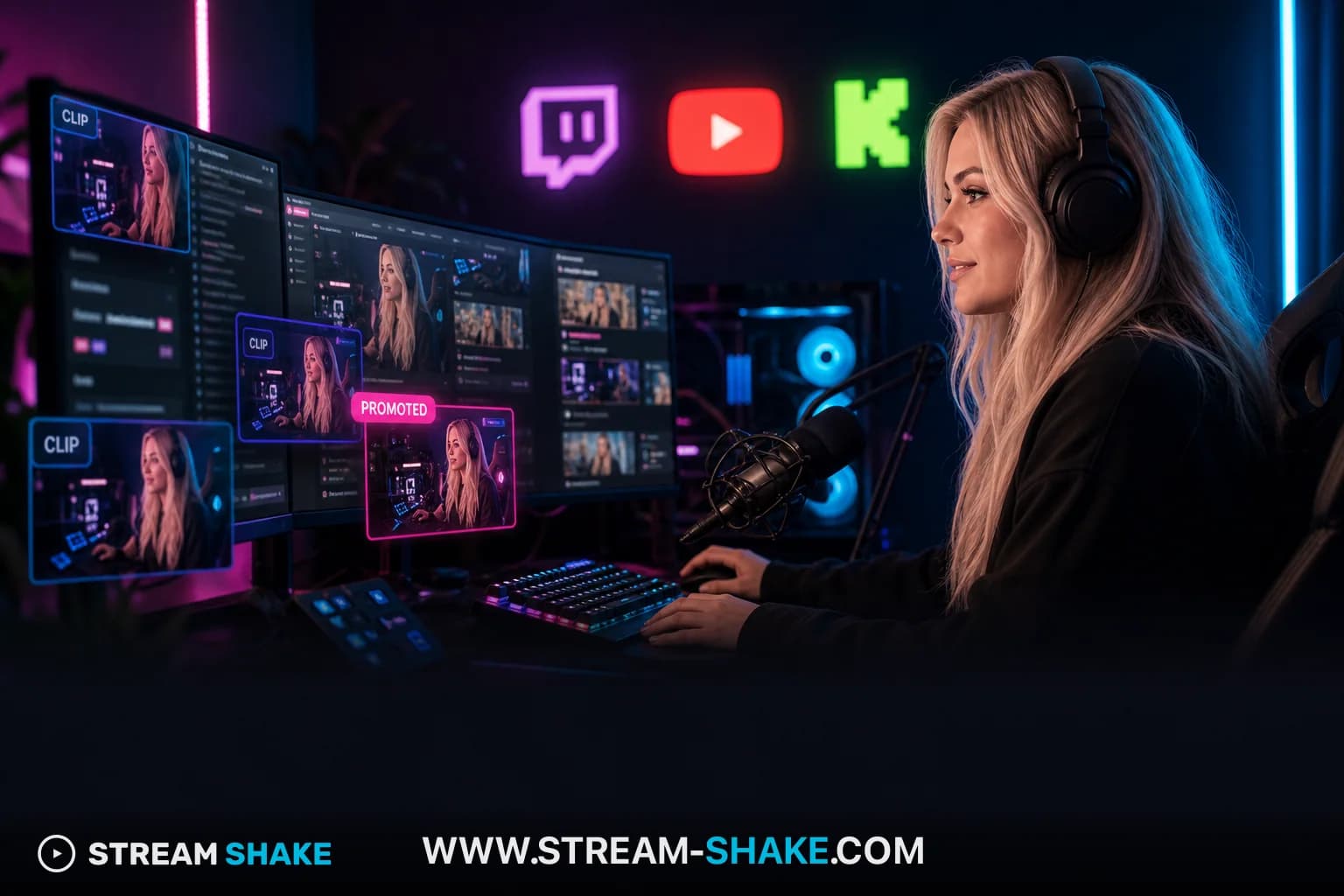
A good streamer recognizes that live broadcasting is the *end* of the funnel, not the beginning. Streamers must use AI clipping tools to identify highlight moments, edit them with captions, and distribute them across TikTok, YouTube Shorts, and Instagram Reels.
Competitor and Alternative Approaches: Where Should You Stream?#
While Twitch remains the cultural epicenter, a smart creator in 2026 must objectively evaluate the alternatives. The choice of platform dictates monetization potential and discoverability.
YouTube Gaming: The Discoverability Engine
YouTube Gaming is the strongest overall platform for creators focused on long-term, sustainable growth. Unlike Twitch, YouTube actively pushes live streams to new viewers via its recommendation algorithm. Analysis of platform mechanics suggests that up to 30-50% of new viewer acquisition can be driven by learned-interest algorithmic discovery, whereas immediate traffic spikes in the first 10-15 minutes rely heavily on push notifications sent to existing subscribers.
**VOD Value and Monetization:** When a stream ends on YouTube, it instantly becomes a searchable VOD that continues to accumulate views and **AdSense** (Google's advertising placement program that pays creators for ad views) revenue indefinitely. YouTube also offers a 70/30 revenue split on channel memberships.
**Drawbacks:** The live chat culture on YouTube is less culturally developed than Twitch's famous emote ecosystem.
Kick: The High-Revenue Disruptor
Kick burst onto the scene in 2023 and has sustained its aggressive growth through a creator-first financial model.
**The 95/5 Split & Monetization Hurdles:** Kick's primary weapon is its staggering 95% revenue share for creators on subscriptions. Furthermore, Kick offers incredibly low thresholds for monetization, requiring only 75 followers and 5 hours streamed with zero CCV requirements. This stands in stark contrast to Twitch's much steeper Affiliate hurdles, which explicitly mandate 50 followers, 8 hours streamed, 7 unique broadcast days, and an average of 3 CCV to unlock monetization.
**Drawbacks:** Despite massive registered user growth, Kick's daily live concurrent viewership lacks the absolute sheer audience scale of Twitch.
The Simulcasting Strategy
In 2026, exclusivity is a relic of the past. The most effective competitor approach is **Simulcasting** (broadcasting a single live feed to multiple streaming platforms simultaneously). By streaming to Twitch, YouTube, and Kick simultaneously using cloud-based studio tools, a creator can build an indexed VOD library on YouTube, capture high-margin subscription revenue on Kick, and maintain a cultural foothold in the Twitch community—all at the same time.
Conclusion: Thriving in the 2026 Ecosystem#
To be a "good Twitch streamer" in 2026 requires abandoning the outdated fantasy that playing video games in a dark room will organically lead to fame. The data paints a clear picture of an evolving, highly competitive market where attention is fractured across Twitch, YouTube, and Kick.
Success today is a highly structured pursuit. It requires leveraging AI and short-form video to build a top-of-funnel discovery engine, utilizing lawful community networks like Stream Shake to safely generate the initial real-viewer momentum required to survive algorithmic "cold starts," and understanding the grave risks of attempting to cheat platform systems with viewbots. As Twitch enforces brutal CCV caps to destroy artificial engagement, the only path forward is absolute authenticity.
The streamers who will dominate the remainder of the decade are those who treat their channel not as a hobby, but as a multi-platform media brand—fostering real human connection, embracing data-driven scheduling, and building communities that will follow them no matter what URL they broadcast from.
Frequently asked questions#
The Pinnacle of Success: Deconstructing the Titans#
To understand lawful growth, we must examine the creators who have successfully navigated the algorithm to achieve unprecedented scale. The top echelon of Twitch in 2025 and 2026 is defined by event-driven streaming, cross-cultural appeal, and high-production value.
Kai Cenat and the Million-Subscriber Milestone
The most followed and most subscribed streamer on Twitch in 2026 is American creator Kai Cenat. Rather than relying solely on high-level gaming, Cenat built an empire on "always-on" entertainment, viral internet slang, and massive cultural crossover events.
20.2M+
Total Followers
As of 2026
1.1M+
Peak CCV
Concurrent viewers
1.1M+
Mafiathon 3 Subs
Active subscribers
During his historic "Mafiathon 3" subathon in September 2025, Cenat shattered all previous platform records. Estimates suggest this single event generated between $984,958 and $3,288,758 in subscription revenue alone. Recreating such success requires an "event titan" combining celebrity participation, immense reach, and platform-wide algorithmic amplification.
Ibai Llanos and the Spanish Streaming Hegemony
While Kai Cenat dominates the English-speaking world, the second most-followed streamer globally is Spain's Ibai Llanos. Ibai's success highlights the immense, decentralized power of regional streaming communities, substituting casual broadcasts with television-quality events.
19.8M
Total Followers
As of 2026
9.33M
Peak CCV
La Velada del Año V
146,000
Average CCV (2025)
Sustained
Ibai represents the modern, multi-platform mogul. His annual boxing event, *La Velada del Año V*, drew an astonishing 9.33 million concurrent viewers. His Twitch earnings are massively augmented by his YouTube empire, generating substantial monthly revenue beyond his direct platform subscriptions.
The Rising Class: Fastest Growing Channels
Success on Twitch is not limited to established veterans. Emerging talent continuously proves that off-platform funneling dictates modern growth.
**JasonTheWeen** built a massive, dedicated audience on TikTok before transitioning his viewership to Twitch, culminating in him joining FaZe Clan. His 2.22 million followers and peak CCV of 123,770 demonstrate the power of external audience import. Similarly, Spanish-speaking creator **xCry** leveraged his existing popularity on Instagram (10.2 million followers) and YouTube to pull massive audiences to Twitch, achieving a peak CCV of 623,590. The common thread among all these creators is that they do not rely on Twitch to *find* their audience; they use Twitch as the venue to *host* an audience they have cultivated across the broader digital ecosystem.
The Dark Side of Growth: Viewbotting, Risks, and Platform Policies#
Where there is immense financial incentive, there will inevitably be bad actors. For years, the streaming industry was plagued by the shadow economy of "viewbotting"—the practice of using automated scripts or hijacked accounts to artificially inflate a channel's concurrent viewer count, follower count, or chat activity. In 2025 and 2026, the regulatory and platform-level tolerance for this behavior completely collapsed.
The 2025 Twitch Engagement Purge
In August 2025, Twitch implemented a devastatingly effective enhanced detection system targeting artificial engagement. CEO Dan Clancy publicly addressed the initiative, noting that the rollout was deliberately cautious to avoid "inadvertently filtering out real users." Within days of its August 21, 2025, implementation, streaming analytics reported a massive 24% drop in overall platform viewership compared to the previous week. This dramatic reduction exposed a harsh reality: a significant portion of Twitch's historical viewership metrics had been artificially inflated by digital illusions for years.
The Federal Hammer: FTC Regulations and Massive Fines
While a Twitch ban is disastrous for a career, the United States Federal Trade Commission (FTC) has escalated artificial engagement to a matter of federal law. On August 14, 2024, the FTC announced its final Trade Regulation Rule on the Use of Consumer Reviews and Testimonials, which became effective on October 21, 2024. This sweeping legislation contains a specific, devastating clause regarding the "Misuse of Fake Social Media Indicators."
Because modern Twitch streamers function as commercial entities—selling ad space, securing brand sponsorships, and generating subscription revenue—inflating one's metrics with bots constitutes commercial fraud under this rule. This legal framework effectively destroys the risk-to-reward ratio of viewbotting.
The Algorithmic Reality: Lawful Growth Tactics for 2026#
With artificial engagement criminalized and strictly policed, legitimate growth requires a deep understanding of Twitch's recommendation algorithms. Growing a Twitch channel in 2026 is fundamentally a discoverability problem. Twitch's internal surfaces—like the Browse page and the newly integrated mobile Discovery Feed—reward three primary signals: schedule regularity, concurrent-viewer stability, and chat-engagement density.
1. The Content Engine and Off-Platform Funnels
Because Twitch's internal discoverability for channels with fewer than five average viewers is notoriously poor, the most effective growth strategy is the "Content Engine." Streamers must treat their live broadcast not as the final product, but as raw material.
How to Build a Content Engine for Twitch Growth
- Stream a niche game or host a highly interactive 'Just Chatting' segment consistently.
- Post-stream, isolate 3-5 highly entertaining, context-free moments (wins, epic fails, funny reactions). Utilize AI clipping software like Opus Clip and StreamLadder for speed, or professional Non-Linear Editors (NLEs) like DaVinci Resolve for high-end polish.
- Format these clips vertically and upload daily to TikTok, YouTube Shorts, and Instagram Reels. Consistency is key across all platforms.
- Direct viewers who enjoy the short-form content via bio links and pinned comments back to your live Twitch channel. Make the call-to-action clear and compelling.
What is Twitch's new CCV cap policy?
In May 2026, Twitch introduced a policy to apply a hard cap on visible Concurrent Viewers (CCV) for channels persistently using viewbots. The cap is based on a streamer's legitimate historical traffic, effectively neutralizing the algorithmic benefits of artificial growth tactics.
Why is viewbotting no longer effective on Twitch?
Viewbotting is ineffective because Twitch's new CCV cap policy prevents bots from artificially inflating a channel's visible viewer count. Furthermore, repeated violations lead to permanent shadowbans, suppressing channel visibility in directories and searches, making growth mathematically pointless.
How has Twitch's market share changed in 2025-2026?
While Twitch still holds the largest market share (~53%), it experienced an 8.9% year-over-year decline in hours watched in 2025. YouTube Gaming (~24% market share) and Kick (~12% market share) have seen significant growth, leading to a more fragmented live streaming market.
What is the best platform for new streamers to start on?
The 'best' platform depends on goals. YouTube Gaming offers excellent long-term discoverability and VOD value. Kick provides a highly favorable 95/5 revenue split and low monetization thresholds. Twitch remains a cultural hub but requires more strategic external promotion for new channels.
How does Stream Shake help new streamers?
Stream Shake is an ethical, free mutual viewing network that connects real, authenticated users to watch and engage with peer streams. It helps new streamers overcome the 'cold start' problem by generating legitimate social proof and initial algorithmic lift without violating platform terms of service.
What is simulcasting and why is it important for streamers?
Simulcasting is broadcasting a single live feed to multiple streaming platforms (like Twitch, YouTube, and Kick) simultaneously. It's crucial for streamers in 2026 because it allows them to maximize reach, build indexed VOD libraries, capture diverse revenue streams, and maintain a presence across different communities without exclusivity.
Why is "Just Chatting" so popular on Twitch?
"Just Chatting" is the #1 category on Twitch, amassing 3.8 billion hours watched in 2025. Its popularity reflects Twitch's evolution into a personality-driven platform where viewers primarily tune in for the creator's commentary, interaction, and personal connection rather than specific gameplay.
What defines a 'successful' Twitch streamer in 2026?
Success in 2026 is defined by the ability to cultivate and host an external audience on Twitch, leveraging multi-platform content creation, maintaining high concurrent viewership stability, and adhering strictly to platform policies and federal regulations against artificial engagement. Financial success is often diversified across subscriptions, ads, and external sponsorships.
How important is multi-platform presence for Twitch growth?
It's critically important. With Twitch's internal discoverability challenges, successful streamers use a 'Content Engine' approach, creating short-form content for TikTok, YouTube Shorts, and Instagram Reels, then funneling that audience to their live Twitch broadcasts. This bypasses Twitch's saturated directory and leverages algorithms of other platforms.
What are the biggest risks for streamers related to artificial engagement?
Beyond Twitch bans, the most significant risk is federal penalties. The FTC's 2024 regulations prohibit the purchase of fake social media indicators (like viewbots or fake followers), with civil fines exceeding $51,000 per violation. This makes viewbotting not just a Terms of Service breach, but a severe legal and financial liability.
Do I need high production value to be successful?
While top streamers like Ibai Llanos use television-quality events, successful growth is more about consistent, engaging content and effective audience funneling. High production value can help, but it's not a prerequisite for building an initial audience if your content is compelling and distributed strategically.