
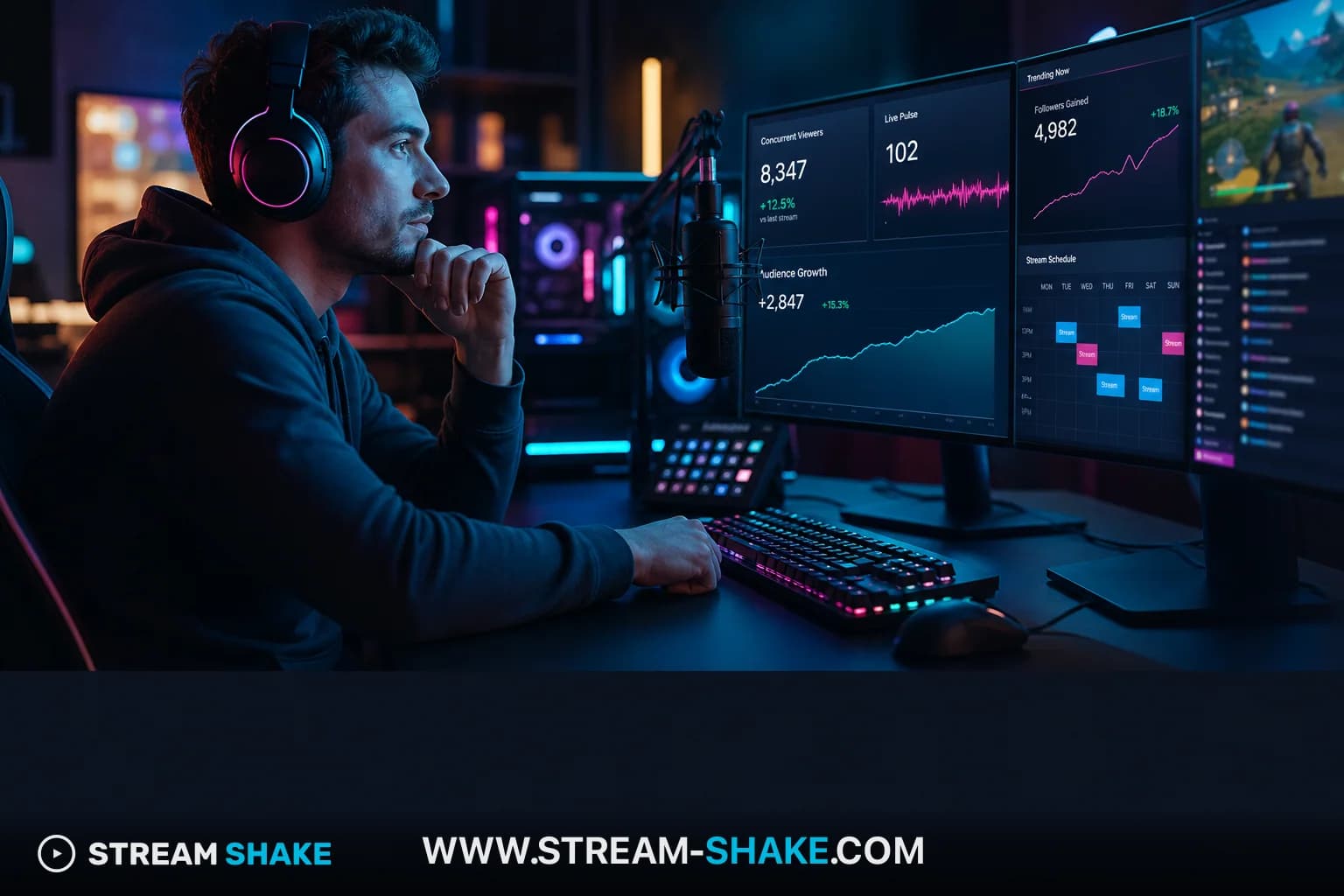
The 2026 live streaming landscape represents a fundamental paradigm shift from unchecked growth models. This report answers core operational and analytical questions: analyzing the viewership reality, platform policy shifts, risks of botting, and lawful growth tactics for sustainable success in the creator economy.
The Apex of Twitch Viewership in 2026#
To understand how to grow on modern streaming platforms, one must first analyze the creators currently commanding the largest audiences. The top echelon of Twitch streamers in 2026 relies less on traditional gameplay and more on high-production event streaming, celebrity collaborations, and extreme consistency. Streaming success is measured primarily in Hours Watched (HW), a metric calculated by multiplying concurrent viewers by the total duration of the broadcast.
Statistical Dominance and Real Examples
The viewership metrics of 2025 and 2026 demonstrate a massive concentration of attention at the very top of the platform. The following data highlights the most dominant forces on Twitch, showcasing the sheer scale of their audiences:
134.4M
Kai Cenat (US)
Hours Watched (2025), first streamer to surpass 20M followers & 1M active subs.
19.8M
Ibai Llanos (ES)
Followers (mid-2026), achieved 10.8M peak concurrent viewers for 'La Velada del Año 5'.
30M
Caedrel (UK)
Hours Watched (Q3 2025), consistently averages 37k-41k viewers as an esports analyst.
67.9M
TheBurntPeanut (VTuber)
Hours Watched (365-day period), averaging 30k-42k concurrent viewers with 24/7 streams.
These figures reveal a bifurcated platform. On one end, creators like Kai Cenat and Ibai operate akin to traditional television networks, utilizing massive budgets and celebrity guests to generate viral, cross-platform moments. On the other end, analytical streamers like Caedrel and gameplay-focused VTubers like TheBurntPeanut prove that deep expertise and community engagement in specific niches can still yield top-tier viewership. The primary takeaway for emerging creators is that massive average viewership does not automatically equate to long-term dominance; consistency and loyal communities often beat sporadic, high-viewership events.
The Viewbotting Epidemic and the 2026 Policy Overhaul#
As financial incentives for reaching the top of the Twitch directory have grown, so too has the temptation to artificially inflate channel statistics. Viewbotting—the use of illegitimate scripts or third-party tools to falsely inflate Concurrent Viewers (CCV)—has plagued streaming platforms for a decade. In 2026, Twitch radically altered its approach to combating this form of fake engagement.
The Shift from Detection to Visible Punishment
Historically, Twitch relied on periodic "purges" of bot accounts. However, bot developers quickly deployed residential proxies, unique device fingerprints, and AI-simulated chat behaviors to evade detection. On May 7, 2026, Twitch CEO Dan Clancy announced a paradigm shift: the implementation of the "CCV Cap".
The capped viewership number affects discoverability platform-wide, including the browse page and algorithmic recommendations. To prevent bot developers from reverse-engineering detection triggers, Twitch does not publicly announce these caps. Instead, streamers receive a private notification detailing the penalty and appeal options. Twitch also rolled out a "Self Service Cap" empowering honest creators to manually limit their CCV if targeted by an attack.
Systemic Risks and the Weaponization of Suspicion
While Twitch frames this policy as a pragmatic solution, the streaming community has raised severe concerns regarding the potential for malicious exploitation. The primary risk of the CCV cap is "weaponized suspicion," often referred to as "hate raiding" via bots. Because Twitch punishes the channel rather than solely the bot operator, malicious actors can purchase viewbots and direct them at a rival streamer.
Although Twitch explicitly states it "will not punish a user for the actions of another" and encourages victims to report activity, the opacity of the CCV cap system breeds performance paranoia. Honest creators are left anxious that an organic raid or viral surge in viewership might be misclassified by Twitch's automated systems as artificial engagement.
The Platform Wars: Twitch vs. Kick vs. YouTube#
Twitch's strict policy enforcement and algorithmic opacity in 2026 have accelerated the fragmentation of the live-streaming market. Streamers are no longer confined to a single platform, and understanding the competitive landscape is crucial for maximizing audience reach and revenue.
The Rise of Kick and the Maturation of Alternatives
Data from Q2 2025 and early 2026 clearly shows that Twitch's dominance is eroding. YouTube Gaming has demonstrated remarkable growth, leveraging its broader ecosystem, while Kick has rapidly secured market share through aggressive creator-first economics. A comparative analysis reveals stark differences in strategy, audience size, and creator economics:
| Feature | Twitch | YouTube Gaming | Kick |
|---|---|---|---|
| Monthly Active Users (MAU) | ~140 Million | 100 Million+ | 7 Million |
| Hours Watched (HW) | 4.64 Billion (Q2 2025) | 2.2 Billion (Q2 2025) | 1.22 Billion (Q4 2025) |
| Creator Revenue Split | 50/50 (scales to 70/30) | 70/30 | 95/5 |
| Exclusivity Rules | Relaxed (Simulcasting allowed) | Non-exclusive | Non-exclusive |
Twitch remains the undisputed leader in sheer volume, capturing a 54% market share of hours watched in Q2 2025. However, YouTube Gaming is closing the gap, accounting for 25% of gaming livestream hours globally. Kick's primary weapon is its 95/5 subscription revenue split, while YouTube maintains a steady 70/30 split, bolstered by massive brand sponsorships. While Kick struggles with "weak plumbing," Twitch retains deep technical advantages via its ecosystem of Twitch Extensions, which can raise average watch time by 25-27%.
Market Fragmentation and Simulcasting
For modern streamers, the definitive strategy to mitigate risk is <em>simulcasting</em> (multistreaming). Because Twitch officially relaxed its exclusivity rules in late 2023, creators can legally broadcast to Twitch, Kick, and YouTube simultaneously. This multi-platform approach allows creators to harness Twitch's superior discovery algorithm and advanced extensions while monetizing Kick's lucrative 95/5 split and YouTube's robust Video-On-Demand (VOD) ecosystem.
Lawful Growth Tactics: The Stream Shake Methodology#
In an environment where artificial engagement triggers algorithmic death penalties, how do emerging creators break through the noise? The Twitch directory is notoriously unforgiving to new streamers; channels with zero viewers are buried at the bottom of the browse page, creating a "cold start" problem. The solution lies in lawful, ToS-compliant mutual promotion networks.
Distinguishing Between Viewbots and Real Engagement
To grow safely, streamers must understand exactly how Twitch's behavioral AI differentiates between a bot and a human. In 2026, Twitch is vastly more concerned with <em>engagement</em> than raw numbers. Viewbots operate by artificially inflating a live view count using proxy scripts that do not watch the video player or interact with the platform, creating a statistical anomaly. Conversely, organic mutual viewing relies on actual humans. Platforms like Stream Shake facilitate lawful growth by organizing communities of real broadcasters who support one another.
The Economy of Mutual Promotion: A Step-by-Step Guide
How to Grow Your Stream with Stream Shake
- Register & Link Channel: Sign up for a free Stream Shake account and link your Twitch, YouTube, or Trovo channel to get started.
- Earn Points: Navigate to your dashboard, where the system assigns you a peer's broadcast to watch. This target stream rotates every 10 minutes.
- Engage in Chat: Maximize your points by actively participating in the peer's chat, adhering to a 60-second cooldown and 5-character minimum for messages.
- Spend Points for Viewers: When you go live, spend your accrued points to create a task, bringing real concurrent viewers from the network into your own broadcast.
Addressing the "Next Logical Question": Traffic Origination Risks
If a streamer uses Stream Shake, won't Twitch's algorithm detect that all traffic is coming from a single referring domain and flag it as unnatural? Unlike bot farms that send raw, naked hits from centralized servers, Stream Shake users are actual humans who log into their own standard browsers, engaging with Twitch organically. Because these viewers have deep, pre-existing watch histories and authenticated cookies, their entrance to the channel registers as legitimate external or direct traffic, effectively mimicking a genuine social media raid or Discord referral rather than a suspicious traffic cluster.
Emerging Content Trends and the Future of Streaming#
Beyond platform choices and promotional tactics, success in 2026 requires an understanding of shifting audience preferences. The traditional model of a creator silently playing a video game in a bedroom is rapidly losing market share to more dynamic, interactive formats.
The Ascendancy of Non-Gaming Content and IRL Streaming
By Q2 2025, non-gaming content in live streaming grew by 28% year-over-year, significantly outpacing traditional gaming streams. The definition of a "streamer" has expanded drastically, with In Real Life (IRL) broadcasting evolving into complex, near-broadcast-level productions. To achieve this, creators are utilizing advanced cellular bonding backpacks (specialized hardware that aggregates multiple cellular network connections for uninterrupted, high-bitrate video streaming from remote locations).
This transition has yielded massive audiences. Top IRL streams today command upwards of 20,000 live average viewers and attract substantial brand dollars. Specific examples include IShowSpeed, who reached an astonishing peak audience of 512,000 concurrent viewers during an IRL stream from Peru, and Xocliw, co-founder of UnlimitedIRL, who streams continuously for 30 days straight, drawing consistent 20,000+ viewer crowds.
The AI and Virtual Creator Revolution
Perhaps the most disruptive trend of 2026 is the mainstream integration of Virtual YouTubers (VTubers) and AI-driven entities. While human creators like Kai Cenat and IShowSpeed maintain massive audiences, virtual avatars are capturing unprecedented engagement. A prime example is Neuro-Sama, an AI-powered VTuber that shattered Twitch records by generating over 262,000 subscribers during a single "Hype Train" event. The appeal of AI and virtual creators lies in their novelty, limitless stamina, and unique interactions with chat algorithms.
Conclusion#
The live-streaming ecosystem of 2026 is an unforgiving but immensely lucrative frontier. Twitch's aggressive implementation of the CCV cap policy signals a definitive end to artificial viewbotting, replacing brute-force bans with quiet, algorithmic suppression. Simultaneously, the rapid rise of platforms like YouTube Gaming and Kick has disrupted Twitch's monopoly, forcing creators to adopt multi-platform simulcasting strategies to optimize both their reach and revenue. Success hinges on authenticity, diversification, and a deep understanding of evolving platform mechanics and audience preferences. By leveraging lawful growth tactics and embracing new content formats, streamers can not only survive but thrive in this dynamic environment.
Glossary of Streaming Terms#
- VOD
- Video on demand — the replay of your stream after you go offline. Separate from live viewer counts.
Frequently Asked Questions#
How do the most watched Twitch streamers maintain their high viewership?
Top Twitch streamers like Kai Cenat and Ibai Llanos maintain high viewership through a combination of high-production event streams, celebrity collaborations, and extreme consistency. They often invest heavily in unique content experiences and foster deeply loyal communities rather than relying solely on gameplay.
What is the Twitch CCV Cap and how does it affect streamers?
The Twitch CCV (Concurrent Viewers) Cap is a 2026 policy change where Twitch's AI freezes the visible viewer count of channels suspected of viewbotting. Instead of an immediate ban, it permanently throttles their displayed viewership based on historical legitimate data, severely impacting their discoverability and potential sponsor deals.
Is viewbotting still a viable strategy for growth in 2026?
No, viewbotting is no longer a viable strategy in 2026. Twitch's new CCV Cap and advanced AI detection lead to algorithmic shadowbans, where artificial engagement suppresses organic discoverability. Using viewbots carries significant risks of losing legitimate audience growth and damaging channel reputation.
How can Stream Shake help streamers achieve lawful growth?
Stream Shake provides a ToS-compliant mutual viewing network where real human users watch and engage with each other's streams. By generating authentic views and chat activity from diverse accounts with genuine watch histories, Stream Shake helps emerging creators overcome the "cold start" problem safely and build a foundational audience.
What emerging content trends should streamers focus on for 2026?
For 2026, streamers should focus on non-gaming and In Real Life (IRL) content, which are significantly outpacing traditional gaming streams in growth. Additionally, integrating AI and virtual creators (VTubers) is becoming a major disruptive trend, appealing to audiences with novelty, limitless stamina, and unique interactions.