
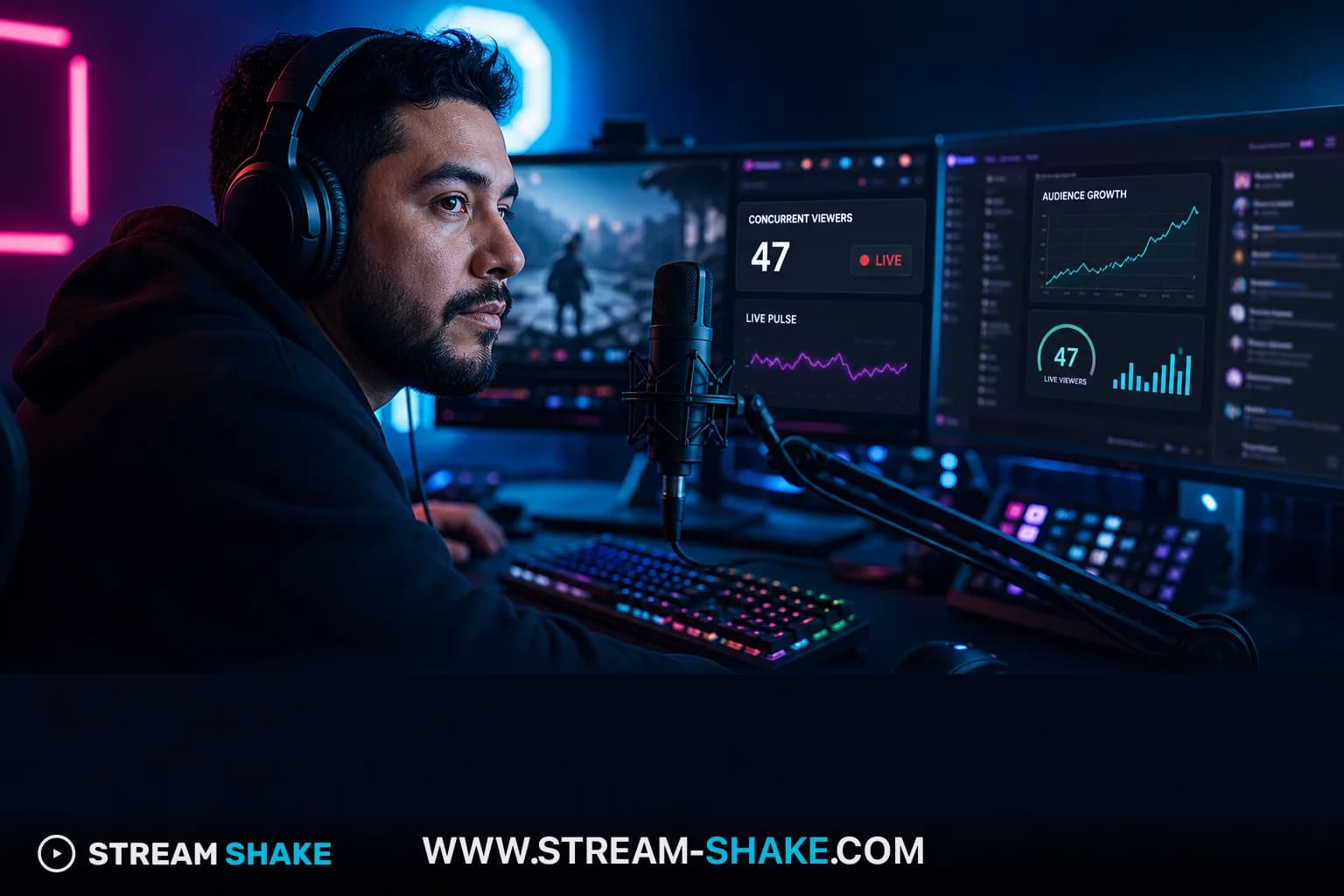
The global live streaming market is projected to reach $62.4 billion in 2026, with Twitch navigating a pivotal era defined by aggressive competitors and sophisticated AI. Success now demands strategic digital marketing, leveraging multi-platform funnels and lawful engagement networks to bypass algorithmic cold starts. This report analyzes the most watched streamers, evolving policies like CCV caps and relaxed simulcasting, and crucial differences between hazardous viewbotting and legitimate growth methods.
The Apex Creators: Analyzing the Most Watched Twitch Streamers#
To understand how to grow on a platform, one must first analyze the creators who currently dominate its attention economy. In 2026, the data indicates that the highest echelons of Twitch viewership are controlled by creators who have mastered either unparalleled event-driven spectacle or intense, hyper-focused gameplay scheduling.
The Reign of Event-Driven Personalities
At the absolute pinnacle of Twitch's traditional broadcasting hierarchy sits Kai Cenat. By late 2025 and early 2026, Cenat surpassed industry veterans like Ninja and Ibai Llanos to become the most-followed streamer on Twitch, approaching a historic 20 million followers. His dominance is not merely a product of consistent broadcasting, but rather the execution of massive, high-production cultural events.
“By featuring surprise appearances from global icons, such as NBA superstar LeBron James, Kai Cenat elevated his stream from a standard gaming broadcast into a global entertainment spectacle.”
His trajectory highlights a core reality of the 2026 landscape: the absolute top tier of Twitch operates more like a traditional television network than a grassroots gaming channel. Similarly, Spanish creator Ibai Llanos continues to command massive audiences through highly produced events, previously holding the concurrent viewership record with over 5.1 million live viewers during his La Velada del Año boxing events, a benchmark that soared even higher to 9.33 million concurrent viewers at La Velada del Año V.
The Ascendance of Niche Gameplay and Anonymity
Conversely, the data from early 2026 reveals a fascinating counter-trend: the sheer volume of watch hours can be dominated by highly disciplined, niche-focused creators who lack the mainstream celebrity of Cenat. In January 2026, the most-watched channel on Twitch by total watch hours (11.35 million hours) belonged to "TheBurntPeanut".
TheBurntPeanut is an anonymous Virtual YouTuber (VTuber—a creator who uses a digital avatar instead of a webcam) who focuses almost exclusively on extraction shooters, particularly the game ARC Raiders. He outpaced massive legacy creators like Asmongold (zackrawrr), Caedrel, and HasanAbi. The synthesis here is crucial for emerging streamers: TheBurntPeanut did not achieve dominance through celebrity cameos, but through a deeply reliable, highly disciplined streaming schedule centered on a specific gaming niche.
Other top performers reflect this strategy of specialized dominance:
- **Marc 'Caedrel' Lamont** anchors the *League of Legends* ecosystem, translating his professional casting background into massive peak viewership (reaching over 224,000 peak viewers in early 2026 and crossing 100 million hours watched overall in 2025).
- **Nicholas 'Jynxzi' Stewart** captured vast audiences by pivoting strategically between highly competitive games like *Rainbow Six Siege* and *Rocket League*. In the first half of 2026, Jynxzi achieved an astonishing all-time peak viewership of 417,711 concurrent viewers on May 11, drawing over 9.21 million hours watched in a 30-day window and boasting an average of 47,899 live viewers alongside his massive 10.1 million follower base.
- **Hasan 'HasanAbi' Piker** continues to command the political commentary space. By early 2026, he drove 5.8 million hours watched within a 30-day period, holding an average of 27,039 viewers. His broadcasts hit extraordinary heights, such as an all-time peak of 357,084 concurrent viewers in February 2026, securing his 3.05 million follower count.
- **Zack 'Asmongold'** (streaming largely under 'zackrawrr' and 'Asmongold247') perfectly illustrates the power of unmonetized "alt-channels" and multi-streaming. In Q2 of 2025 alone, his cross-platform streams garnered 28.58 million hours watched. On his primary active channel (*zackrawrr*), he holds an all-time peak of 311,167 viewers, logging an average of 33,659 viewers and 5.86 million hours watched in just 30 days, serving 2.37 million followers. Concurrently, his *Asmongold247* VOD-replay channel quietly adds 1.28 million watch hours per month with a smaller peak of 10,381 viewers.
The AI and Virtual Broadcaster Revolution
Perhaps the most radical shift in the 2026 'most watched' demographics is the permanent establishment of VTubers and Artificial Intelligence (AI) broadcasters as top-tier talent. Beyond TheBurntPeanut, VTubers as a collective demographic have emerged as some of the most-watched content producers among American audiences.
This trend reached a technological milestone in January 2026 when 'Neuro-Sama,' an AI-powered VTuber, shattered Twitch engagement records by driving a Hype Train to over 262,000 subscriptions. This data point is a powerful indicator that audience retention on Twitch is no longer strictly dependent on human charisma; interactive novelty, algorithmic responsiveness, and unique format innovations can compete directly with traditional, human-led content.
The Competitor Matrix: Twitch vs. YouTube Gaming vs. Kick#
Twitch’s internal creator dynamics do not exist in a vacuum. In 2026, the live streaming market is fiercely contested. While Twitch remains the largest single platform—commanding over 240 million Monthly Active Users (MAUs), 35 million Daily Active Users (DAUs), and maintaining a daily average of 2.55 million concurrent viewers across 7.3 million monthly active streamers—its historical near-monopoly has fractured. Analysts report that Twitch's share of global live streaming watch hours dropped from 70% in recent years down to a range of 52.8% to 60.3% (solidifying around 54%) by the first quarter of 2026. This decline is directly correlated with the aggressive expansion of YouTube Gaming and Kick.
Platform Specifications Summary (2026)
| Market Share (Hours Watched) | ~54% (19.2B hours) | ~24% (8.8B hours) | ~11% (4.5B hours) |
|---|---|---|---|
| User Base | 240M MAU / 35M DAU | 2.53B–2.7B Global / 800M Gaming MAU | 57M Registered Users |
| Creator Revenue Split | 50/50 Subs (60/40 or 70/30 on Partner Plus) | 70/30 Fan Funding, 55% AdSense | 95/5 Subscriptions |
| Core Architecture | Live-First Directory | VOD-First Algorithm | Live-First Directory |
| Moderation Stance | Strict / Brand-Safe | Moderate / Brand-Safe | Permissive (Casino/Gambling heavy) |
YouTube Gaming: The VOD and Ad-Tech Engine
YouTube Gaming has steadily climbed to capture approximately 23% to 24.3% of the live streaming market, totaling 8.8 billion hours watched in 2025 and accelerating into 2026. While Twitch owns 240 million MAUs, YouTube operates on a vastly larger global scale with 2.53 to 2.7 billion users total, of which an estimated 800 million are unique monthly gaming viewers.
YouTube's primary advantage over Twitch is its fundamental architecture: it is a Video on Demand (VOD) platform first. For creators, this means that live streams immediately convert into searchable, monetizable long-form videos, creating passive income—a feature Twitch historically lacks. In terms of revenue, YouTube Gaming provides a 70/30 split on fan funding (Channel Memberships and Super Chats—a feature where viewers pay between $1 and $500 to pin colorful, prominent messages at the top of the chat) and a 55% share to the creator for ad revenue, with AdSense RPMs generally ranging from $1 to $8.
Furthermore, in April 2026, YouTube introduced highly sophisticated, AI-driven 'Engagement-Sensing Ad Suppression.' A core tension in live streaming is that forced advertisements often interrupt critical broadcast moments, driving viewers away. YouTube’s new system uses artificial intelligence to sense peaks in live chat activity, automatically pausing ads for all viewers during high-engagement moments. Additionally, viewers who purchase virtual items (like Super Chats) trigger personalized ad-free windows. By treating viewer attention as a delicate variable to be optimized rather than a constant resource to be extracted, YouTube is actively attempting to solve the monetization friction that has long plagued Twitch.
Kick: Aggressive Splits and Brand Safety Tensions
The most disruptive force in the 2026 streaming market is Kick. Backed by the founders of the cryptocurrency casino Stake.com, Kick exploded from near-zero to capturing over 11% to 12.4% of the global live streaming market, officially crossing 57 million registered users (and moving toward 100 million) by April 2026.
Kick’s aggressive growth is fueled by a singular, market-breaking economic policy: a 95/5 subscription revenue split in favor of the creator. In stark contrast, Twitch generally offers a 50/50 split, which only increases to 70/30 for creators who qualify for the restrictive Partner Plus Program. Kick's model allows mid-tier creators to earn significantly more absolute revenue with a smaller audience. Quantitatively, a creator with 1,000 paid subscribers on Twitch takes home roughly $2,500 a month, whereas that identical 1,000-subscriber base on Kick yields approximately $4,750 a month.
However, Kick represents a complex trade-off regarding brand safety and moderation. The platform heavily features 'Slots & Casino' streams and operates with a significantly looser moderation framework compared to Twitch. Investigations by internet safety groups have highlighted elevated risks for minors on Kick, noting higher densities of mature themes and less stringent behavioral enforcement. Consequently, while Kick is highly lucrative for creators willing to tolerate a volatile environment, Twitch remains the preferred destination for 'brand-safe' advertising budgets and mainstream sponsorships (which now top $4.8 billion globally).
The 2026 Viewbotting Crisis and Twitch's CCV Cap Policy#
As the competition for viewers intensifies, the incentives for creators to manipulate the system have skyrocketed. Twitch organizes its directories primarily by Concurrent Viewers (CCV); a channel with zero viewers is mathematically invisible, buried at the bottom of the Browse page, while a channel with 50 viewers appears credible and attracts organic clicks. This architectural flaw birthed the black market of viewbotting—the use of automated scripts, proxy networks, and fake accounts to artificially inflate a stream’s CCV.
The Escalation of Artificial Engagement
By late 2025 and early 2026, the viewbotting industry had become highly sophisticated. Services like Viewbot.tv began utilizing advanced rotating proxy networks to bypass standard IP bans, combining fake viewership spikes with AI-driven chatbots that simulate human conversation. A whitepaper published by Streams Charts revealed a startling statistic: in Q2 2025, at least 10% of Twitch accounts averaging 50 or more viewers displayed persistent signs of viewbotting.
This artificial engagement represents an existential threat to Twitch. It distorts the discovery algorithm, allowing cheaters to suppress honest creators, while simultaneously defrauding advertisers who pay for human impressions. The stakes are massive; the global macro-economic race for AI compute power underscores how valuable digital platform integrity and data processing have become. Twitch cannot afford to sell bot traffic to advertisers in a hyper-competitive, $62.4 billion digital ecosystem.
Dan Clancy's CCV Caps: The Blunt Instrument
On May 7, 2026, Twitch CEO Dan Clancy announced a radical shift in enforcement policy. Acknowledging that traditional bans and real-time algorithmic purges were failing—because bot developers instantly patched their software to bypass Twitch's updates—Clancy introduced a system of punitive CCV Caps.
Under this new framework, if Twitch’s machine learning systems identify a channel as persistently viewbotting, the platform does not immediately ban the creator. Instead, Twitch quietly applies a hard cap to the streamer's displayed CCV across all Twitch surfaces (directories, search, and the channel page). This cap is dynamically generated based on Twitch's historical data regarding that specific creator’s legitimate, non-viewbotted traffic.
The synthesis of this policy is profound: Twitch shifted from attempting to perfectly detect bots in real time to directly neutralizing the psychological and algorithmic benefits of cheating. If a streamer pays for 1,000 bot viewers, but their CCV cap restricts their public display to their organic baseline of 40 viewers, the financial incentive to purchase bots is destroyed.
The Risks of Weaponized Suspicion and 'Hate-Botting'
While theoretically sound, the CCV cap policy has triggered severe anxiety among streamers regarding the 'weaponization' of viewbots. Because anyone can send viewbots to any public channel, malicious actors can flood a rival’s stream with artificial traffic to trigger penalties—a practice known as 'hate-botting.'
A highly illustrative real-world example of this vulnerability occurred on February 21, 2026, when prominent political streamer HasanAbi became the target of a massive hate-botting attack. His viewership was artificially and violently spiked to 356,000 peak viewers by malicious third parties. While Hasan was large enough to weather the incident, Kick CEO Edward Craven publicly criticized Twitch's new capping policy using exactly this vulnerability. Craven argued that smaller creators who are victims of hate-botting could have their growth algorithmically capped for weeks through no fault of their own, as the automated systems struggle to differentiate between a streamer buying bots and a streamer under attack. Although Twitch claims its systems can differentiate between the two, the opacity of the enforcement process leaves legitimate creators terrified of sudden algorithmic throttling.
Furthermore, a CCV cap acts as a 'scarlet letter.' If a channel historically spikes to 2,000 viewers during prime time, but suddenly stagnates at an unnatural, mathematically flat 200 viewers despite active chat, the community will instantly deduce that the streamer has been penalized. This introduces a chilling effect on legitimate marketing efforts, as sudden organic spikes from viral TikTok videos or large raids might trigger automated suspicion.
The Multistreaming Paradigm and the Fall of the Combined Chat Ban#
Given the competitive pressures and the volatility of platform policies, successful streamers in 2026 are increasingly adopting a multi-platform approach, known as simulcasting or multistreaming. In late 2023, Twitch revised its Terms of Service to officially allow all creators—including Affiliates and Partners without exclusive contracts—to simultaneously broadcast to platforms like YouTube Gaming and Kick. However, Twitch maintained strict quality-parity rules: a creator’s Twitch stream could not be of lower audiovisual quality than their broadcast on competing platforms, and creators were strictly forbidden from providing links that directed Twitch viewers to leave for another site.
The Gigguk Incident and the Reversal of the Chat Rule
The most contentious simulcasting rule was the prohibition against 'combined chat.' Twitch explicitly forbade broadcasters from using third-party software to merge the chat feeds of YouTube, Kick, and Twitch into a single, unified on-screen overlay. Twitch argued this was necessary to protect the platform's culture and maintain moderation standards, as Twitch moderators could not ban offensive users originating from YouTube or Kick.
The breaking point occurred in early 2026 when prominent creator Gigguk received a formal enforcement warning from Twitch for displaying a merged chat overlay during a joint broadcast. The community backlash was swift and severe, highlighting that the rule forced multi-platform communities into fragmented, isolated silos.
In a surprising pivot during a Patch Notes broadcast in February 2026, CEO Dan Clancy announced that Twitch would suspend enforcement actions against combined chat overlays. Streamers are now free to use unified chat widgets to bridge their audiences across Twitch, Kick, and YouTube. However, this freedom comes with a strict caveat: the broadcaster remains wholly responsible for the content displayed on their stream. If a YouTube viewer types a ToS-violating slur and that message appears on the Twitch broadcast via the unified overlay, Twitch will hold the broadcaster accountable, potentially issuing a channel strike or suspension. Consequently, while combined chat is now permitted, it necessitates rigorous, cross-platform automated moderation tools.
The 'Cold Start' Problem and Lawful Growth Tactics#
Understanding policies and market share is only the prerequisite; the functional challenge for any creator in 2026 is overcoming Twitch's brutal discoverability mechanics. The Twitch recommendation engine rewards three primary signals: schedule regularity, CCV stability, and chat-engagement density. However, this creates a paradox known as the 'cold start' problem. To get organic recommendations, you need viewers; to get viewers, you need organic recommendations. Because directories sort by viewership, a streamer with zero to three viewers is essentially invisible.
The Off-Platform Funnel Strategy
In 2026, the consensus among growth experts is that the 'go live and grind' methodology is entirely dead. Twitch is no longer a platform where creators *find* an audience; it is a conversion engine where creators *monetize* an audience built elsewhere.
- Top of Funnel (Discovery): Generate short-form vertical content (TikTok, YouTube Shorts, Instagram Reels) with a 'clip-first' mindset. Use AI clipping tools like OpusClip or Eklipse to create high-stakes, 3-second hooks that stop doom-scrolling users.
- Middle of Funnel (Nurturing): Engage viewers off-stream using Twitch Stories for daily updates and Discord for community events, keeping your channel top-of-mind before the next broadcast.
- Bottom of Funnel (Conversion): The live Twitch stream itself. Maintain consistent scheduling (3-4 days a week at the same time) to train algorithmic traffic to return predictably.
Strategic Niche Selection
A critical error new streamers make is broadcasting in saturated categories like *Fortnite* or *Valorant* with zero to five viewers, where they are statistically invisible. Instead, focus on building a loyal audience in smaller, less competitive categories. The goal is not to immediately compete with top streamers, but to achieve discoverability within a smaller pond, then scale upwards.
The Twitch Affiliate status requires an average of 3 concurrent viewers over a 30-day period, alongside 50 followers and 500 total minutes broadcast over 7 unique days. Achieving this benchmark unlocks basic monetization and community features. Lawful engagement networks, such as Stream Shake, facilitate authentic, ToS-compliant mutual viewing, offering a vital bridge for emerging creators to reach this critical threshold without resorting to viewbotting or 'Follow for Follow' schemes.
Glossary#
The Top Echelon: The Most Watched Twitch Streamers of 2026#
To understand how to grow on Twitch, one must first study the broadcasters who have successfully captured and monetized the largest audiences. The top tier of Twitch in 2026 is divided primarily into two distinct success models: the Event-Driven Entertainer and the Niche-Disciplined Grinder.
Follower Titans and Event-Driven Entertainment
At the absolute apex of Twitch's cultural footprint are the follower titans—creators whose broadcasts transcend traditional gaming to become global entertainment events. The most prominent example is American streamer Kai Cenat. Despite taking an extended hiatus, Cenat became the first streamer in Twitch history to cross the 20 million follower threshold. His growth is driven by massive, high-production 'subathons' like 'Mafiathon 3,' which generated over 85 million hours watched and secured over 1.1 million active subscribers. By integrating mainstream celebrity culture with guests such as Snoop Dogg and Serena Williams, Cenat successfully bridged the gap between internet culture and traditional media. His success demonstrates that for the absolute top tier, Twitch is no longer just a gaming platform, but a live, interactive reality television network.
Closely following Cenat are established international giants. Spanish streamer Ibai Llanos commands 19.8 million followers, with viewership peaks during highly orchestrated events like his annual 'La Velada del Año' boxing livestreams. To maintain parity, Ibai's channel averages 35 million watch hours monthly and secures over 250,000 active subscribers. Rounding out the historical top three is Richard Tyler Blevins, known as Ninja, who maintains 19.3 million followers, relying on a legacy gaming model featuring *Fortnite* and *Valorant* grinds, averaging 5 million watch hours monthly.
The Hours-Watched Leaders: Niche Discipline
A more analytical metric for evaluating day-to-day Twitch dominance is "Hours Watched." This metric highlights streamers who maintain massive, highly engaged audiences over long, consistent broadcast schedules. In the first quarter of 2026, the most-watched streamer by hours was TheBurntPeanut, a VTuber specializing in extraction shooters like *ARC Raiders*, generating over 11.35 million average watch hours monthly. His success is anchored in an ironclad, disciplined schedule—often streaming up to nine hours a day, six days a week, securing over 85,000 active subscribers.
Other leaders in the Hours Watched category rely on deep expertise in specific competitive or commentary niches: Nicholas “Jynxzi” Stewart (expanding beyond *Rainbow Six Siege* to high-stakes 1v1 competitive matchups), Marc “Caedrel” Lamont (a former professional esports caster dominating the *League of Legends* ecosystem), and Hasan “HasanAbi” Piker & Zack “zackrawrr” (Asmongold) who both dominate the platform through political and social commentary respectively.
| Streamer | Followers | Peak/Avg Watch Hrs (Mo) | Active Subs | Est. Revenue | Niche & Model | Content Example |
|---|---|---|---|---|---|---|
| Kai Cenat | 20.1M | 85M / 110M | 1.1M+ | $3.2M+ | Event-Driven (IRL, Celebrity Collabs) | Mafiathon 3 (w/ Snoop Dogg) |
| Ibai Llanos | 19.8M | 35M / 90M | 250K+ | $800K+ | Event-Driven (Sports, Boxing) | La Velada del Año |
| Richard 'Ninja' Blevins | 19.3M | 5M / 10M | 20K+ | $100K+ | Legacy Gaming (Multi-game) | Fortnite / Valorant grinds |
| TheBurntPeanut | 3.5M | 11.35M / 15M | 85K+ | $300K+ | Niche-Disciplined (VTuber, Shooters) | ARC Raiders extraction loops |
| Nicholas 'Jynxzi' Stewart | 7.2M | 10M / 14M | 120K+ | $450K+ | Niche-Disciplined (Competitive) | Rocket League 1v1 Tournaments |
| Marc 'Caedrel' Lamont | 2.8M | 8M / 20M (Peak) | 60K+ | $200K+ | Esports Commentary | League of Legends Co-casting (220k peak viewers) |
| Hasan 'HasanAbi' Piker | 3.1M | 7M / 12M | 55K+ | $180K+ | Political Commentary | Just Chatting debates |
| Zack 'zackrawrr' (Asmongold) | 3.8M | 6M / 10M | 0 (No sub button) | Ad & Sponsor heavy | MMO & Social Commentary | WoW / FFXIV reaction streams |
The synthesis of this data provides a clear directive for emerging creators: If you do not have the budget to host Kim Kardashian, you must become the undisputed authority in a specific niche—whether that is a specific extraction shooter, esports commentary, or specialized "Just Chatting" debates. The recommendation engine heavily rewards schedule regularity, concurrent-viewer stability, and chat-engagement density.
The Risks of Outdated and Artificial Growth Tactics#
Beyond malicious viewbots, many new streamers fall victim to outdated, highly inefficient growth tactics born out of desperation. Understanding why these fail is crucial before implementing systems that actually work.
The Follow-for-Follow (F4F) Fallacy
For years, beginner streamers have populated Reddit, Discord, and Facebook groups offering "Follow for Follow" (F4F) or "Lurk 4 Lurk" arrangements. The premise is to inflate follower metrics, theoretically accelerating the path to Twitch Affiliate status. However, the reality of F4F is starkly negative:
- **It Violates Terms of Service:** Twitch explicitly categorizes F4F networks as "artificial engagement," risking indefinite account suspension.
- **It Destroys Analytics:** A follower who does not watch your content is mathematically detrimental. Brands and sponsors in 2026 ignore follower counts entirely, looking only at Average Concurrent Viewers (ACV) and chat engagement metrics.
- **It Fosters a Selfish Economy:** F4F participants are not genuine fans; they are transactional actors seeking to boost their own numbers and will not genuinely engage or return.
The Psychological Toll and "Cozy" Burnout
Desperate growth tactics often intersect with severe psychological strain. The global "cozy gaming" market, driven by a demographic seeking low-stress entertainment, is projected to reach $1.47 billion by 2032. While this niche appears relaxing, the intimate nature of cozy streaming carries significant mental health risks. When growth stagnates, streamers often increase their hours, leading to severe burnout, emotional dependency on chat validation, and the heavy burden of managing viewers' emotional crises. Sustainable growth requires setting strict chat boundaries and relying on automated, ethical promotional systems rather than sheer exhaustive willpower.
- VOD
- Video on demand — the replay of your stream after you go offline. Separate from live viewer counts.
- Twitch Affiliate
- The first Twitch monetisation milestone — still driven by real viewers and stream consistency, not bought metrics.
Frequently Asked Questions#
Who are the most watched Twitch streamers in 2026?
In 2026, top streamers include event-driven personalities like Kai Cenat and Ibai Llanos, alongside niche-focused creators such as TheBurntPeanut (VTuber), Jynxzi, HasanAbi, and Asmongold. AI-powered VTubers like Neuro-Sama have also gained significant viewership.
What is Twitch's new CCV cap policy?
Twitch introduced a punitive Concurrent Viewership (CCV) cap policy in May 2026. If a channel is suspected of viewbotting, Twitch quietly limits the displayed CCV to the streamer's historical legitimate traffic, effectively neutralizing the benefits of buying fake viewers.
Can I simulcast on Twitch, YouTube, and Kick?
Yes, Twitch has relaxed its simulcasting rules. Creators can now broadcast simultaneously to other platforms and use unified chat overlays. However, broadcasters remain responsible for all content displayed on their stream, including messages from other platforms.
How can new streamers grow on Twitch in 2026?
New streamers should adopt an 'off-platform funnel' strategy, focusing on short-form content for discovery (TikTok, YouTube Shorts), nurturing communities on Discord, and maintaining consistent Twitch schedules for conversion. Strategic niche selection and lawful engagement networks are also crucial.
What are the differences between Twitch, YouTube Gaming, and Kick?
Twitch remains dominant (~54% market share) but faces competition from YouTube Gaming (~24%) and Kick (~11%). YouTube excels in VOD integration and AI-driven ad suppression. Kick offers a lucrative 95/5 subscription split but has looser moderation and brand safety concerns, in contrast to Twitch's stricter brand-safe environment.
Why is 'Follow-for-Follow' (F4F) bad for Twitch growth?
Follow-for-Follow (F4F) is detrimental because it violates Twitch's Terms of Service, risks account suspension, and destroys channel analytics. Followers gained through F4F do not genuinely engage with content, leading to a low Average Concurrent Viewer (ACV) ratio which negatively impacts discoverability and attractiveness to sponsors.