
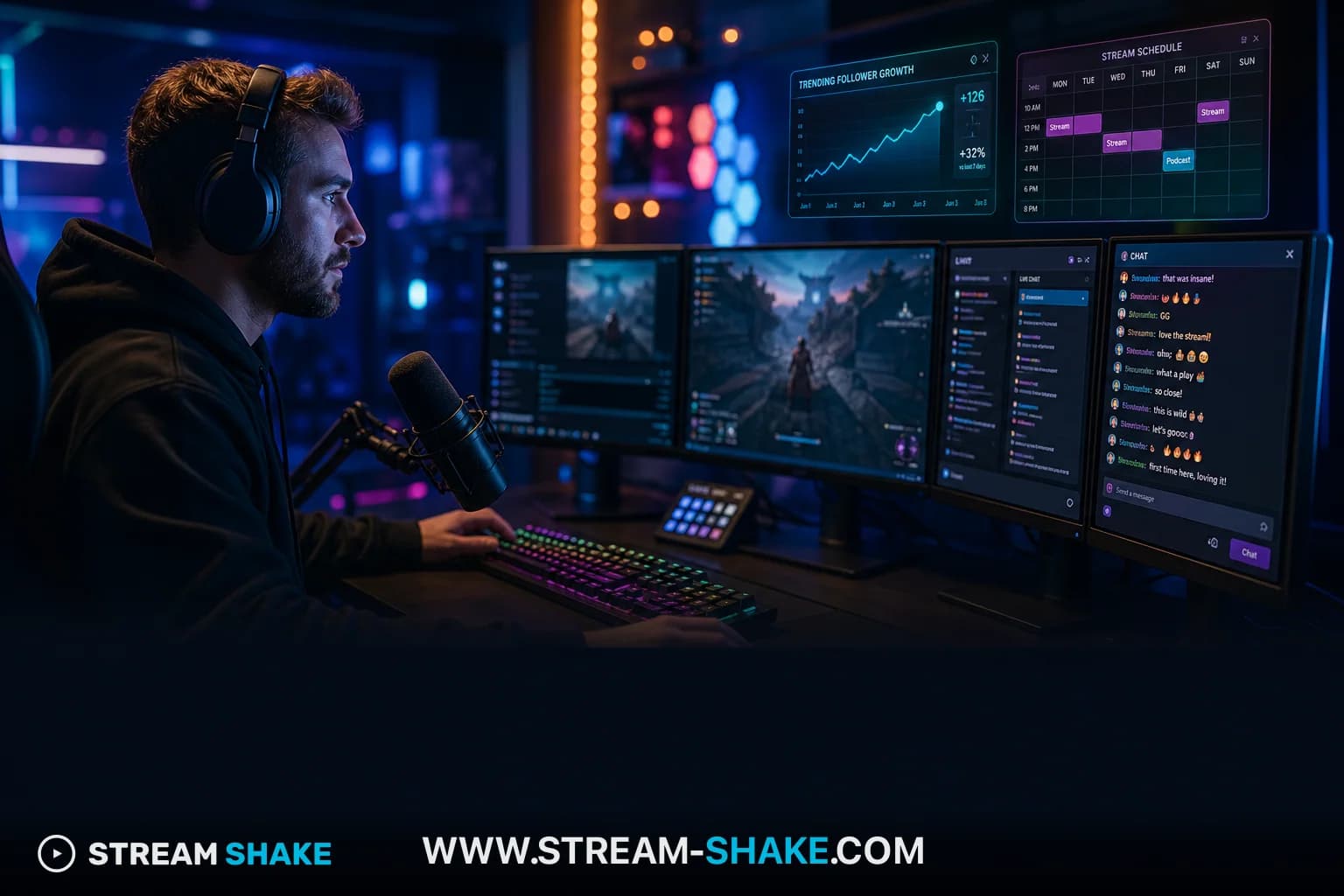
Entering the Twitch broadcasting space in 2026 presents both unprecedented opportunities and significant challenges. New streamers must navigate a hyper-competitive landscape, understanding evolving platform algorithms, updated Terms of Service (ToS), and new monetization structures to build a sustainable audience.
The 2026 Streaming Landscape: Statistical Realities and Market Share#
To understand how to grow as a new Twitch streamer, one must first analyze the macroeconomic environment of the live-streaming industry. Twitch has evolved dramatically since its inception as a casual gaming site, maturing into a multi-billion-dollar creator economy with complex viewer demographics and intense competition.
Platform Viewership and Demographics
The scale of Twitch in 2026 is massive, but the distribution of viewership is highly unequal. Understanding these metrics is vital for setting realistic growth expectations.
240M+
Twitch MAUs
Monthly Active Users platform-wide
609M
Gaming Viewers
Monthly active viewers in live game streaming
35M
Daily Logins
Users logging in daily on Twitch
7.3M
Active Channels
Average monthly active streaming channels
2.55M
Avg. CCV
Average concurrent viewers at any given moment
19.2B
Hours Watched (2025)
Total hours of content consumed on Twitch
The implications of these statistics are stark. The average Twitch stream has about 7.4 concurrent viewers, but this figure is heavily skewed by the top 5% of mega-creators who absorb the vast majority of the platform's attention. For a new streamer, this creates the dreaded "discoverability trap." Twitch's recommendation algorithm inherently favors streams that already show activity. Consequently, millions of smaller streamers compete for a handful of organic clicks, making external marketing and structured growth networks essential for survival.
Evolving Platform Policies: The Simulcasting Revolution#
For years, Twitch maintained strict exclusivity clauses that prevented creators from broadcasting to competing platforms simultaneously. While the foundational ban on simulcasting was lifted in October 2023, a highly restrictive caveat remained: streamers were strictly prohibited from displaying "merged" or "combined" chat overlays on their Twitch broadcasts. This created a fractured experience and operational anxiety for multi-platform creators.
The Death of the Unified Chat Ban
The turning point occurred in early 2026, following widespread community backlash. In a pivotal announcement during *Patch Notes Ep43* in February 2026, Twitch CEO Dan Clancy officially reversed this policy. Acknowledging that unified chats create a better "meeting place" for audiences, Twitch formally updated its enforcement guidelines, granting creators the green light to display messages from YouTube, Kick, and other platforms directly on their Twitch overlay. This policy shift represents a monumental victory for smaller streamers.
The COPPA Liability Trap
However, the unified chat era introduces complex new legal liabilities, most notably regarding the **Children's Online Privacy Protection Act (COPPA)**. If a streamer's YouTube broadcast is flagged as "Made for Kids" but uses a unified overlay that pulls those users' data into a Twitch stream rated for general audiences, they risk bypassing federal safety protections.
Actionable COPPA Synchronization Procedure
Monetization for All: Twitch's Radical 2026 Economy Shift#
Historically, Twitch locked its monetization tools behind the "Affiliate" milestone, requiring new creators to stream purely as a hobby until they cleared specific statistical hurdles. In 2026, Twitch fundamentally restructured this economy to remain competitive against aggressive rivals.
The Lowered Affiliate Threshold
In early 2025, Twitch streamlined the canonical requirements to reach Affiliate status, making the program vastly more accessible. To qualify for the Twitch Affiliate Program in 2026, a creator must achieve four metrics within a rolling 30-day window:
25
Followers
Reduced from the legacy 50-follower threshold
4 hours
Streaming Time
Total streaming time
4
Broadcast Days
Unique broadcast days
3
Avg. CCV
Average Concurrent Viewers across broadcast days
While the follower, hour, and day requirements are easily achievable through consistency, the **3 Average Concurrent Viewers** metric remains the primary bottleneck that halts most new creators.
Pre-Affiliate Monetization Tools
In a massive structural change launched on May 13, 2026, Twitch announced its "Monetization for All" initiative. Acknowledging the grueling effort required to build a community from zero, Twitch un-gated its most powerful interactive tools—including Bits, Subscriptions, Emotes, Badges, and Channel Points—making them available to *all* eligible streamers globally from day one.
The War on Artificial Engagement: Viewbots vs. The CCV Cap#
As streamers struggle to achieve the 3 CCV Affiliate requirement and climb the highly saturated directory rankings, some turn to illicit shortcuts, such as **viewbotting**. This is the use of illegitimate, automated third-party scripts to artificially inflate a channel's concurrent viewer count, mimicking human traffic to cheat the discovery algorithm.
Dan Clancy's 2026 CCV Cap Enforcement
On May 7, 2026, Twitch CEO Dan Clancy announced the platform's most aggressive, and controversial, anti-botting measure to date: the **CCV Cap**. Rather than relying solely on endless account bans, Twitch implemented a blunt instrument to neutralize the benefit of cheating.
The Danger of Weaponized Suspicion
While widely praised as a necessary step to protect honest creators and advertisers, the CCV Cap policy has sparked immediate dread within the community due to the risk of "weaponized suspicion."
“During a stream, Kitsaniro's dashboard displayed 1,195 viewers; however, when she attempted to "raid" to another channel, only 277 viewers actually carried over. This proved that roughly 900 viewers were malicious bots forcefully injected into her stream.”
Lawful Growth Tactics: Beating the Discoverability Trap#
If viewbots result in CCV caps and algorithmic suppression, how does a new streamer legally overcome the "empty room" penalty? Growing a Twitch channel in 2026 is fundamentally a discoverability problem. The platform's recommendation engine heavily weights three specific signals: schedule regularity, concurrent-viewer stability, and chat-engagement density. Channels that optimize for these three vectors move up the Browse page.
1. Niche Selection and Consistency
Variety streaming as a beginner is an almost guaranteed path to failure in 2026. The algorithm cannot categorize random content. Creators must lock into a tight niche with a repeatable show format, such as "Viewer Challenges Fridays" or indie speedruns. Schedule regularity is mathematically weighted higher than raw stream hours; consistency trains both the human audience and the Twitch algorithm to expect activity.
2. The Short-Form Content Engine
Twitch's internal discoverability for new channels remains incredibly weak. Therefore, off-platform traffic generation is mandatory. The most effective 2026 growth loop is the Short-Form Content Engine, utilizing specialized AI clipping platforms to isolate and format high-retention moments.
One viral clip processed through these engines can drive more organic traffic to a Twitch channel in a day than months of grinding to an empty directory.
3. Lawful Mutual Viewing: The Stream Shake Ecosystem
4. Interactive Extensions and Retention
Once Stream Shake delivers real viewers to the broadcast, the streamer must retain them. In 2026, passive broadcasting is obsolete. The most successful channels utilize **Twitch Extensions** and third-party bots—sandboxed web applications embedded directly into the video player or chat client.
By turning passive lurkers into active co-authors of the stream, these tools raise average watch time by roughly 25% to 27%. Furthermore, the Bits-in-Extensions economy operates on a highly favorable 80/20 split (80% to the streamer, 20% to the developer), providing an immediate monetization vector for highly engaged, small audiences.
The Competitor Matrix: Twitch vs. YouTube Gaming vs. Kick#
While Twitch remains the dominant player, a comprehensive strategy for new streamers in 2026 must involve understanding the strengths and weaknesses of its main competitors and embracing aggressive simulcasting. This multi-platform approach leverages Twitch for its robust community alongside YouTube Gaming for its powerful VOD algorithm, and carefully evaluates Kick's high-risk, high-reward revenue split. (Note: Research report truncated at this point for article prompt.)
Glossary of Streaming Terms#
Frequently Asked Questions#
How can new streamers get discovered on Twitch in 2026?
New streamers must focus on off-platform traffic generation, primarily through short-form content engines (like Streamladder or OpusClip) and participating in lawful mutual viewing networks like Stream Shake. On-platform, consistent scheduling and niche selection are crucial.
What is the Twitch CCV Cap and how does it affect new streamers?
The CCV Cap is Twitch's 2026 anti-botting measure. It artificially limits a channel's visible concurrent viewer count based on its historical legitimate traffic if viewbotting is detected. This means viewbotting is ineffective and can be a career-ending risk, even for innocent streamers targeted by 'hate-botting'.
Can new Twitch streamers make money before becoming an Affiliate?
Yes, as of May 2026, Twitch's 'Monetization for All' initiative allows non-Affiliate streamers to receive Bits and Subscriptions from day one. However, these funds are locked as 'Spendable Balance' and cannot be cashed out until the streamer achieves Affiliate status (which requires 3 average concurrent viewers).
Is simulcasting allowed on Twitch in 2026?
Yes, Twitch lifted its ban on unified chat overlays in February 2026, allowing streamers to display merged chats from platforms like YouTube and Kick. However, streamers must strictly synchronize age-designation tags across all platforms to comply with COPPA regulations and avoid severe penalties.
Sign up today and connect with real viewers, ethically.