
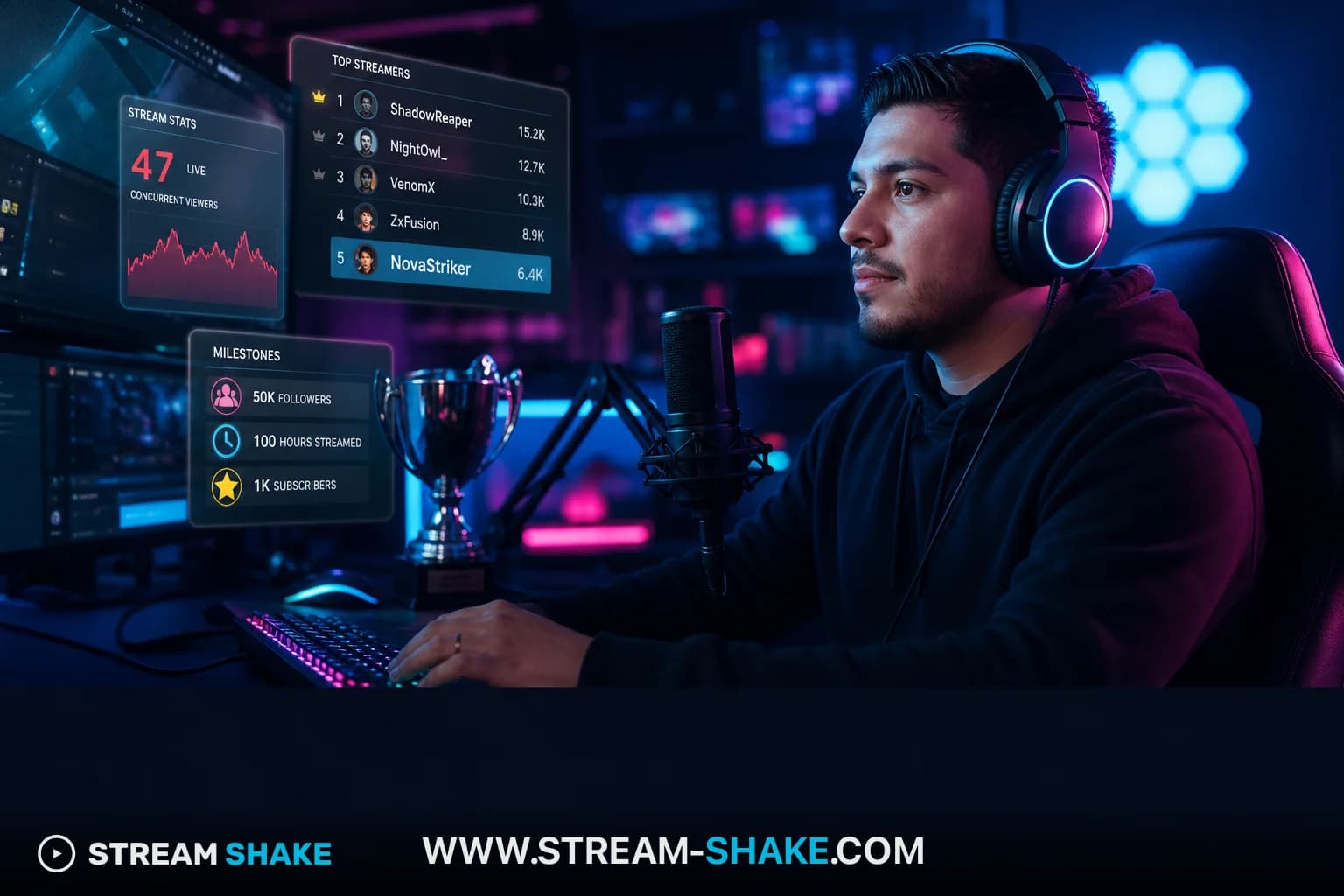
The digital broadcasting landscape of 2026 represents a highly matured, fiercely competitive entertainment industry. Twitch, long the undisputed hegemon of livestreaming, remains the cultural epicenter of internet broadcasting, boasting approximately 140 million Monthly Active Users (MAU). However, the mechanics of achieving and maintaining the coveted 'Top 1' status on the platform have evolved from relying on organic platform discovery to orchestrating massive, cross-platform spectacles. As streamers transition from isolated gamers into full-scale production studios, the metrics for success—followers, active subscribers, and concurrent viewers—fluctuate wildly based on event-driven subathons and strategic simulcasting.
This comprehensive report is designed for both emerging and veteran streamers, as well as analytical viewers, seeking to understand the intricate machinery behind Twitch's elite tier in 2026. By examining the trajectories of platform-defining creators, dissecting the latest policy updates regarding artificial engagement, exploring lawful growth accelerators, and analyzing the existential threat posed by competitors like Kick, this document serves as a master blueprint for navigating the modern streaming economy.
Executive Summary#
To successfully encapsulate the current state of Twitch's elite tier, this executive summary outlines the critical takeaways, addressing platform policies, statistics, real-world examples, engagement risks, lawful growth tactics, and competitor dynamics.
- **The definition of 'Top 1' is bifurcated:** In 2026, the pinnacle of Twitch is measured either by monumental subscriber records—such as Kai Cenat's unprecedented 1.11 million active subscriptions—or by sustained, cross-platform viewership metrics, as seen with VTuber phenomenon TheBurntPeanut.
- **Platform policies have fundamentally shifted:** As of early 2026, Twitch has abandoned outright bans for combined simulcast chats, while simultaneously launching sophisticated Concurrent Viewer (CCV) caps to shadow-penalize persistent viewbotting without providing feedback loops to bad actors.
- **The 'Go Live and Grind' era is dead:** Research overwhelmingly indicates that growing a modern Twitch channel requires a multi-platform content funnel, rigid scheduling, and strategic, ToS-compliant mutual viewing ecosystems to overcome algorithmic 'cold starts'.
- **Competitors are forcing economic evolution:** Kick's aggressive 95/5 revenue split has pushed the platform to 100 million registered users by April 2026, permanently altering streamer monetization expectations and normalizing simulcasting across rival platforms.
The Titans of Twitch: Profiling the Top Streamers of 2026#
To understand how to grow on Twitch, one must first analyze the creators who dictate the platform's ceiling. The title of 'Top 1 Twitch Streamer' is not monolithic; it is categorized by all-time follower counts, peak active subscriptions, and raw hours watched. The strategies employed by these apex creators reveal the changing tastes of global audiences.
The Follower Kings: Legacy vs. New Momentum
Historically, follower counts were the primary metric of a streamer's influence. However, in 2026, this metric represents a mix of historical legacy and explosive modern momentum. The upper echelon of Twitch followers is dominated by massive, event-driven creators.
20.2 Million
Kai Cenat
Followers, achieved during 'Mafiathon 3' (Sept 2025)
19.8 Million
Ibai Llanos
Followers, known for 'La Velada del Año' events
19.3 Million
Tyler 'Ninja' Blevins
Followers, legacy from 2018 Fortnite boom
While follower counts are impressive, they are often a trailing indicator of success. Ninja's presence on the list is a testament to platform history, whereas Kai Cenat and Ibai represent the modern meta: high-production, high-stakes event streaming. This data indicates that casual, daily gameplay is no longer sufficient to reach the platform's zenith; streamers must operate as event promoters and network television hosts to capture tens of millions of users.
The Economics of the Subathon: Shattering Subscriber Records
While followers demonstrate reach, active subscriptions represent real, immediate financial mobilization. A Twitch subscription—typically costing around $5.99 USD in tier-one countries—provides users with ad-free viewing and custom emotes, while directly funding the creator. The ultimate weapon for skyrocketing this metric is the 'Subathon' (Subscription Marathon), where every purchased subscription adds time to a continuously running live broadcast clock.
- **Ironmouse's Philanthropic Breakthrough (Sept/Oct 2024):** VTuber Ironmouse broke records with 326,252 active subscribers, cementing VTubing's mainstream viability.
- **Kai Cenat's 'Mafiathon 2' (Nov 2024):** Cenat aggressively shattered Ironmouse's record, concluding with an astonishing 728,535 active subscribers by featuring A-list celebrity guests.
- **The One Million Milestone (Sept 2025):** During 'Mafiathon 3,' Cenat broke the seemingly impossible seven-figure barrier, peaking at 1,112,947 active subscriptions, making him the most-subscribed creator in Twitch history.
The synthesis of these events reveals a critical evolution in streamer monetization. Subathons are no longer mere endurance tests; they are highly produced, capital-intensive reality shows. Cenat's success required elaborate advertising campaigns and celebrity leverage, effectively turning his stream into a pop-culture nexus. Meanwhile, Ironmouse proved that deep, parasocial community bonding and philanthropic causes can rival mainstream celebrity pull.
The Hybrid Vanguard: The Rise of TheBurntPeanut
While Cenat dominates event-based metrics, the day-to-day viewership charts of early 2026 have seen the meteoric rise of unconventional creators. By February 2026, a creator known as 'TheBurntPeanut' briefly topped the active subscriber leaderboard with 81,900 subs and led the platform in Q1 Hours Watched (over 8 million hours in a 30-day window). Trading a traditional facecam for a custom 3D peanut avatar, TheBurntPeanut created a new sub-genre known as 'P-Tubing'. By leveraging a rigorous schedule focused on extraction shooters like *ARC Raiders* and *Rust*, and seamlessly simulcasting across Twitch, Kick, and YouTube, he captured a massive, dedicated audience (with an estimated average concurrent viewership between 25,000 to 35,000). This proves that while massive events capture headlines, extreme consistency, unique digital branding, and multi-platform presence remain the bedrock of sustainable, top-tier daily viewership in 2026.
The Evolving Architecture of Twitch Policies in 2026#
As the financial stakes of livestreaming have escalated, so too have the attempts to artificially game the system. In response, Twitch's executive team, led by CEO Dan Clancy, implemented sweeping policy reforms in early 2026. These changes targeted both the malicious inflation of metrics and the restrictive rules that previously hindered multi-platform growth.
The War on Fake Engagement: CCV Caps
Viewbotting—the use of automated scripts to artificially inflate a channel's Concurrent Viewer (CCV) count—has plagued Twitch for years. Malicious actors use these bots to artificially propel their channels to the top of Twitch's Browse directories, hoping to capture organic viewers through false social proof. Prior to 2026, Twitch relied on massive 'ban waves', purging millions of accounts at once. However, this real-time detection created a feedback loop: bot makers would immediately see their bots banned, allowing them to tweak their code to bypass Twitch's algorithms.
Twitch's Stealth-Based CCV Enforcement Mechanism (May 2026)
- Statistical Historical Analysis: Twitch's machine learning now analyzes a creator's historical, non-botted traffic patterns instead of relying purely on real-time detection.
- The Invisible Ceiling: For channels identified as persistently utilizing viewbots, Twitch silently applies a CCV cap. Any traffic exceeding this historical baseline is simply ignored by the platform's public counters and ranking algorithms.
- Information Denial: Twitch purposefully refuses to publicly announce when a channel is capped. The offending streamer receives a private notification, but bot providers are left blind, unable to determine if their tools are failing or if the channel has been capped.
- Self-Service Capping: To protect innocent streamers who are the victims of 'hate-botting,' Twitch introduced a tool in the Stream Manager allowing creators to voluntarily cap their own CCV, ensuring their metrics remain authentic.
This paradigm shift demonstrates Twitch's acknowledgment that brute-force bans are insufficient against evolving AI and bot networks. By rendering the bots ineffective at altering public metrics, Twitch has fundamentally devalued the viewbotting industry.
The Simulcasting Renaissance: Unified Chat Approval
For years, Twitch strictly prohibited 'simulcasting'—broadcasting the same stream simultaneously to Twitch, YouTube, Kick, and other platforms. When they finally relented and allowed simulcasting, a highly controversial caveat remained: streamers were forbidden from merging the chat rooms of different platforms into a single on-screen overlay. Twitch argued this would degrade the native viewer experience. Streamers who violated this rule were hit with swift enforcement warnings and 24-hour bans.
- **The New Standard:** Streamers can now legally display a unified chat feed containing messages from YouTube, Kick, and Twitch on their broadcast video without fear of platform strikes.
- **The Moderation Caveat:** The suspension of the rule comes with a strict liability clause. Streamers are held entirely responsible for the content that appears on their stream. If a YouTube viewer types a message that violates Twitch's Terms of Service (ToS), and it appears on the Twitch broadcast overlay, the streamer's Twitch channel can still be banned.
This policy update has catalyzed a golden age of multi-streaming. Creators no longer have to fracture their communities; they can operate as platform-agnostic broadcasters, treating the stream overlay as a unified 'meeting place'.
Navigating the Risks: Fake Engagement vs. Authentic Growth#
In the desperate bid to escape the bottom of the Twitch directory, many novice creators fall into the trap of artificial engagement. It is vital to delineate between ToS-violating shortcuts and lawful, algorithmic growth accelerators.
The Pitfalls of Illegitimate Services
- **Viewbots and Follow-Bots:** Purchasing fake viewers or followers provides empty numbers that do not engage. When detected, Twitch will issue warnings, strip artificial followers, apply CCV caps, or permanently ban the account.
- **Follow 4 Follow (F4F) / Lurk 4 Lurk (L4L):** Twitch officially classifies coordinated F4F or L4L rings as 'fake engagement.' Services that require users to open dozens of unrelated, muted embedded streams to artificially inflate metrics are heavily penalized.
- **Security Threats:** Many illicit growth services require account login credentials, leading to rampant phishing, account hijacking, and subsequent bans for off-platform misconduct.
The Stream Shake Paradigm: Lawful Mutual Viewing
Conversely, the market has seen the rise of ToS-compliant promotional networks like Stream Shake. Designed specifically to combat the 'cold-start' problem—where a channel with zero viewers is completely ignored by Twitch's algorithm—Stream Shake operates on a lawful framework of mutual participation.
How Stream Shake Facilitates Lawful Growth
- Authenticated Peer Engagement: Stream Shake connects real, beginner streamers globally. Users earn points by actively watching and chatting in their peers' streams (with quality-control limits, such as a 5-character minimum for chat points).
- Algorithmic Priming: Streamers then spend these points to receive genuine viewers during the critical first hour of their own broadcast. Because these viewers are real, authenticated Twitch users (not bots or hidden embeds), they count legitimately toward Affiliate status and Browse directory ranking.
- ToS Compliance: Stream Shake does not use viewbots, shadowbans, or view-counter tricks. It functions as a networking hub, facilitating organic discovery and collaborations among creators who would otherwise be buried by the platform's top-heavy architecture.
By utilizing platforms like Stream Shake, creators can ethically boost their initial CCV, signaling to the Twitch algorithm that the stream is active, which in turn attracts organic, non-network viewers.
Strategic Lawful Growth Tactics for the Modern Streamer#
Reaching the heights of Kai Cenat or TheBurntPeanut is mathematically improbable for a new creator without a systematic approach. In 2026, organic discovery on Twitch is notoriously difficult; the platform is designed to convert and retain audiences, not necessarily to help new creators find them. To build a lawful, thriving channel, streamers must adopt a holistic 'Funnel Strategy'.
The Content Engine: Off-Platform Discovery
The 'Go Live and Grind' strategy—streaming to zero viewers for eight hours a day—is statistically dead. With over 41,200 channels live at any given moment, raw broadcast hours do not translate to visibility.
- **The 3-Second Hook:** Livestreams must be designed to generate highly engaging short-form vertical video. Clips cannot merely be 'funny moments'; they must start with intense stakes, a question, or a visual hook.
- **The Cross-Platform Funnel:** Streamers must export these clips daily to TikTok, YouTube Shorts, and Instagram Reels. A single viral clip on these platforms can funnel more organic viewers to a Twitch channel in one hour than months of grinding at the bottom of the Twitch directory.
- **Congruence:** The live stream must match the promise of the viral clip. If a YouTube Short advertises high-tier *Apex Legends* gameplay, the streamer cannot be sitting silently in the 'Just Chatting' category when the viewer arrives, or the bounce rate will be immediate.
Mastering the Twitch Algorithm
Once off-platform content and mutual viewing hubs like Stream Shake bring viewers to the door, the creator must satisfy Twitch's internal recommendation engine. The 2026 algorithm heavily weights three specific signals:
- **Schedule Regularity:** Twitch values predictability. Streaming for three hours on specific, scheduled days outperforms streaming fifteen random hours a week. The algorithm ranks channels higher when it can accurately predict returning viewership based on a set schedule.
- **Category Selection:** Streaming in the most popular categories (like *League of Legends* or *Just Chatting*) guarantees a new streamer will be buried. Creators must target 'tight niches' (defined mathematically as categories with fewer than 50 channels broadcasting live, but possessing over 1,500 total viewers) where high viewer engagement intersects with lower channel competition.
- **Interactive Density:** Twitch measures how many chat messages are sent per viewer. Silence is the enemy of retention. Streamers must narrate their gameplay constantly, even to an empty room, to ensure that when a viewer does arrive, they are greeted with an active, engaging environment.
Leveraging Twitch Extensions for Retention
To boost watch time and interactivity, elite streamers heavily utilize Twitch Extensions—sandboxed web apps embedded directly into the video overlay or panels beneath the stream.
**Case Study: Crowd Control and Co-Creation** To ground these statistics in reality, consider the 'Crowd Control' extension, which acts as a robust 'co-creation' tool allowing viewers to function as a second player. Supporting over 100 games, including *Elden Ring*, *Minecraft*, and *Dead Cells*, the extension permits viewers to spend Bits to spawn enemies, hand out buffs, or slow the streamer's character mid-fight. A case study examining *Dead Cells* streams utilizing Crowd Control reported a staggering 848% lift in hours watched, proving that transforming passive viewers into active participants significantly boosts engagement.
Frequently asked questions about Top Twitch Streamers#
Who holds the record for the most subscribers on Twitch in 2026?
As of September 2025, Kai Cenat holds the undisputed record for the most active subscribers on Twitch, peaking at 1,112,947 during his 'Mafiathon 3' event. This milestone cemented him as the most-subscribed creator in the platform's history.
What are Twitch's latest policies on simulcasting (multi-streaming) in 2026?
In February 2026, Twitch reversed its policy, officially allowing streamers to display unified chat feeds from multiple platforms (like YouTube and Kick) directly on their broadcast overlay without penalty. However, streamers remain responsible for ensuring all displayed content adheres to Twitch's Terms of Service.
How does Twitch combat viewbotting and fake engagement in 2026?
Twitch has implemented a stealth-based enforcement mechanism. Instead of outright bans, the platform's machine learning analyzes historical traffic and applies an 'invisible CCV cap' to channels persistently using viewbots. Any traffic exceeding this cap is ignored, rendering viewbots ineffective without providing direct feedback to bot providers. Streamers can also self-cap their CCV to protect against 'hate-botting'.
Is using services like Stream Shake for growth considered legitimate by Twitch's Terms of Service?
Yes, Stream Shake operates as a lawful, ToS-compliant mutual viewing network. It connects real, authenticated streamers who actively watch and chat in each other's broadcasts, earning points to receive genuine viewers. This helps channels overcome the 'cold-start' problem by providing initial organic engagement, which is distinct from artificial viewbotting.
What are the most effective strategies for a new streamer to grow on Twitch in 2026?
For new streamers, key strategies include a 'Clip-First' content engine for off-platform discovery (TikTok, YouTube Shorts), mastering the Twitch algorithm through consistent scheduling, niche category selection, and high interactive density. Leveraging Twitch Extensions for viewer engagement and using lawful mutual viewing platforms like Stream Shake for initial algorithmic priming are also crucial.