
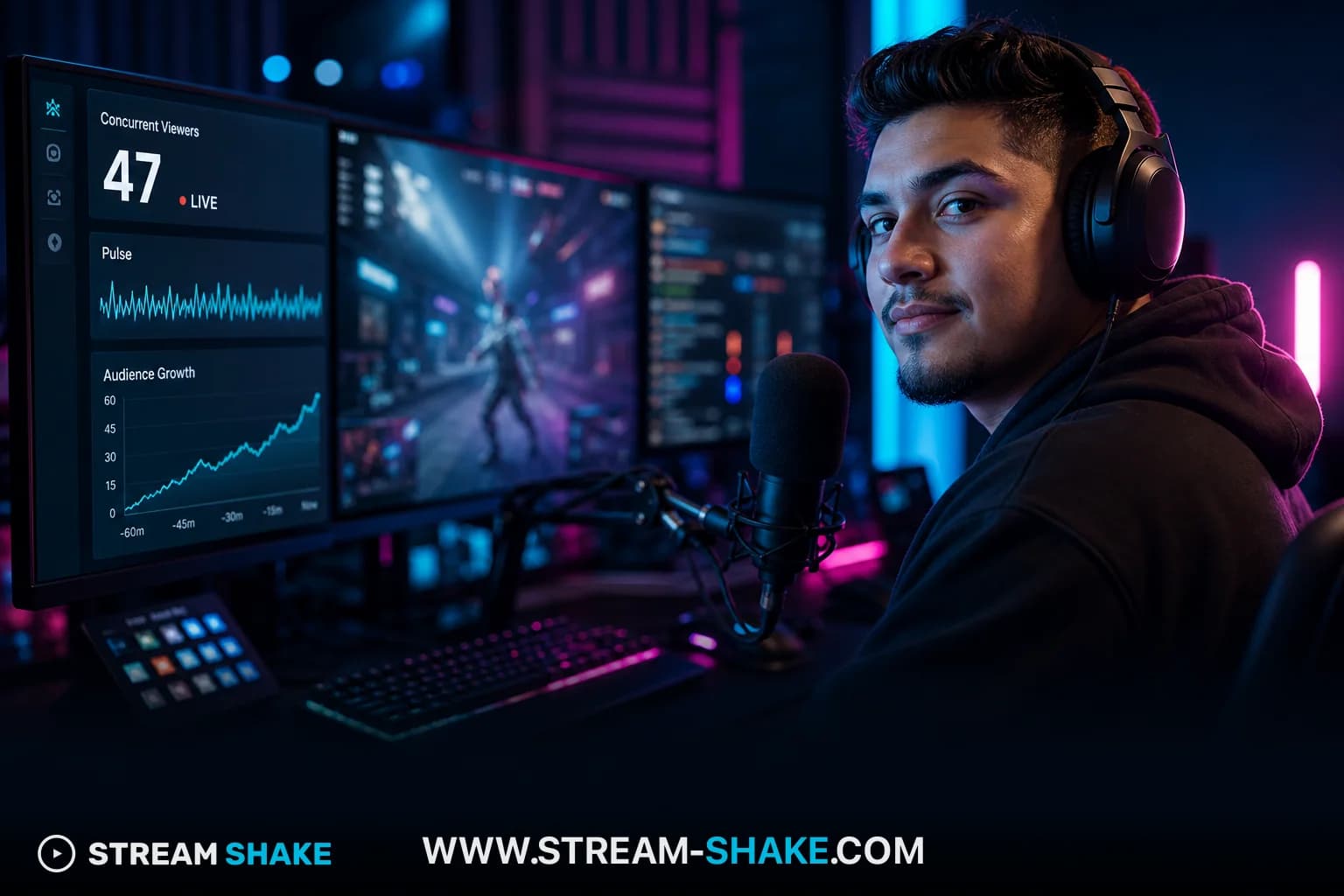
The digital broadcasting landscape in 2026 is undergoing a profound structural shift. For years, "live streaming" was virtually synonymous with Twitch for Western audiences. However, the ecosystem has matured into a heavily contested oligopoly. As creators seek to capture the highly coveted "most viewers" status, they are navigating a complex intersection of shifting platform demographics, rigorous new community guidelines, and advanced algorithmic discovery models.
Research suggests that while achieving record-breaking viewership is an outlier phenomenon, the underlying mechanics of audience acquisition remain universally applicable. This report provides a definitive blueprint for navigating this ecosystem, driven by foundational realities like market fragmentation, stricter enforcement against viewbotting, and the rise of lawful mutual engagement platforms.
The Apex of Live Streaming: Twitch Viewership Records#
To understand audience growth, one must first examine the absolute ceiling of live streaming potential. The definition of "most viewers" on Twitch is generally split into two distinct metrics: Peak Concurrent Viewers (CCV)—the maximum number of devices tuned into a stream simultaneously—and Active Subscribers, which reflects the financial backing of a dedicated community. The following numbers are based on peak recorded milestones confirmed by analytics platforms and social media reporting.
The Peak CCV Record: Ibai Llanos and Event-Based Streaming
For several years, the record for peak CCV on Twitch has been dominated by the Spanish-speaking community, culminating in the monumental success of Ibai Llanos. An internet personality and former esports commentator, Ibai successfully merged traditional sports spectacle with creator-led broadcasting.
His annual event, La Velada del Año (The Night of the Year), an influencer boxing tournament, has consistently shattered global records. After drawing millions of viewers in previous years, his 2025 event, La Velada del Año V, reached an unprecedented 10.8 million peak concurrent viewers. Broadcast live from La Cartuja Stadium in Sevilla, this achievement highlights a critical shift: mega-audiences are formed through massive, highly anticipated, collaborative events that transcend traditional gaming content.
The Subscriber and Follower Record: Kai Cenat and the Subathon Model
Conversely, the American streamer Kai Cenat represents the apex of community retention and financial monetization through continuous, high-engagement marathon streams (subathons).
During his "Mafiathon 3" streaming marathon in September 2025, Cenat reached over 1.1 million active Twitch subscribers, setting a monumental financial and community milestone. Furthermore, as of early 2026, Cenat became the first streamer in Twitch history to surpass 20 million followers. While Ibai commands massive, momentary global attention, Cenat's records demonstrate the power of deep, parasocial community building and prolonged viewer retention. Both approaches underscore that top-tier Twitch success in 2026 relies heavily on high-production value, cross-creator collaboration, and mainstream cultural integration.
The Shadow Side: Fake Engagement and Viewbotting Risks#
The immense financial and social incentives attached to high viewer counts have birthed a sprawling black market of artificial engagement. Viewbotting is defined by Twitch as the practice of artificially inflating a live view count using illegitimate scripts or tools to make a channel appear more popular than it actually is. In the highly competitive 2026 landscape, where algorithmic discovery heavily favors channels with existing momentum, some creators resort to these illicit tactics.
The Mechanics and Penalties of Viewbotting
Artificial engagement is not limited to mere viewer counts; it includes coordinated "Follow 4 Follow" (F4F) rings, "Lurk 4 Lurk" (L4L) scripts, and services that promise higher visibility via large numbers of unrelated embedded streams. Historically, Twitch combated bots with massive purges of fake accounts. However, as of a major policy update in May 2026, the platform has fundamentally changed its enforcement mechanism, introducing CCV Caps for repeat offenders.
Under this new policy, channels identified as persistently viewbotting will have a hard limit placed on their concurrent viewership numbers displayed across all Twitch discovery surfaces. This cap is calculated based on the creator's historical, non-botted traffic data. Punishments escalate for repeat offenders, though the platform maintains a policy of private notification.
Case Studies: QueenGloriaRP and Nick White
The risks associated with fake engagement are absolute, leading to demonetization, indefinite suspension, and the loss of sponsor trust. In March 2025, QueenGloriaRP was permanently banned after she accidentally alt-tabbed, revealing viewbotting software on her screen. The panel demonstrated a token-based system where she was paying to add approximately 20 artificial viewers. This incident sparked widespread debate regarding how many seemingly organic mid-tier streamers might be utilizing hidden inflation tools.
Similarly, streamer Nick White was banned from Kick in early 2024 after he coded and showcased a functional viewbot live on stream to prove how easily the system could be manipulated. While White argued he was exposing a platform vulnerability, Kick suspended him for "promoting botting services," highlighting that platforms strictly prohibit the facilitation of fake engagement, regardless of intent.
The Threat of Malicious Viewbotting
A notable complication in enforcing anti-bot policies is the phenomenon of Malicious Viewbotting. Because viewbots can be deployed to any channel by third-party actors, malicious users occasionally flood rival streamers with bots in an attempt to trigger a platform ban or destroy their credibility. Twitch explicitly states that they will not punish a user for the actions of another, advising creators to remain calm and use internal reporting tools without drawing attention to the bots on stream.
Platform Wars: Twitch vs. YouTube Gaming vs. Kick (2025–2026)#
To effectively capture viewers, creators must understand the macroeconomic shifts across streaming platforms. 2025 marked the year the platform war ceased to be one-sided. While global live streaming hours grew by 6% year-over-year to 36.4 billion in 2025, Twitch's total market share of hours watched experienced a historic decline.
| Metric / Feature | Twitch | YouTube Gaming | Kick |
|---|---|---|---|
| Hours Watched (2025) | ~19.2 Billion | ~8.8 Billion | ~4.5 Billion |
| Gaming Market Share | ~53 - 54% | ~24% | ~11 - 12.4% |
| YoY Growth (2024 to 2025) | -8.9% Decline | +12% Growth | +131% Growth |
| Creator Revenue Split | 50/50 or 70/30 (Partner Plus) | ~55% / 70% (Varies) | 95/5 |
| Core Demographic | 18-34, Gaming & IRL | Broadest, Global, 22-38+ | Youngest, heavily male-dominated |
The data reveals a rapidly shifting hierarchy. Twitch remains the undisputed leader, retaining over half of all global watch hours. It possesses the deepest creator infrastructure, brand-deal ecosystem, and engaged live chat cultures. However, the platform has faced four straight quarters of viewership decline through late 2025, largely attributed to increased competition and aggressive crackdowns on artificial engagement.
YouTube Gaming has emerged as the definitive second-place powerhouse. By leveraging its unparalleled Video-On-Demand (VOD) algorithm and mobile-first ecosystem, YouTube generated record growth. This constitutes a profound advantage because YouTube's search-based VODs offer evergreen discoverability, continuously accruing views and directing long-term traffic to live streams.
Kick represents the most aggressive market disruptor. By offering an unprecedented 95/5 subscription revenue split, Kick effectively declared war on historical revenue models. While it holds the smallest overall market share, its 131% year-over-year growth has successfully courted major creators and established a buyable inventory pool for advertisers, despite ongoing controversies.
Lawful Growth: Shared Viewership and Discovery#
As organic discovery becomes increasingly difficult on saturated platforms, Twitch has introduced native mechanics to encourage authentic cross-pollination of audiences. The most notable update is the Shared Viewership metric, launched in December 2024.
When two or more streamers utilize Twitch's "Stream Together" feature with "Shared Chat" enabled, the platform aggregates the total unique concurrent viewers across all participating channels. This combined viewership metric is then displayed on the creators' individual channel pages and the platform's discovery surfaces.
Case Study: Minecraft Championship 24 (MCC24)
To ground this in reality, consider the network effects of shared viewership during large collaborative events. In the MCC24 event, which peaked at 305,909 concurrent viewers, over 776,000 unique viewers participated across 37 Twitch streamers. The highest degree of shared viewership occurred between creators Dream (who peaked at 70,000 viewers) and George, who shared 59,000 unique viewers. This massive overlap illustrates how shared viewership mechanics accurately aggregate existing community networks, turning isolated audiences into a compounded directory powerhouse.
However, this system has drawn criticism regarding its potential for exploitation. Critics note that if four channels collaborate, and one channel possesses a large number of illicit viewbots, those bots become part of the shared pool, artificially inflating the directory position of all four creators. Despite these edge cases, Shared Viewership remains Twitch's strongest endorsement of collaborative, organic growth.
Strategic Organic Growth: Navigating the 2026 Twitch Algorithm#
To legitimately achieve higher viewership without violating ToS, creators must systematically address the "cold start" problem. This refers to the mathematical reality of Twitch's Browse page: if a stream has zero to three viewers, it is buried at the bottom of the directory, making organic discovery practically impossible.
Growth in 2026 is no longer about simply "going live" and hoping to be found; it requires a structured, multi-funnel approach. Creators must execute a highly specific procedural workflow.
Step 1: Execute Off-Platform Discovery Funnels (The Content Engine)
Twitch is historically a platform where you retain viewers, not necessarily where you are discovered. The most effective growth engines treat live streaming as the final destination in a content pipeline. Streamers must capture high-emotion moments, educational micro-tips, or relatable commentary during their live broadcasts, edit them into short-form vertical videos, and distribute them across other algorithmic platforms.
Optimize Platforms for Distinct Engagement
Procedural Implementation (AI Clipping Tools)
Because manually editing 15-to-60-second clips requires immense labor (often upwards of 10 hours a week), successful creators in 2026 leverage AI clip generation software. Recommended tools include:
- **Opus Clip:** Identifies viral moments from long VODs and produces 1-click vertical edits with animated captions.
- **Eklipse:** Specifically tuned for gaming highlights, automatically detecting in-game kills or high-action moments.
- **Nexus Clips:** Ideal for automatic vertical formatting and animated subtitle generation.
- **StreamLadder:** Recommended for dedicated Twitch streamers, specifically optimizing facecam-over-gameplay layouts prior to AI virality scoring.
Step 2: Optimize Algorithmic Signals (Consistency and Retention)
Once viewers land on a Twitch channel, the platform's internal recommendation engine takes over. Twitch's algorithm rewards specific signals above all else:
- **Schedule Regularity:** Predictability trains viewer habits and signals to the algorithm that the channel is a reliable content source.
- **First 60-Seconds Retention:** When a user clicks a thumbnail, the creator is essentially auditioning. High retention in the first minute is crucial.
- **Chat-Engagement Density:** Meaningful chat interaction is a massive algorithmic booster. For front-page streams, a healthy baseline often sees 10-15% of viewers acting as active chatters, or roughly an 8:1 viewer-to-chatter ratio.
100%+
Small Streams (100K-500K Followers)
Message engagement ratio often exceeds 100% as single users send dozens of messages.
1.75%
Mega-Streamers (5M-10M Followers)
Active chatter ratio, with message ratios dropping to 40-42%.
Hitting these target percentages signals immense relevance to the platform's discovery system, prompting further algorithmic promotion.
Step 3: Implement Lawful Mutual Viewing via Stream Shake
To conquer the cold start problem and safely secure the crucial first 5 to 20 concurrent viewers, many creators in 2026 utilize lawful mutual viewing networks, most notably Stream Shake.
Stream Shake functions on a direct "minutes-to-points" exchange rate. Creators register their channel on the official platform, and the system automatically assigns them a peer stream to watch, rotating every 10 minutes to earn points. These points are then spent to receive real, verified human viewers when they themselves go live.
The platform's anti-bot infrastructure detects headless browsers, massive IP overlaps, and rapid, repetitive script behaviors typical of viewbotting. Stream Shake evades these triggers because it strictly relies on authenticated Twitch accounts running in genuine browser sessions. To validate engagement and simulate genuine human pacing, the Stream Shake engine enforces strict active chat technical markers: viewers receive bonus points for chat activity, throttled to one message every 60 seconds and a minimum length of 5 characters, filtering out bot-like spam.
By utilizing Stream Shake appropriately, a new creator ensures their broadcast maintains a baseline of real concurrent viewers during high-leverage windows. This initial boost elevates the stream out of the "zero-viewer graveyard," placing it higher in the Twitch directory where it can then be discovered by organic viewers. It is the digital equivalent of seating a few friends in the front row of an empty comedy club to encourage passersby to walk in and stay.
Frequently Asked Questions#
Who has the most viewers on Twitch in 2026?
Ibai Llanos holds the record for peak concurrent viewers (CCV) with 10.8 million during his "La Velada del Año V" event in 2025. Kai Cenat holds the record for active subscribers (1.1 million) and followers (20 million) on Twitch as of early 2026.
What is Twitch's policy on viewbotting in 2026?
As of May 2026, Twitch has implemented CCV Caps for repeat offenders caught viewbotting. This means channels found using artificial engagement will have their displayed viewership numbers capped based on their historical, non-botted traffic, in addition to potential bans and demonetization.
How can I legally get more viewers on Twitch?
Legitimate strategies include creating off-platform discovery funnels using platforms like TikTok, Instagram Reels, and YouTube Shorts (often with AI clipping tools), optimizing for Twitch's algorithmic signals (consistent schedule, high retention, chat engagement), and utilizing lawful mutual viewing networks like Stream Shake to overcome the "cold start" problem.
How does Twitch's "Shared Viewership" work?
Launched in December 2024, Shared Viewership aggregates the total unique concurrent viewers when two or more streamers use Twitch's "Stream Together" feature with "Shared Chat" enabled. This combined metric is displayed on discovery surfaces, allowing smaller creators to gain visibility through collaboration.
What are the biggest competitors to Twitch in 2026?
In 2026, YouTube Gaming is the definitive second-place powerhouse with significant growth, leveraging its VOD and mobile ecosystem. Kick is the most aggressive market disruptor, growing over 131% year-over-year by offering a 95/5 revenue split to creators, despite having a smaller overall market share.