
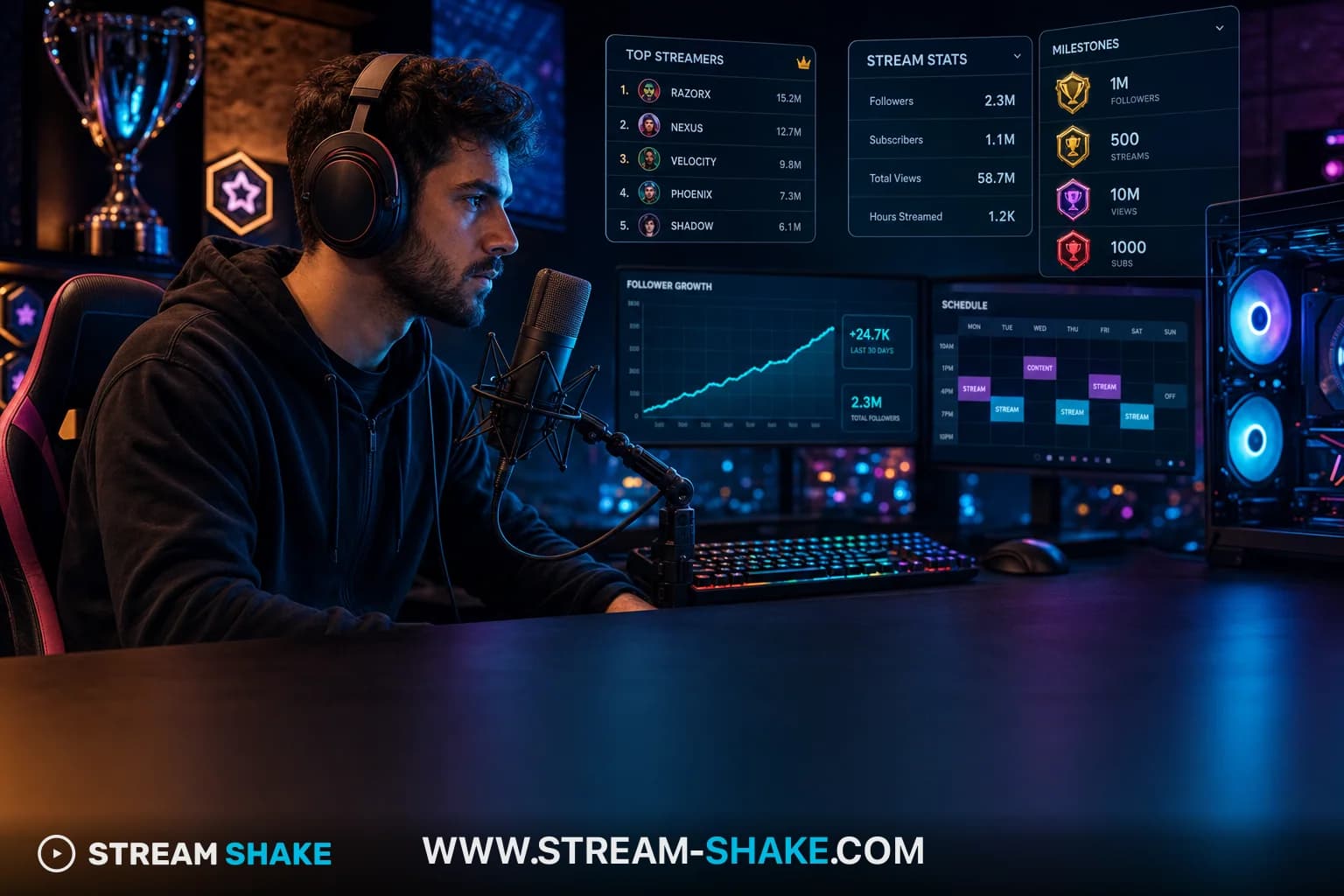
To succeed on Twitch in 2026, streamers must navigate a dynamic environment marked by evolving platform policies, intense competition, and strict regulations against artificial engagement. Success hinges on strategic eventization, diversified income streams, and utilizing legitimate growth tactics like mutual viewing platforms and AI-driven content distribution to overcome the 'Cold Start' problem.
The Statistical Landscape of Twitch in 2026#
To understand the strategies of top streamers, one must first comprehend the sheer scale and demographic realities of the platform they inhabit. Twitch's growth trajectory has transitioned from explosive pandemic-era expansion into a mature, stabilized phase marked by intense viewer retention battles.
Audience Size and Demographic Realities
Twitch's user base remains staggering, firmly cementing it as the global leader in live interactive media. In 2026, the platform boasts over 240 million Monthly Active Users (MAUs)—a metric defining the number of unique individuals who log into the site at least once a month. Daily, approximately 30 to 35 million users engage with the platform.
240M+
Monthly Active Users
Unique individuals logging in monthly
72-73%
Under 35 Age Group
Dominant demographic on the platform
63-73%
Male Audience
Platform continues to skew heavily male
21-25%
US Market Share
Representing 35-44M active users
This demographic reality—young, heavily male, and Western-centric—explains why competitive gaming, high-stakes interactive events, and fast-paced "Just Chatting" streams dominate the upper echelons of platform viewership.
Market Share and Viewership Trends
Despite its massive scale, Twitch has experienced a contraction in its absolute dominance. In 2024, viewers consumed 20.8 billion hours of content on the platform. By 2025, that figure softened to 19.2 billion hours watched, representing an 8.9% year-over-year decline. During this broader period, Twitch's total market share of the live-streaming gaming sector dropped from roughly 70% in late 2023 to 52.8% by the end of 2025.
19.2B hours
2025 Watch Time
8.9% YoY decline from 2024
52.8%
Live Gaming Market Share
Down from 70% in late 2023
2.05-2.73M
Average Concurrent Viewers
Viewers at any given moment
7.3M+
Monthly Unique Creators
Broadcasting to an increasingly competitive platform
This contraction is not indicative of a dying platform, but rather a deliberate market correction and technological house-cleaning. The 8.9% YoY drop and an unprecedented, sudden 24% viewership plunge recorded in August 2025 were explicitly driven by Twitch deploying aggressive new detection algorithms to purge millions of viewbots and fake accounts. Therefore, the statistical loss reflects a necessary culling of artificial inflation rather than a mass exodus of real human audiences. With over 7.3 million unique creators going live every month, the competition for eyeballs has never been fiercer. Consequently, the ratio of viewers to live channels presents a mathematical bottleneck for new creators, making algorithmic discovery an immense hurdle.
The Titans of Twitch: Who Dominates in 2026?#
The highest tier of Twitch streamers operates far beyond the traditional concept of a gamer broadcasting from a bedroom. In 2026, the top creators are multi-million-dollar brands, orchestrating stadium-sized events, launching physical products, and commanding mainstream celebrity status.
The Reigning Champions of 2026
The hierarchy of Twitch's most followed channels highlights a blend of English-speaking pop-culture icons and massive Spanish-speaking communities. The top three streamers illustrate the diverse avenues to platform dominance, sharing a similar operational blueprint of immense live events, lucrative revenue streams, and diversified external businesses:
Kai Cenat (20.2 Million Followers)
An American creator known for high-energy comedy and "Just Chatting" content, Cenat holds the title of the most-followed Twitch channel in 2026. His ascension is largely attributed to highly produced subathons (subscription marathons), reaching an unprecedented 1.11 million active concurrent subscribers during his "Mafiathon 3" event in September 2025. Cenat generated an estimated $1.6 to $3.2 million from subscription revenue alone during this single event. His total estimated net worth is between $14 million and $35 million, bolstered by external ventures like his clothing brand "Vivet" and major brand deals with companies like Nike.
Ibai Llanos (19.8 Million Followers)
Representing the massive Spanish-speaking market, Ibai exemplifies the "event-streaming" meta. His annual influencer boxing event, *La Velada del Año V*, shattered global records by drawing 10.8 million concurrent viewers (CCV) in July 2025. Ibai averages over 40,000 concurrent viewers during standard broadcasts, generating estimated monthly earnings of $261,000. Industry analysts place his net worth between $14 million and $20 million, heavily bolstered by co-founding the KOI esports team and running the Kings League.
Tyler "Ninja" Blevins (19.2 to 19.5 Million Followers)
Though his streaming frequency and concurrent viewership have decreased from their peak, Ninja remains the third most-followed creator, a legacy of his monumental Fortnite broadcasts in 2018. Despite a smaller active daily audience in 2026, Ninja's legacy contracts and diversified income continue to generate roughly $500,000 per month. He remains one of the wealthiest creators on the platform with an estimated net worth of $50 million, with influence persisting through vast corporate equity and executive roles like Chief Innovation Officer (CIO) for GameSquare.
The Blueprint of Top-Tier Success
Analyzing these titans reveals several distinct patterns that define success in 2026. First, the traditional daily gameplay broadcast has been supplanted by "Eventization." Audiences now expect spectacles—boxing matches, month-long marathon broadcasts, and celebrity cameos—that demand live attendance to avoid missing cultural moments. Second, the monetization strategy has shifted. The wealthiest streamers diversify immediately. Whether it is xQc securing massive non-exclusive platform deals, or Amouranth investing in real estate and generating immense revenue through external platforms, the top streamers use Twitch as a top-of-funnel marketing tool for broader business empires.
Decoding the Twitch Algorithm: Overcoming the 'Cold Start' Problem#
For the 7.3 million monthly broadcasters striving to reach the heights of Cenat or Ibai, understanding Twitch's recommendation engine is mandatory. The platform's algorithm is a complex system of machine learning designed to maximize viewer retention and engagement.
Algorithmic Ranking Factors
- **Concurrent Viewership (CCV):** The total number of live viewers remains the single most heavily weighted ranking factor, with the algorithm equating high viewership with high value.
- **Viewer Engagement Metrics:** Raw numbers must be supported by active participation. The algorithm tracks Chat Activity, Watch Time (average session length), and the Follower-to-Viewer Ratio. A stream with active chatters is flagged as a "high-heat" event.
- **Collaborative and Content-Based Filtering:** The system analyzes viewer habits, recommending streamers based on overlapping audiences or matching viewers with streams utilizing specific tags, gaming categories, and descriptive titles.
The 'Cold Start' Dilemma
These algorithmic parameters create a paradox for new creators known as the "Cold Start" problem. Because Twitch ranks streams primarily by existing viewership and chat activity, a channel broadcasting to zero viewers is buried at the absolute bottom of a directory. This mathematical reality means high-quality content alone is insufficient for growth on Twitch; creators must proactively engineer their initial viewership to trigger the algorithm. This drives many creators toward external marketing, community networking, or, unfortunately, illicit shortcuts.
Evolving Twitch Policies: Simulcasting and Combined Chats#
To combat platform stagnation and offer creators more flexibility, Twitch has radically overhauled its broadcasting policies, most notably regarding simulcasting—the act of broadcasting to multiple platforms simultaneously (e.g., Twitch, YouTube, and Kick).
The Fall of Exclusivity
Historically, Twitch strictly prohibited its Partners and Affiliates from streaming live content to competitor platforms. This exclusivity clause was a defensive measure to lock in top talent. However, due to intense competitive pressure, Twitch abolished this rule in late 2023, allowing creators to stream anywhere simultaneously, provided they maintained "quality parity" (ensuring the Twitch broadcast is of equal or better technical quality than the competitor's feed).
The Combined Chat Controversy and Reversal
While simulcasting was permitted, Twitch initially maintained a controversial restriction: creators were forbidden from displaying a "merged" or "combined" chat overlay on their Twitch stream. This meant that if a creator streamed to both Twitch and YouTube, they could not show YouTube chat messages to their Twitch audience. Twitch's CEO, Dan Clancy, originally defended this rule as a safety measure, arguing that Twitch could not effectively moderate comments originating from third-party platforms. In a watershed moment in February 2026, Twitch capitulated. CEO Dan Clancy announced the suspension of enforcement against combined chat overlays.
The Perils of Fake Engagement: Viewbots, CCV Caps, and FTC Regulations#
Desperate to overcome the Cold Start problem, some creators resort to viewbotting—purchasing artificial, automated viewers to inflate their CCV and trick the algorithm into ranking them higher. In 2026, this practice is not only ineffective but carries catastrophic platform and legal risks.
The Mechanics and Failure of Viewbots
Viewbots are artificial scripts that connect to a stream to simulate viewership. While they may artificially boost a channel's directory ranking, they fail the algorithm's secondary checks: chat engagement and watch-time retention. High viewer numbers without corresponding chat activity flag the stream as highly suspicious to Twitch's anomaly detection systems. Furthermore, when human viewers click on a botted stream, they are met with a silent, unnatural chat room, resulting in immediate churn and reputational damage.
Twitch's 2026 CCV Cap Enforcement
Historically, Twitch combated viewbotting through mass account purges and outright channel bans. However, this created a vulnerability known as "weaponized suspicion" or "hate-botting," where malicious actors would point viewbots at an innocent streamer to trigger an automated ban against them. To neutralize this, CEO Dan Clancy announced a radical new policy in May 2026: instead of banning suspected channels, Twitch now enforces a Concurrent Viewership (CCV) Cap.
The October 2024 FTC Rule
Lawful Growth Tactics and the Power of Mutual Viewing#
With artificial botting neutralized by algorithmic CCV caps and federal law, how do creators legitimately solve the Cold Start problem in 2026? The answer lies in combining algorithmic distribution (via specialized AI tools and short-form content) with legitimate, peer-to-peer community networks like Stream Shake.
The Mutual Viewing Economy (Stream Shake)
Stream Shake represents a paradigm shift in early-channel growth, operating entirely within Twitch's Terms of Service and FTC guidelines. It is a mutual viewing marketplace designed exclusively for real human interaction. Streamers register on the platform and earn internal points by actively watching and engaging with the broadcasts of other participating creators. When a streamer goes live on their own channel, they spend these accrued points to receive genuine, authenticated human engagement without the financial or platform risks of botting.
- VOD
- Video on demand — the replay of your stream after you go offline. Separate from live viewer counts.
Frequently Asked Questions About Top Twitch Streamers & Growth in 2026
What are the biggest changes on Twitch in 2026?
Twitch has lifted its exclusivity clauses, allowing simulcasting and combined chat overlays. Crucially, new policies and FTC regulations now severely penalize artificial engagement, with Twitch implementing CCV caps instead of bans for suspected viewbotting.
Why is viewbotting risky now, and what are the penalties?
Viewbotting is ineffective due to Twitch's advanced detection algorithms and 2026 CCV caps, which hide fake viewer counts. Furthermore, the October 2024 FTC rule prohibits using 'fake indicators of social media influence' for commercial gain, carrying civil penalties up to $51,744 per violation.
What is the 'Cold Start' problem for new streamers?
The 'Cold Start' problem describes the difficulty new streamers face in getting discovered. Twitch's algorithm prioritizes channels with existing high concurrent viewership and engagement, leaving channels with zero viewers buried at the bottom of directories, making organic discovery extremely challenging.
Can I stream on Twitch and YouTube simultaneously in 2026?
Yes, Twitch abolished its exclusivity clauses in late 2023, permitting simulcasting to platforms like YouTube and Kick. In February 2026, Twitch also suspended enforcement against displaying merged chat overlays, giving streamers more flexibility.
How do top Twitch streamers make money in 2026?
Top streamers like Kai Cenat and Ibai Llanos operate as multi-million dollar brands. They earn from subscriptions, donations, and ad revenue, but significantly diversify through external ventures like clothing lines, esports teams, and multi-million dollar brand sponsorships, using Twitch as a primary marketing channel.
Unlock genuine engagement and overcome the 'Cold Start' problem.