
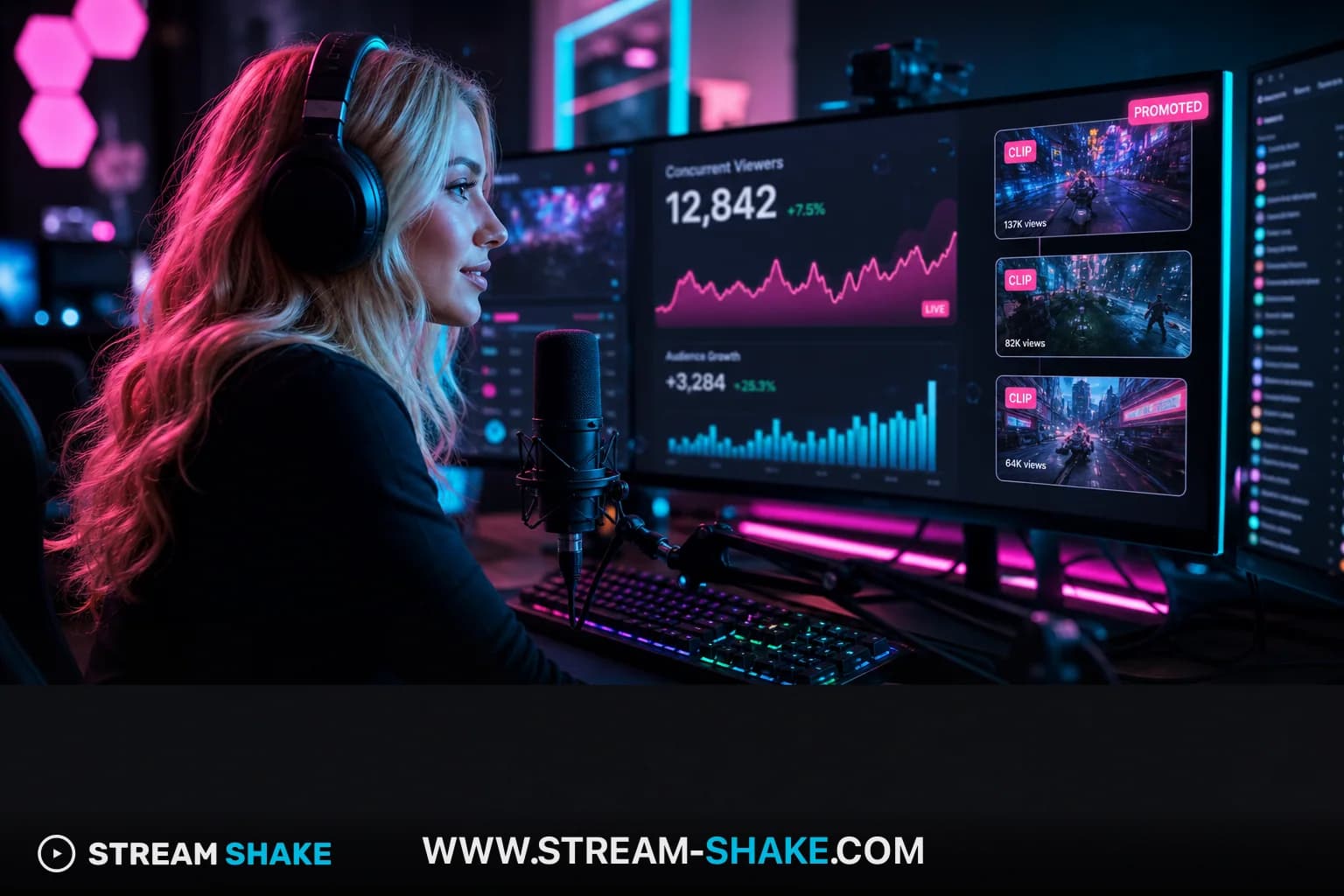
The live streaming ecosystem in 2026 is highly saturated and competitive, with discoverability being the greatest hurdle for creators. This report examines Twitch’s architectural realities, new policies against artificial engagement, and outlines lawful, strategic growth frameworks to help streamers scale their audiences without risking penalties.
The Global Streaming Landscape in 2026: By the Numbers#
To understand the mechanics of channel growth and platform policy, one must first examine the macroeconomic scale of the live streaming industry. The data from 2026 paints a picture of a top-heavy ecosystem where massive user bases are juxtaposed against severe discoverability bottlenecks for emerging talent.
Aggregate Viewership and Market Share
Twitch continues to operate as the undisputed titan of the live streaming space, commanding roughly 60.3% to 67% of the total global watch time and an estimated 54% share strictly within gaming content. As of early 2026, the platform boasts over 240 million Monthly Active Users (MAUs) and 35 million Daily Active Users (DAUs) globally, with peaks of over 140 million dedicated monthly active creators and users interacting dynamically. The United States remains Twitch's primary demographic stronghold, accounting for approximately 23.67% of the total user base, followed by robust markets in Brazil, Russia, and Mexico.
60-67%
Twitch Market Share
of total global watch time
240M+
Monthly Active Users
global MAUs on Twitch
35M+
Daily Active Users
global DAUs on Twitch
95 min
Daily Watch Time
average per user
55%+
Zero-Viewer Streams
of creators stream to <5 CCV
The Broad Base and the Zero-Viewer Trap
However, these staggering aggregate numbers obscure the harsh reality of the individual creator experience. Twitch is a highly stratified platform. In 2025, the platform hosted roughly 11.4 million monthly active streamers, yet the distribution of viewership is intensely skewed. While the average Twitch stream technically boasts 7.4 concurrent viewers, this statistic is heavily distorted by the top 1% of megastreamers. In reality, more than 55% of creators on the platform broadcast to fewer than five concurrent viewers, trapped in an algorithmic blind spot where native discoverability is virtually non-existent.
Peak Viewership and the Megastreamer Phenomenon#
The concept of a 'successful' stream has evolved dramatically. While consistency remains vital, the upper echelons of Twitch are now dominated by 'eventized' streaming—highly produced, culturally pervasive broadcasts that draw mainstream attention. Analyzing the top creators of 2026 reveals the diverging paths to audience capture.
Kai Cenat: The Power of the Subathon
In April 2026, American creator Kai Cenat cemented his status as the most-followed individual on Twitch, crossing the 20.2 million follower threshold. Cenat's meteoric rise underscores the power of high-stakes, endurance-based content, specifically the 'subathon'. His September 2025 event, Mafiathon 3, featured celebrity appearances and culminated in a record-breaking 1.1 million active Twitch subscriptions, alongside a peak viewership of over 1 million concurrent viewers. This single event generated an estimated $5 to $8 million in revenue within 30 days, proving that internet culture fluency and high-production event spectacles can transcend traditional gaming content.
Ibai Llanos: The Live Entertainment Agency
Spanish broadcaster Ibai Llanos represents a different architectural approach to the megastream. With 19.8 million followers, Ibai has effectively transformed his Twitch channel into a bespoke media and sports broadcasting agency. Ibai holds the all-time global record for peak Concurrent Viewers (CCV) across any streaming platform. In July 2025, his annual amateur boxing event, La Velada del Año 5, drew an astonishing 9.3 million concurrent viewers. By treating Twitch as a delivery vehicle for premium, traditional-style sports entertainment, Ibai tapped into an audience far wider than the endemic gaming demographic.
TheBurntPeanut: The VTuber Mainstream Ascendency
The first quarter of 2026 highlighted another major paradigm shift: the dominance of Virtual YouTubers (VTubers). In January 2026, an anonymous creator known as TheBurntPeanut became the most-watched streamer on Twitch. Utilizing a minimalist visual aesthetic—a Snapchat-style filter that superimposes a giant, animated peanut—TheBurntPeanut capitalized heavily on chaotic gameplay. In January 2026 alone, he accumulated 11.35 million hours watched, with an average of 31,243 viewers and a peak of 53,387 across roughly 271 hours of airtime, vastly outpacing industry veterans. His rapid rise confirms that viewers are increasingly drawn to highly stylized, character-driven avatars.
Twitch's Escalating War on Artificial Engagement: The 2026 CCV Cap Policy#
As the financial incentives for high viewership have skyrocketed, so has the proliferation of 'viewbotting'—the illicit use of automated scripts to artificially inflate a channel's concurrent viewer count. Historically, Twitch relied on retroactive purges, but as bot developers integrated advanced AI simulations, detection became an endless cat-and-mouse game.
Dan Clancy's Paradigm Shift
On May 7, 2026, Twitch CEO Dan Clancy announced a radical shift in enforcement strategy, introducing a punitive Concurrent Viewer (CCV) Cap applied directly to offending channels. Under this new policy, channels identified as persistent users of viewbots face a hard, artificial limit on the number of viewers publicly displayed on their streams. This cap is algorithmically pegged to historical, non-botted traffic data and applied silently across all Twitch surfaces, with repeat offenses resulting in extended caps.
The Risks of Weaponized Suspicion
While aimed at maintaining algorithmic integrity, the CCV cap has introduced severe psychological and operational risks. Viewbots can be deployed to any channel by third parties for a negligible cost, enabling 'hater raids'—malicious actors inundating a rival streamer with bot traffic to purposely trigger Twitch's automated CCV cap. The mere presence of a visible viewership cap can irreparably damage a streamer's reputation, causing lucrative sponsorship deals to evaporate.
The High Stakes of Platform Migration: Twitch vs. Kick vs. YouTube Gaming#
Streamers in 2026 are no longer bound to a single platform. The rescinding of strict exclusivity clauses for Twitch Affiliates and Partners has ushered in the era of simulcasting. Creators must strategically navigate the varying architectures of Twitch, YouTube Gaming, and Kick to optimize their reach and revenue.
| Platform | Market Share (Overall) | Base Revenue Split | Discoverability Engine | Primary Drawbacks |
|---|---|---|---|---|
| Twitch | ~60% - 67% | 50/50 (up to 70/30 via Plus Program) | Directory/Category sorting (Low native discovery) | CCV Caps, zero-viewer trap, high saturation |
| YouTube Gaming | ~22% - 24% | 70/30 | Algorithm recommendations, Search, Shorts | Fragmented live chat culture, UI complexities |
| Kick | ~5.5% - 12.4% | 95/5 | Category sorting, fast-growing mid-tier | Brand safety issues, gambling associations |
The Challenger: Kick's Creator-Centric Economics
Backed by the founders of the crypto casino Stake.com, Kick emerged as the most aggressive disruptor in the streaming space. By April 2026, Kick successfully crossed the 100 million registered user milestone, fueled by a staggering 112% year-over-year growth in watch hours. Kick's primary weapon is its unprecedented 95/5 revenue split on subscription revenue, compared to Twitch's baseline 50/50 model. While its overall market share remains smaller, it has successfully poached massive creators and established a highly lucrative mid-tier economy.
The Discovery Engine: YouTube Gaming
YouTube Gaming currently holds the second-largest market share, capturing 22% to 24% of global live streaming hours. The platform acts as a massive repository, tapping into YouTube's broader pool of 2.53 to 2.7 billion global monthly active users. Its absolute advantage lies in its algorithm and monetization structures, natively recommending live streams and offering a highly favorable 70/30 revenue split on Super Chats and channel memberships. YouTube streams automatically convert into highly searchable Video On Demand (VOD) assets, granting broadcasts a long-term shelf life for passive ad revenue.
The Incumbent: Twitch's Moat
Despite losing market share, Twitch remains the cultural epicenter of live broadcasting. Its native chat integrations, ease of monetization (via the Affiliate program), and deep entrenchment in the esports and gaming communities provide a formidable defensive moat. Furthermore, Twitch commands an estimated 2-4% conversion rate for non-endemic brand sponsorships, making it the preferred platform for high-tier corporate advertising. This dominance is cemented by Twitch's robust API ecosystem, allowing third-party applications to seamlessly interact with live data.
Escaping the Zero-Viewer Trap: Lawful, Systemic Growth Tactics#
Because Twitch lacks aggressive native discoverability for new creators, growth cannot be left to chance. Purchasing fake engagement guarantees a punitive CCV cap, while 'Go Live and Grind' guarantees burnout. Therefore, creators must execute systematic, lawful growth tactics predicated on two pillars: The Off-Platform Funnel and Peer-to-Peer Mutual Viewing.
Strategy 1: The Content Funnel and Short-Form Conversion
- The Clip-First Mindset: Treat live broadcasts as raw material factories; every two-hour stream should yield at least three high-quality vertical clips for platforms like TikTok and YouTube Shorts.
- The 3-Second Hook: Viewers abandon short-form videos quickly. Clips must begin with a clear visual hook, a stated challenge, or an immediate high-stakes scenario to instantly engage.
- Congruency: The live stream must reflect the promise of the short-form content. If a TikTok clip advertises high-energy gameplay, the Twitch stream must match this to prevent high bounce rates.
Strategy 2: Algorithmic Compliance and Retention Signaling
- Schedule Regularity: The algorithm vastly prefers a streamer who broadcasts for 3 hours, three days a week at the exact same time, over inconsistent, longer streams. Predictability breeds retention.
- Concurrent Viewer Stability: Sudden artificial spikes trigger red flags. A steady, stable average CCV signals legitimate community health and is favored by the Twitch recommendation engine.
- Chat Engagement Density: Twitch prioritizes streams where the ratio of chat messages to viewers is above the category median. Creators must actively talk, narrate, and utilize tools like Channel Points and polls to force viewer interaction.
Strategy 3: Lawful Mutual Viewing via Stream Shake
To overcome the initial hurdle of cold-start visibility—securing those crucial first 5 to 15 concurrent viewers needed to lift a channel out of the absolute bottom of a directory—creators require a catalyst. Given the severe risks of viewbotting outlined by the 2026 CCV cap policy, streamers must turn to strictly lawful, ToS-compliant promotional networks like Stream Shake.
**Price and Availability:** Stream Shake is a strictly 100% free mutual viewing network. Currency is attention, not capital — earn points watching peers, spend them on real concurrent viewers when you go live.
**The 'Anti-Use Case':** Stream Shake is *not* a passive growth tool. Creators seeking 'zero-effort' audience inflation or automated viewer spikes should categorically avoid this platform, as the system mandates manual user effort and active community participation to function.
**The Technological Enforcement of Authentic Engagement:** Stream Shake's system is designed to prevent passive lurk-farming by requiring mandatory human interaction and chat participation. This ensures that engagement signals are genuine, protecting creators from algorithmic suppression and platform penalties.
Glossary#
- VOD
- Video on demand — the replay of your stream after you go offline. Separate from live viewer counts.
Frequently Asked Questions#
Why is Twitch discoverability so difficult for new streamers in 2026?
Over 55% of Twitch creators stream to fewer than five concurrent viewers, and the platform’s algorithm prioritizes channels with existing high viewership, creating a "zero-viewer trap" for new talent.
What is Twitch's 2026 CCV Cap policy, and what are its risks?
Twitch now applies an artificial limit on publicly displayed viewers for channels caught viewbotting. This policy risks "hater raids" where malicious actors inflate a rival's bot count to trigger the cap, damaging reputation and sponsorships.
How do megastreamers like Kai Cenat and Ibai Llanos achieve such high viewership?
Kai Cenat utilizes high-stakes "subathons" and celebrity collaborations, while Ibai Llanos transforms his channel into a media agency for massive, eventized sports entertainment, both leveraging production value and cultural impact.
Should streamers focus on Twitch, YouTube Gaming, or Kick in 2026?
The optimal strategy is hybrid: build discoverability via YouTube's algorithm and short-form content, cultivate community on Twitch, and use Kick's 95/5 revenue split for direct monetization, adapting to each platform's strengths.