
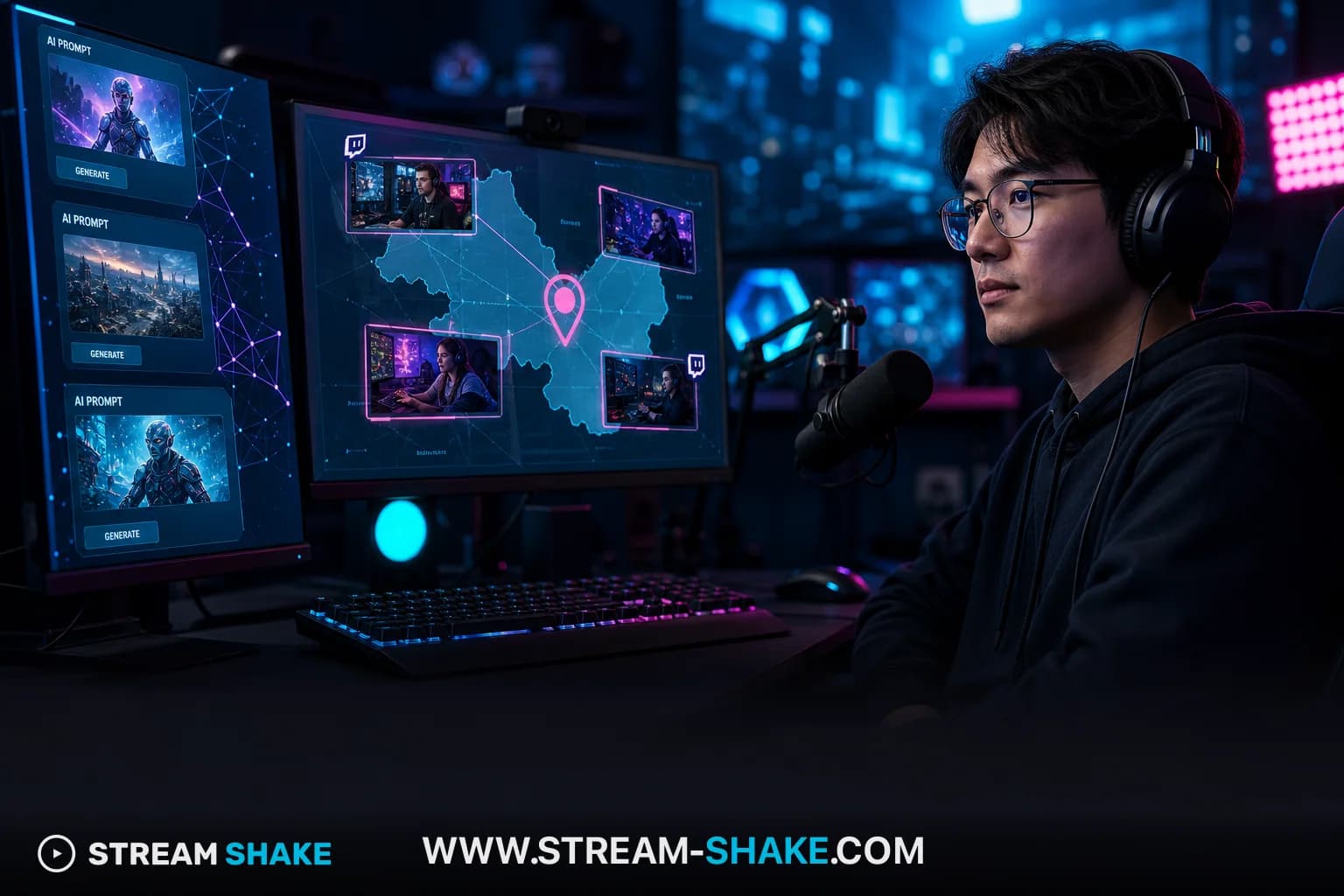
The livestreaming ecosystem of 2026 exists at a complex intersection of global reach and localized desire. As platform saturation reaches critical mass, the search query "Twitch streamers near me" represents a growing paradigm shift, with viewers increasingly seeking digital communities that mirror their physical realities.
The State of Twitch Streaming in 2026: Statistics and Saturation#
To understand why localized discovery has become so highly sought after, one must first analyze the sheer volume of the livestreaming market in 2026. Precise, real-time metrics fluctuate daily, but the available foundational data paints a picture of a massive, heavily saturated platform where organic, global discovery is statistically improbable for a new creator.
240M+
Twitch MAUs
Monthly Active Users
52.8–54%
Twitch Market Share
Down 4.6–8.9% YoY in 2025
24–24.3%
YouTube Gaming Share
Growing 12% YoY
11–12.4%
Kick Market Share
Explosive 131% growth
- **The Creator Glut:** Twitch hosts an average of 6.9 to 7.3 million unique streaming channels per month, with approximately 93,000 to 95,000 channels broadcasting concurrently at any given moment.
- **The Viewership Disparity:** While the platform maintains an average of 2.1 to 2.5 million concurrent viewers, this audience is heavily consolidated. The top 1% of streamers dominate discovery and monetization, leaving over 55% of creators broadcasting to fewer than five concurrent viewers.
This severe oversaturation is the primary catalyst driving the search for alternative discovery vectors, such as geolocation. By targeting "Twitch streamers near me," viewers filter out the overwhelming noise of the global platform, and creators can establish a monopoly over a micro-demographic rather than fighting a losing battle in the global arena.
The Search Mechanics: Navigating Geographic Discovery on Twitch#
Despite the growing demand for local content, Twitch's platform architecture fundamentally resists geographic discovery. Unlike dating applications or local service directories, Twitch does not natively offer a "Near Me" search filter or a geolocation-based discovery feed. This omission is widely considered a deliberate "privacy-by-design" choice, shielding creators from unwanted physical tracking.
Third-Party Geographic Analytical Tools
For digital marketers, esports organizations, and highly strategic creators, third-party platforms have developed sophisticated workarounds to approximate a streamer's location and their audience's geography.
Organic Tagging and Nomenclature: The Step-by-Step Guide
For everyday viewers lacking access to enterprise marketing tools, finding local streamers relies entirely on the creator's willingness to self-identify. Historically, viewers resort to searching Twitch using city names in the search bar, or looking for specific regional stream titles and language filters. Creators looking to capture local traffic often explicitly opt-in to localized discovery by deliberately tagging their stream.
How to Tag Your Twitch Stream for Local Discovery
- Log in and access Dashboard: Log into your Twitch.tv account and click your profile icon in the top-right corner. Select "Creator Dashboard" from the drop-down menu.
- Navigate to Stream Manager: On the left-side menu of the Creator Dashboard, click into the "Stream Manager" tab.
- Edit Stream Info: Within the "Quick Actions" panel, click the "Edit Stream Info" button.
- Add Local Tags and Title: In the pop-up window, adjust your stream Title to include local phrasing (e.g., "Chicago Gamer"). Crucially, add custom **Tags** like "Texas", "London", or "NYC" before clicking "Done" to apply them.
Because Twitch actively obscures precise location data, the process of finding local streamers is inherently friction-heavy. Streamers must explicitly opt-in to localized discovery by deliberately broadcasting their region via manual dashboard tagging. This dynamic forces creators to make a calculated risk assessment: does the benefit of capturing a loyal, local audience outweigh the severe privacy risks associated with tethering a digital persona to a physical location?
Bridging the Digital and Physical: Twitch Community Meetups#
The most successful manifestation of the "Twitch streamers near me" phenomenon is not digital, but physical. Over the past decade, grassroots organizations have proven that geographically bound streaming communities foster unparalleled networking opportunities, eventually recognized and officially supported by Twitch itself.
The "Community MeetUps, Powered by Twitch" Program
Observing the spontaneous gathering of broadcasters and fans in local cities, Twitch established the Community MeetUps, Powered by Twitch program. This initiative officially sanctions independent, community-run events to connect viewers and creators IRL (In Real Life). By 2026, this program encompasses over 50 cities worldwide, from Adelaide, Australia, to Toronto, Canada.
Case Study: Stream Texas
One of the most prominent examples of successful local streaming integration is Stream Texas. Operating as a 501(c)6 not-for-profit, community-run organization founded around 2017, Stream Texas focuses on facilitating social events, education, and business opportunities for local streamers, viewers, and game developers. The organization is heavily fragmented to serve local geographies, boasting highly active specific chapters like Austin, Dallas-Ft Worth, San Antonio, and Houston.
These meetups prioritize physical networking over digital broadcasting. For example, the Austin chapter hosts annual SXSW meetups at specific real-world venues like Vigilante Gastropub & Games, offering gaming PC stations, food, and partner giveaways. A defining characteristic of these events is that they strictly prohibit and explicitly ban IRL streaming on the premises during the gatherings, ensuring attendee privacy.
Events like Stream Texas illustrate a vital lawful growth tactic. While digital discovery is oversaturated, physical meetups allow creators to network organically. A viewer attending a Dallas meetup is highly likely to follow and support a Dallas-based streamer they met in person. This cross-pollination of local audiences creates a robust, localized support system that algorithms cannot easily replicate.
Competitor Approaches: The TikTok "Local Feed" Paradigm#
To fully understand the landscape of localized streaming in 2026, one must examine how Twitch's competitors are solving the geographic discovery problem. The most disruptive alternative approach comes from TikTok, which launched its "Nearby Feed" (or "Local Feed") in late 2025 and fully rolled out in 2026, fundamentally transforming the app into a hyperlocal discovery engine.
Mechanics of the TikTok Local Feed
- **A Dedicated Surface:** Sitting alongside the traditional "For You" and "Following" tabs, the Local Feed prioritizes content based on proximity to the user, topical relevance (events, food, travel), and recency.
- **Privacy Guardrails:** The feature is entirely opt-in, only accessible to users aged 18 and older, and only tracks the device's GPS when the app is actively in use. Private accounts and content set to "Friends Only" are ineligible for the feed.
Platform Symbiosis: Twitch vs. TikTok
The launch of the Local Feed highlights the stark contrast between TikTok and Twitch. As streaming strategists have noted, TikTok is an engine for rapid, short-term discovery, generating high volumes of passing viewers. Conversely, Twitch excels at long-term community building and sustained monetization, but it lacks an effective engine for immediate, top-of-funnel discovery.
| Feature Category | Twitch | TikTok (Local Feed) |
|---|---|---|
Converting the Short-Form Viewer: The TikTok to Twitch Funnel
Because TikTok keeps users engaged with rapid scrolling while Twitch requires sustained attention, creators cannot expect viewers to naturally migrate without guidance. An optimal, lawful growth tactic involves capturing geographic discovery on TikTok and explicitly funneling those users to the long-form live broadcast.
- **Link-in-Bio Strategy:** Your TikTok bio must contain a direct URL to your Twitch channel. Avoid intermediate landing pages to reduce viewer conversion friction. Include a clear Call to Action (CTA).
- **Teaser Clips & CTAs:** Clip your Twitch highlights into 15–60 second TikToks. Include a direct CTA at the very beginning (first 2-3 seconds) or end, telling viewers where to watch live.
- **Simultaneous Broadcasting:** Use software like OBS or Streamlabs to broadcast to Twitch and TikTok Live concurrently. Use the TikTok stream strictly as a funnel, actively directing TikTok chat to Twitch for full gameplay.
- **Gamified Milestones:** Establish cross-platform goals to give TikTok viewers urgency to migrate (e.g., "If we hit 100 subs on Twitch this week, I'll do a 24-hour stream!").
The Threat Vector: Privacy Risks, Doxxing, and Platform Policies#
The active pursuit of a local audience introduces severe security vulnerabilities. The internet's inherent anonymity is stripped away when a creator actively broadcasts their geographical location.
Doxxing and Swatting Defined
- **Doxxing:** The malicious practice of collecting and publicly sharing a user's private Personally Identifiable Information (PII), including real names, home addresses, phone numbers, and financial information.
- **Swatting:** A severe, potentially lethal form of harassment where a bad actor makes a prank call to dispatch emergency services (such as a SWAT team) to a streamer's physical address.
Twitch's Off-Service Conduct Policies
In late 2023 and continuing through 2026, Twitch solidified strict Off-Service Conduct Policies. Twitch now actively suspends or permanently bans users who commit severe offenses off-platform—including doxxing and swatting—provided there is verifiable evidence. Twitch's Community Guidelines explicitly prohibit sharing PII with malicious intent, and strictly forbids the "Unauthorized Sharing of Private Information."
Operational Security (OPSEC) for Streamers
To mitigate these risks, streamers seeking a local audience must employ rigorous OPSEC tactics:
- **Self-Doxxing Prevention:** Search your own name in public databases (like Whitepages or CheckPeople) and request removal.
- **Separate Digital Identities:** Maintain strictly separate social media accounts for your streaming persona. Ensure personal family photos, local hometown high school names, or real-life friends are not linked to your public profile.
- **Chat Moderation via AutoMod:** Heavily utilize Twitch's AutoMod feature to automatically blacklist phrases or keywords that could lead to accidental PII exposure.
- **P.O. Box for Mail:** Use a P.O. Box or a virtual mailbox service for any fan mail or business correspondence, never your home address.
- **VPN & IP Masking:** Employ a Virtual Private Network (VPN) while streaming to mask your true IP address, which can reveal your general geographic location.
Glossary of Key Terms#
1. The Macro-Environment: Twitch and the 2026 Platform Wars#
To understand the challenges and opportunities facing local streamers, one must first analyze the broader economic and statistical realities of the live-streaming market in 2026. Twitch, owned by Amazon, is no longer the undisputed, monopolistic king of live video. The platform is currently engaged in a multi-front war for audience attention and creator retention.
The Statistical Realities of Twitch
As of 2026, Twitch remains a formidable presence, though its market dominance has shown signs of erosion. The platform currently boasts over 240 million monthly active users (MAUs) and approximately 35 million daily active users (DAUs). The demographic composition is notably young, with 72% of Twitch users under the age of 34, making it a prime target for youth-oriented digital marketing. However, the raw hours consumed on the platform tell a story of stagnation.
19.2 Billion
Total Hours Watched (2025)
8.9% decline year-over-year, driven by market correction and competitor siphoning.
52.8%
Live Streaming Market Share
Dropped 8.3 percentage points year-over-year.
7.3 Million
Monthly Active Streamers
Massive creator base, leading to market saturation.
2.3 – 2.55 Million
Average Concurrent Viewership (CCV)
Platform-wide average at any given time.
While 19.2 billion hours watched is a staggering figure, the 8.9% contraction indicates that viewer attention is fracturing. The abundance of creators—7.3 million monthly broadcasters—means that the market is deeply saturated. For a local streamer attempting to build an audience in cities like Chicago or Cardiff, the sheer volume of competing live channels makes purely organic, directory-based discovery nearly impossible.
The Competitor Landscape: TikTok Live, Kick, and YouTube
The decline in Twitch's market share is directly correlated with the aggressive rise of its competitors, each offering unique algorithmic or financial incentives that challenge Twitch's traditional model. The primary competitors reshaping the local streaming landscape include:
**TikTok Live:** Utilizing a mobile-first, vertical format, TikTok Live generated over 8 billion watch hours in the first quarter of 2025 alone, capturing roughly 27% of the total streaming market. TikTok's "For You Page" (FYP) algorithm pushes live broadcasts to users based on session-based behavioral tracking, meaning discovery is active rather than passive.
**Kick:** Launched as a direct, creator-friendly alternative to Twitch, Kick reached over 100 million registered users by April 2026. The platform experienced a 131% year-over-year growth, hitting 4.5 billion hours watched. Kick's primary lure is its 95/5 revenue split (favoring the creator). However, its looser content moderation—which explicitly permits the broadcasting of unregulated cryptocurrency gambling and virtual slot machines—presents distinct brand-safety risks for localized, community-friendly streamers.
**YouTube Live:** Google's streaming arm leverages its unparalleled Video on Demand (VOD) ecosystem to support live content. YouTube Live accounted for nearly 15 billion watch hours in Q1 2025, maintaining over 50% of the total livestreaming hours when factoring in non-gaming content. In stark contrast to Kick, YouTube enforces highly stringent, ad-friendly content moderation. Furthermore, monetization is gatekept; creators must first achieve 1,000 subscribers and 4,000 watch hours to qualify. Once eligible, YouTube retains 45% of advertising revenue, passing 55% to the creator (averaging roughly $9.90 per 1,000 ad views based on an $18 CPM), but offers a much more favorable 70/30 split for direct viewer funding through Super Chats, Super Stickers, and Channel Memberships.
The synthesis of this competitive landscape reveals a strategic divergence. TikTok Live is currently the superior platform for raw, algorithmic discovery, especially for hobbyists with under 100 CCV. Kick offers unmatched financial splits but carries brand-safety risks due to its association with gambling content. Twitch, despite its slowing growth, retains the most robust community-building infrastructure, deepest chat integration, and the highest cultural cachet for dedicated gaming and IRL communities. For local streamers, the strategic consensus in 2026 leans toward multi-streaming—broadcasting to Twitch for core community building while utilizing alternative platforms to funnel algorithmic traffic.
2. Platform Policies: The 2026 Simulcasting Landscape#
A fundamental question for any creator attempting to build a local audience across multiple sites is whether broadcasting to competitors violates Twitch's Terms of Service. Until recently, Twitch strictly prohibited this practice for contracted creators. However, in response to intense market pressure, Twitch radically overhauled its Simulcasting (multi-streaming) policies.
The timeline of these critical ToS changes dictates how local streamers operate today:
**The End of Exclusivity (October 2023):** At TwitchCon 2023 in Las Vegas, CEO Dan Clancy officially announced the removal of all simulcasting exclusivity restrictions for both Affiliates and Partners. Creators are now legally permitted to stream simultaneously to any web-based platform, including direct competitors like YouTube Live and Kick.
**The Reversal of the Combined Chat Ban (February 2026):** Initially, Twitch's simulcasting guidelines expressly forbade the use of "merged" or "unified" chat overlays (software that displays YouTube or Kick chat messages on the Twitch broadcast). This rule caused significant anxiety, with some creators facing 24-hour suspensions. However, during PatchNotes Ep43 in February 2026, Dan Clancy announced that Twitch would officially halt enforcement of this ban, acknowledging that unified chats serve as a better "meeting place" for fragmented audiences.
If a local streamer broadcasts in 4K resolution at 60 frames per second on YouTube, they are strictly forbidden from purposefully throttling the Twitch feed down to 720p. Furthermore, streamers are prohibited from providing links during the broadcast that direct their Twitch community to leave the site for a simulcast on another service. For creators seeking maximum compliance safety despite the relaxed chat rules, specialized tools like Streamlabs Chat Box widgets allow streamers to display Twitch-only chat natively, while layering a completely separate, visually distinct browser source chat box for YouTube and Kick.
3. The Algorithmic Discoverability Problem on Twitch#
The fundamental hurdle for any local Twitch streamer in 2026 is the platform's architectural approach to content discovery. Unlike TikTok, which proactively serves unknown creators to highly targeted micro-communities via the FYP, Twitch's primary discovery mechanism is the category directory, which ranks channels in descending order based on CCV. This creates a structural "catch-22" for new and local streamers. To achieve visibility on a game's directory page, a creator needs viewers; however, to attract viewers, the creator must already possess visibility. A local streamer broadcasting to five concurrent viewers will invariably sit at the absolute bottom of the directory, essentially hidden from organic browsing.
Localized Tagging Strategies: A Procedural Guide
To combat this, streamers must rely on metadata manipulation—specifically, Twitch Tags. Tags act as a filtering mechanism, allowing viewers to narrow down the directory based on specific interests, demographics, or geographic locations.
- Before going live, navigate to the "Stream Manager" and select "Edit Stream Info." After optimizing the stream title (often assisted by ToS-compliant AI drafting tools), locate the "Tags" field.
- Input highly specific regional tags. Twitch has introduced hundreds of localized tags (e.g., the "Malaysian" tag). Utilizing native language tags alongside regional identifiers ensures that local viewers actively filtering the directory will immediately surface the stream.
- Layer in specific broadcast identifiers such as "VTuber," "No Spoilers," or "First Playthrough".
- Analytical tools recommend blending these variables based on competition rows. The ideal formula involves combining a Low-competition tag (resulting in 2-5 rows of streamers) with a Medium-competition tag (5-10 rows), strictly avoiding generic tags that dump the streamer into High-competition (10+ rows) oblivion.
While optimizing metadata helps, it is rarely sufficient on its own. Because Twitch relies on existing CCV to rank streams within those tagged categories, creators must actively source initial viewership from outside the organic directory. This necessity has historically driven creators toward networking groups, and occasionally, illicit artificial inflation.
4. Lawful Audience Growth vs. ToS Violations: The Role of Stream Shake#
Because a baseline CCV is mathematically required to trigger Twitch's organic visibility, the ecosystem is flooded with growth services. However, there is a strict, heavily enforced line between lawful mutual networking and illegal viewbotting. Understanding this distinction is paramount for creators utilizing platforms like Stream Shake.
Understanding Viewbotting, Fake Engagement, and "Headless Browsers"
Twitch explicitly prohibits "fake engagement," which it defines as the artificial inflation of channel statistics (views, follows, chat activity) through coordination or third-party tools. The most common forms of ToS-violating fake engagement include:
**View-Botting via Headless Browsers:** A "headless browser" is a web browser executed via a command-line interface that operates without a graphical user interface (GUI). To use a simple analogy, it is like a ghost operating a computer without a physical monitor. In the context of viewbotting, malicious scripts utilize headless browsers to silently and rapidly load thousands of video streams in the background of servers, illegally simulating human concurrent viewership without genuine presence.
**Follow-Botting:** The mass creation of fake accounts designed to artificially inflate a channel's follower metric.
**Coordinated Lurk Networks:** Systems identified as "Follow 4 Follow" (F4F) or "Lurk 4 Lurk" (L4L) where services promise higher visibility in exchange for users invisibly embedding multiple unrelated streams in background tabs.
The Federal Trade Commission (FTC) considers manipulating viewer metrics a deceptive online practice, and Twitch heavily penalizes these actions. Viewbots do not subscribe, they do not donate, and their automated nature creates a hollow channel that damages a creator's credibility. Furthermore, artificial engagement restricts growth opportunities for legitimate broadcasters by crowding the directory with fraudulent channels.
The Lawful Architecture and Logistics of Stream Shake
In stark contrast to automated viewbotting, Stream Shake is explicitly built as a lawful mutual promotion network designed to bypass the discoverability cold-start. Founded by Serhii (known on Twitch as AngryCatsPlay), Stream Shake functions as a separate web-based platform (accessible at `stream-shake.com`) that connects beginner creators organically without ToS violations.
The logistical attributes and operational mechanics of Stream Shake include:
- **Availability & Ecosystem:** The service acts as a networking hub across Twitch, Trovo, and YouTube. The community is deeply integrated across multiple social avenues, including Telegram (`t.me/stream_shake_com`), Discord (`discord.com/invite/u6r4y6NPqs`), YouTube (`youtube.com/@angrycatsplay9582`), TikTok (`tiktok.com/@angrycatsplay_twitch_tv`), and Instagram (`instagram.com/serhii.x`) alongside Serhii's Twitch channel (`twitch.tv/angrycatsplay`).
- **Cost and Economy:** Stream Shake is entirely free and requires no credit card. It operates purely on a human-to-human point economy. Creators earn points by actively watching their peers, which they can then spend to have their own streams featured to other real users on the network.
- **Active Chat Requirements:** To prevent the passive "Lurk 4 Lurk" behavior prohibited by Twitch, Stream Shake incentivizes active engagement. Viewers receive additional ecosystem points for participating in the streamer's chat, with anti-spam protections requiring a minimum of 5 characters per message and a cooldown of 60 seconds.
- **Strict Anti-Use Cases:** Stream Shake actively warns against integration with fake engagement loops. Creators should *not* use the platform if their goal is to buy "AI Viewers" or allow chatbots to impersonate human viewers. AI is safely utilized for drafting titles and analyzing VODs, but actual CCV must remain strictly human.
By requiring active, human participation and meaningful chat interaction, Stream Shake avoids the classification of "incidental or duplicitous views." It serves as a digital networking event, allowing local and micro-streamers to manually boost each other's CCV through genuine support, thereby lifting their channels high enough in the Twitch directory to be discovered organically.
5. The 2026 Policy Shift: Dan Clancy and CCV Caps#
Twitch's ongoing war against illicit viewbotting reached a critical turning point in May 2026. Historically, Twitch combated fake engagement through massive ban waves, such as the April 2021 purge of over 7.5 million bot accounts. However, as botting companies continually updated their real-time detection evasion algorithms, Twitch CEO Dan Clancy announced a radical shift in enforcement strategy.
The Implementation of CCV Caps
Rather than solely targeting and banning the bot accounts—or instantly suspending the creator (which often led to innocent streamers being maliciously "hate-botted" by rivals to trigger a ban)—Twitch introduced dynamic CCV (Concurrent Viewership) caps.
The mechanics of the 2026 CCV Cap policy operate as follows:
- **Algorithmic Limitation:** For channels identified as persistently utilizing viewbots, Twitch applies a strict cap to the streamer's displayed CCV across all Twitch surfaces (directories, search, and the channel page).
- **Historical Data Baselining:** The applied cap is not an arbitrary number. It is dynamically calculated based upon historical data regarding that specific creator's non-viewbotted, organic traffic.
- **Silent Enforcement:** To prevent bot developers from reverse-engineering the detection parameters, Twitch does not publicly announce the cap. The penalized streamer receives a private notification detailing the enforcement and the duration of the penalty, complete with an appeals process.
This policy is widely viewed as a brilliant economic deterrent because it completely nullifies the financial incentive to purchase viewbots.
Despite the elegance of this defense, this policy shift has sparked anxiety among local and small streamers. Critics worry about the opacity of Twitch's detection algorithms, fearing that innocent creators targeted by malicious third-party botting could face suppressed discoverability without a transparent way to prove their innocence. This underscores precisely why utilizing transparent, lawful networking platforms like Stream Shake—which generate verifiable human traffic—is vital for creators protecting their channel's reputation.
The Discovery Feed and the Vertical Revolution#
In response to stagnant organic discovery and threats from short-form video platforms, Twitch fundamentally overhauled its mobile user experience. The algorithmic Discovery Feed and Dual-Format vertical streaming represent the most significant shift in how viewers find Twitch streamers in 2026.
The Algorithmic Discovery Feed
Launched in 2024 and fully integrated by 2026, the Discovery Feed is a mobile-first, vertical scrolling experience designed to surface personalized content. Unlike the legacy directory, it uses machine learning to curate live stream snippets and recorded clips based on user interests (games, creators, clip interactions).
Twitch's algorithm heavily favors "Featured Clips" within this feed, with creators publishing mobile-friendly, vertical highlights experiencing a 40% higher tap-through rate. "Subfeeds," a horizontal scrollable shelf, allow viewers to filter by specific categories or collections, blending algorithmic serendipity with user intent.
Dual-Format Broadcasting
Recognizing that horizontal (16:9) video appears suboptimal on mobile, Twitch rolled out "Dual-Format" vertical streaming in partnership with software like OBS and Aitum Vertical. This allows creators to transmit two discrete video feeds simultaneously.
Desktop viewers receive the traditional 16:9 landscape layout, while mobile app users get a specialized 9:16 vertical layout. This format prioritizes the creator's camera and core gameplay, stripping away cluttered alerts and widening the chat interface, which significantly boosts mobile viewer retention and interaction.
The Mechanics of Organic Growth: The 2026 Playbook#
Given the structural realities of the platform, the traditional advice to "go live and grind" is obsolete. Finding an audience on Twitch in 2026 requires creators to view their channel not as the top of the discovery funnel, but as the bottom—the final destination for an audience cultivated elsewhere.
Leveraging Off-Platform Funnels
To overcome Twitch's native discovery limitations, successful creators utilize a multi-platform content engine. The most reliable growth path for small-to-mid-sized channels involves leveraging the aggressive, discovery-focused algorithms of YouTube Shorts, TikTok, and Instagram Reels.
Real Examples: The CPAWS Growth Funnel Case Study
Cody (CPAWS) exemplifies the "Clip-First" approach. Struggling with Twitch's native discoverability, he implemented a strict multi-platform strategy using Nexus Clips. By broadcasting horizontally for Twitch/Kick and producing a dedicated vertical layout for YouTube Shorts/TikTok, he captured audiences where organic algorithmic reach is highest.
CPAWS successfully funneled short-form viewers to his long-form Twitch broadcasts by using simple visual cues like placing a Twitch logo and handle directly in the vertical TikTok feed. This tactical bridging helped his channel escape the sub-300 viewer purgatory, proving active off-platform cultivation is mandatory for on-platform success.
Algorithmic Optimization on Twitch
Once a viewer arrives on the channel, creators must satisfy specific metrics the Twitch algorithm tracks to boost the stream within the traditional "Browse" directory. The 2026 algorithm heavily weights three primary signals:
- **Average Concurrent Viewers (CCV):** A higher, stable CCV pushes a channel up the category ladder.
- **Chat-to-Viewer Ratio:** The algorithm evaluates chat interaction density. A stream with 50 viewers and constant chat activity frequently outranks a stream with 100 idle viewers.
- **Schedule Regularity:** Twitch's recommendation engine favors predictability. A fixed schedule is a reliable predictor of returning viewers.
Navigating Platform Policies: The Risks of Fake Engagement#
As creators aggressively seek metrics for algorithmic discovery, the temptation to use shortcuts has fueled a massive black market of fake engagement. Twitch has adopted an aggressive, highly punitive stance against these practices, making compliance critical for broadcasters.
Defining Fake Engagement and Viewbotting
Twitch's Terms of Service define fake engagement as "artificial inflation of channel statistics, such as views or follows, through coordination or 3rd party tools." This includes incidental or duplicitous views, automated scripts, or coordinated manipulation.
- **Viewbotting:** Deploying illegitimate scripts or bot networks to flood a channel with fake viewers, artificially inflating the Concurrent Viewer (CCV) count. These bots do not subscribe, purchase, or engage organically.
- **Follow-Botting:** Mass influx of fake accounts following a channel, usually in scripted batches. Twitch routinely purges these accounts, as seen in a 2021 action that eliminated over 7.5 million bot accounts.
- **Illicit Coordination (F4F / L4L):** Twitch explicitly prohibits "Follow 4 Follow" (F4F), "Lurk 4 Lurk" (L4L), or "Host 4 Host" (H4H) networks that create a mirage of engagement.
The May 2026 Enforcement Update: CCV Caps
The arms race between bot developers and platform moderation culminated in a major policy shift. In May 2026, Twitch CEO Dan Clancy announced a radical new penalty for channels guilty of persistent viewbotting: the Concurrent Viewer (CCV) Cap.
Rather than relying solely on outright bans, Twitch began artificially capping the displayed viewer count of offending channels. The algorithm analyzes historical, legitimate traffic data and hard-codes a ceiling on their CCV across all Twitch surfaces. This is designed to destroy the financial and algorithmic incentive of viewbotting.
The Threat of Malicious Weaponization
The primary counter-argument against CCV caps is the risk of "weaponized suspicion." Malicious viewbotting, where an attacker intentionally floods a rival streamer’s channel with bots to trigger a platform penalty, has long been a tactic used by internet trolls.
The Lawful Mutual Viewing Model: The Stream Shake Approach#
Strict policing of fake engagement creates a paradox for new streamers: the algorithm demands concurrent viewers for visibility, but new streamers often have zero viewers, making visibility impossible. This is known as the "cold-start" problem.
How Lawful Networks Differ from Illicit Schemes
The distinction between a prohibited "Lurk 4 Lurk" scheme and a lawful mutual viewing platform lies in user intent, automation, and authentic engagement. Twitch's guidelines permit users to freely choose to lurk or watch streams, provided they are not coerced, using automated scripts, or opening hidden tabs to falsify data. Stream Shake operates strictly within these boundaries by facilitating a decentralized marketplace of real streamers watching other real streamers.
The system operates on a reciprocal "Points Economy": creators earn points by actively watching peers and then spend these points to receive real concurrent viewers when they go live. To prevent idle tab-farming, Stream Shake incentivizes active participation, offering bonus points for meaningful chat activity with enforced rate limits.
The Mechanics of View Verification: Muted and Minimized Tabs
A critical question for mutual viewing participants is whether Twitch counts a viewer if the browser tab is muted or minimized. According to official Twitch documentation and 2026 platform mechanics, a user *does* count as a viewer even if the stream is muted, provided the live video is actively playing.
However, modern browsers increasingly use efficiency modes that pause inactive tabs. If the browser pauses video playback, the view ceases to count. Therefore, to ensure views register flawlessly during a Stream Shake session, participants should keep the tab active or leave the stream volume at 1% to prevent auto-pause mechanisms from triggering.
Stream Shake Pricing, Availability, and Anti-Use Cases
Stream Shake is globally accessible via its web portal (stream-shake.com) and is built heavily upon a "Free with optional paid top-ups" model. There are no mandatory monthly subscription fees; however, creators can optionally purchase point top-ups if they lack time to earn points organically.
Procedural Guide: Executing a Stream Shake Campaign
As your channel organically scales past an average of 20 to 30 concurrent viewers, reliance on the mutual viewing network naturally diminishes, having successfully fulfilled its purpose of overcoming the initial algorithmic barrier.
Cross-Platform Approaches and the Competitor Ecosystem#
While Twitch remains a cultural epicenter of live broadcasting, the broader creator economy in 2026 is highly competitive. Twitch's realization that it no longer holds an absolute monopoly has forced significant adaptations. Platforms like YouTube Live, TikTok Live, and Kick now offer vastly superior revenue splits (e.g., Kick's 95/5 model) and more robust algorithmic discovery engines, making multi-platform simulcasting a standard practice.
- VOD
- Video on demand — the replay of your stream after you go offline. Separate from live viewer counts.
Frequently Asked Questions#
Can you search for local Twitch streamers natively on Twitch?
No, Twitch does not offer a native 'near me' search filter. Streamers must manually tag their streams with location-specific keywords, or viewers can use third-party tools to find localized content.
How can I find Twitch streamers in my area?
You can search Twitch using city names in the search bar, look for streams with local tags, or join regional Twitch community meetups. Competitor platforms like TikTok's 'Local Feed' can also help you discover creators based on proximity.
Is it safe to reveal my location as a Twitch streamer?
No, directly revealing your precise location carries significant privacy risks, including doxxing and swatting. It is crucial to implement strict Operational Security (OPSEC) measures, such as using separate digital identities, a P.O. Box, and VPNs to protect your personal information.
What are Twitch Community Meetups?
Twitch Community Meetups are officially sanctioned, independent, community-run events designed to connect streamers and viewers in person. Organizations like Stream Texas host these meetups, fostering real-world networking opportunities.
How can Stream Shake help with local Twitch growth?
Stream Shake provides a Terms of Service (ToS)-compliant mutual-viewing network. By connecting you with real human engagement, it helps overcome the 'cold start' algorithmic problem, providing legitimate growth without violating Twitch's anti-botting policies.
Why is local discoverability so hard for small Twitch streamers?
Twitch's primary directory ranks channels by Concurrent Viewership (CCV), creating a 'catch-22' for new streamers. Without existing viewers, channels are hidden at the bottom, making organic discovery challenging. This necessitates external traffic funnels and precise metadata tagging to gain initial visibility.
Can I multi-stream (simulcast) to Twitch and other platforms in 2026?
Yes, as of 2026, Twitch permits both Affiliates and Partners to simulcast to any web-based platform. Exclusivity requirements and the ban on combined chat overlays have been lifted. However, streamers must adhere to 'Quality Parity' rules, ensuring the Twitch stream quality is no less than on other platforms.
What is Twitch's policy on viewbotting in 2026?
Twitch introduced dynamic Concurrent Viewer (CCV) caps in May 2026. Instead of outright bans, channels identified with viewbots will have their displayed CCV capped based on historical organic traffic. This policy aims to nullify the financial incentive for botting and protect innocent streamers from malicious 'hate-botting'.
What are the security risks for local IRL streamers?
Geographic visibility inherent in local In Real Life (IRL) streaming exponentially amplifies risks like doxxing (revealing personal information) and swatting (false reporting of a serious crime to emergency services). Rigorous operational security, location awareness, and preemptive communication with local law enforcement are essential to mitigate these performative cybercrimes.
What is Twitch's Discovery Feed?
The Discovery Feed is a vertical scrolling, mobile-first experience on Twitch that shows users curated live stream snippets and clips based on their viewing habits. It removes pre-roll ads and prioritizes mobile-friendly, vertical content for better discoverability.
What is the 'Clip-First' growth strategy?
The 'Clip-First' strategy involves structuring Twitch streams to generate high-quality, short-form video content. These clips are then distributed on platforms like TikTok and YouTube Shorts to leverage their aggressive discovery algorithms, driving new audiences back to the live Twitch channel.
Is using mutual viewing platforms like Stream Shake allowed by Twitch?
Yes, lawful mutual viewing platforms like Stream Shake operate within Twitch's Terms of Service. They facilitate genuine human viewers (real streamers watching other real streamers) without automation or coercion, helping new channels overcome the 'cold-start' problem by providing authentic baseline engagement.
What is Twitch's CCV Cap penalty?
The Concurrent Viewer (CCV) Cap, introduced in May 2026, is a new Twitch penalty for persistent viewbotting. Instead of outright bans, Twitch artificially caps an offending channel's displayed viewer count based on its legitimate historical traffic, effectively destroying the algorithmic incentive of fake engagement.