
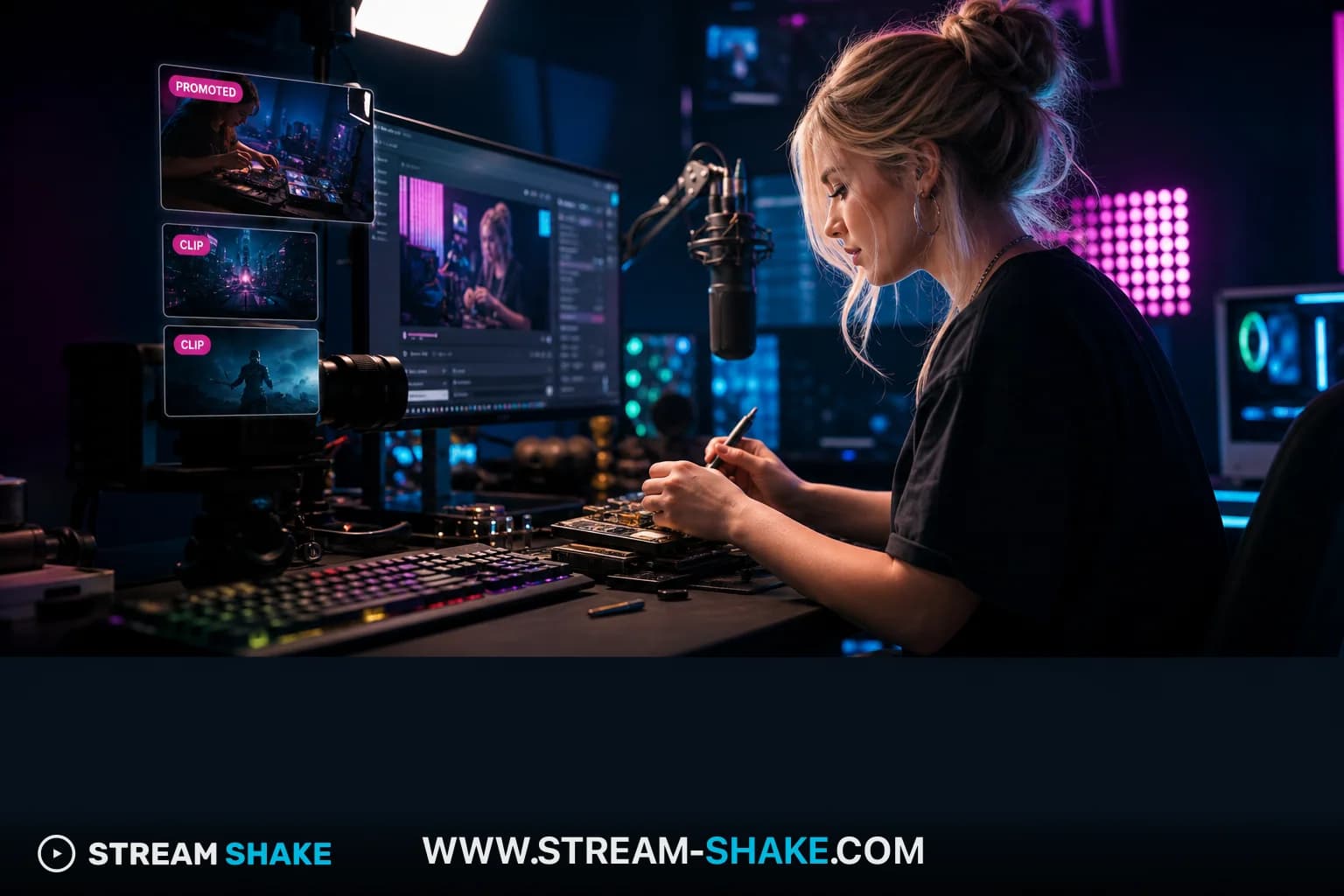
Woodworking has carved out a dedicated and highly engaged subculture within Twitch's "Makers & Crafting" category, demonstrating that traditional crafts can thrive on live streaming platforms. Success hinges on a multi-faceted approach, balancing impeccable shop safety and DMCA compliance with smart growth strategies like mutual viewing networks and multi-platform reach.
The "Makers & Crafting" Renaissance on Twitch#
Historically, Twitch was synonymous with competitive gaming and esports. However, the introduction of the "Creative" category in 2015—which subsequently evolved into today’s robust <mark>Makers & Crafting</mark> directory—fundamentally shifted the platform's demographic and cultural potential. By 2026, the streaming landscape has fragmented, with Twitch holding approximately 14.6% of total global streaming watch time, trailing behind YouTube Live and TikTok Live. Yet, Twitch maintains an absolute monopoly on the depth of real-time viewer interactivity.
For woodworkers, the transition to live streaming solves a historical pain point of the profession: isolation. Traditional woodworking requires solitary, grueling hours in a dusty shop, followed by the exhausting weekend routine of selling wares at local farmers' markets and craft fairs. The advent of live broadcasting allows artisans to monetize the <mark>process</mark> of creation rather than solely the final physical product. Furthermore, the presence of a live chat brings a bustling community directly to the workbench, alleviating the loneliness of the solitary craftsman.
This ecosystem, however, is not without its unique hurdles. Broadcasting a woodshop requires specialized hardware: multiple camera angles, wireless lavalier microphones, and heavy-duty noise gates to filter out power saws. To effectively remove industrial noise, streamers must utilize specific audio suppression filters; highly capable options include the <mark>RNNoise</mark> filter built directly into OBS Studio natively, or external AI-driven software such as <mark>NVIDIA Broadcast</mark>, which perfectly isolate the human voice while completely eliminating the deafening drone of tools. The streamers who thrive in 2026 are those who bridge the gap between ancient analog crafts and modern digital retention strategies.
Digital Audio Processing in OBS
Experts universally recommend a <mark>dynamic microphone</mark> (which rejects background noise) over a condenser — placed on a boom arm close to the mouth, or worn as a head-worn or lavalier mic. Route audio through OBS filters: set a <mark>Noise Gate</mark> with Open threshold at -30 decibels and Close at -40 decibels to block distant shop noise; add a <mark>Compressor</mark> to bring quiet talking up and squish loud peaks; and use a hard <mark>Limiter</mark> to instantly suppress explosive spikes from hammer strikes or chiseling that would otherwise clip into the red audio zones. Dust management is equally critical — overhead cameras must capture macro wood-grain detail while avoiding flying debris that damages sensors and PC components.
2026 Viewer Statistics and the "Makers & Crafting" Category#
To understand the viability of woodworking on Twitch, one must analyze the broader Makers & Crafting directory. Unlike high-adrenaline gaming categories, crafting streams offer a "slow-burn" entertainment value, often functioning as digital companionship or ASMR (Autonomous Sensory Meridian Response) for viewers.
Demographic and Channel Distribution Data
28.3%
Micro-Channels
< 1,000 followers
56.1%
Emerging Channels
1,000 – 10,000 followers
13.9%
Established Channels
10,000 – 100,000 followers
1.7%
Elite Channels
100,000 – 1M followers
0.1%
Megastar Channels
1M – 5M followers
57.8%
Male Broadcasters
in Makers & Crafting
40.3%
Female Broadcasters
in Makers & Crafting
0.7%
Non-binary
in Makers & Crafting
The data reveals a definitive "middle-class" of streamers. Over 56% of channels sit in the 1,000 to 10,000 follower range, indicating that while reaching Affiliate status is highly attainable, breaking into the elite 100K+ tier is exceedingly rare. The gender parity in the Makers & Crafting category is also far more balanced than Twitch's overall gaming directories, which heavily skew male (overall Twitch audience is roughly 72.9% male). This balanced demographic allows woodworkers to cultivate diverse, welcoming communities that are often insulated from the toxicity found in competitive gaming spheres.
Viewership and Retention Metrics
Success in 2026 is measured by <mark>Average Concurrent Viewers (ACV)</mark>—the average number of live humans watching a stream at any given moment—rather than raw follower counts. When a channel's ACV rises over time, Twitch's algorithmic discoverability improves with it. A channel maintaining an ACV of over 200 places it among the most popular in the entire Makers & Crafting directory. For example, in May 2026, the top streamers in this category ranged from 200 to 480 ACV, proving that immense engagement can be cultivated without needing tens of thousands of viewers.
598,781
Hours Watched (March 2026)
Makers & Crafting category total
825
Avg. Concurrent Viewers
Category-wide ACV
2,635
Peak Viewers (March 2026)
Spikes during raids/collabs
Pioneering Broadcasters: Real Examples of Woodworking Streamers#
To contextualize the data, it is crucial to analyze the real-world creators who have paved the way for the woodworking niche. These broadcasters demonstrate that authenticity, skill, and community focus are the primary drivers of success.
Broxh_: The Virtuoso of Whakairo
Daytona Taputu, known universally on Twitch as <mark>Broxh_</mark>, is arguably the most famous woodcarver on the internet. Hailing from Rotorua, New Zealand, Broxh_ specializes in *whakairo*—the traditional, sacred Māori art of carving wood, stone, or bone. Broxh_ uses his platform primarily to share his cultural heritage and inspire the next generation of Māori youth.
Broxh_ achieved viral mega-star status (amassing over 1.6 million followers) due to his profound humility. In an era where streamers aggressively monetize their audiences, Broxh_ actively requested that viewers stop giving him money. He famously told his chat, "You can watch this stuff for free... hold on to your money, use it on your family, not me," and even temporarily disabled his donation button.
“You can watch this stuff for free... hold on to your money, use it on your family, not me.”
This wholesome approach backfired in the most positive way possible; as is common in internet culture, telling viewers *not* to donate often results in massive influxes of support. His community and fellow creators rallied behind him. In a notable instance, Australian streamer PandaTV raided Broxh_ and dedicated an entire subathon to purchasing Broxh_ a state-of-the-art gaming and streaming PC, upgrading him from his original setup of a phone suspended by two pieces of string.
BanzaiBaby: The Professional Transition
An early pioneer of the Creative category, <mark>BanzaiBaby</mark> began streaming in 2016. She is recognized as a highly established Twitch Partner who notably competed for a $60,000 grand prize in Twitch's official *Stream On* interactive reality game show. Her journey highlights the economic realities of traditional craftsmanship. Originally intending to build and sell children's wooden toys at fairs, she found the mass-production process crushing and lonely. Transitioning to Twitch allowed her to bring a community into her shop. Her broadcast became a vital pipeline for new, higher-paying custom commissions, and her live audience directly crowdfunded massive shop upgrades, including a professional-grade table saw.
TexasHula: Niche Diversification
Based in Northeast Texas, <mark>TexasHula</mark> represents the streamer who successfully pivots. Originally a gaming broadcaster, he transitioned his channel entirely to woodworking, cultivating an audience of over 10,000 followers. TexasHula focuses on diverse, highly visual projects—ranging from intricately turned wooden bowls to magic wands—proving that offering variety in projects keeps the visual medium of streaming fresh and engaging.
Regional and ASMR Carvers
While Broxh_ represents a viral anomaly, a steady tier of localized and specialized carvers forms the backbone of the community. <mark>Timberanew</mark>, operating out of the UK, integrates wood carving with the highly popular ASMR genre — streaming Monday, Wednesday, Friday, and Saturday. Carving intricate pieces out of sapele and lime wood (such as custom depth gauges), he captures the scraping, chipping, and sanding audio profiles that provide a deeply relaxing sensory experience. <mark>wood_ilya</mark> similarly merges wood carving with ASMR and spiritual communication, holding an audience of over 11,000 followers by focusing on the meditative nature of the craft. Success in wood carving does not require frantic entertainment: whether through ASMR, cultural education, or quiet companionship, the goal is to create a digital environment where viewers feel they are hanging out in a master artisan's workshop.
Navigating Platform Policies and Risks in 2026#
The physical reality of a woodshop involves sharp implements, high-speed power tools, and copyrighted radio music playing in the background. Consequently, woodworking streamers face a minefield of platform policies that gamers do not. Violating these rules can result in sudden, permanent account termination.
The Contextual Rule on Sharp Objects
A significant anxiety for new wood carving streamers is the presence of sharp, potentially dangerous tools on a live broadcast. Twitch automatically flags extreme violence, gore, and activities that endanger a streamer's life — but the platform utilizes <mark>contextual moderation</mark> when it comes to the display of sharp objects. Knives, chisels, box cutters, and X-Acto knives are perfectly legal to show and use on stream, provided they are utilized strictly as tools for crafting.
The 2026 Simulcasting Guidelines: The End of the Unified Chat Ban
<mark>Simulcasting</mark> (or multi-streaming) is the practice of broadcasting a single live feed to multiple platforms—like Twitch, YouTube, and TikTok—simultaneously. Historically, Twitch strictly prohibited its Partners and Affiliates from simulcasting. In late 2023, Twitch removed the exclusivity clauses, allowing streamers to broadcast everywhere, but they implemented a highly controversial rule: streamers were banned from displaying "merged" or "unified" chat overlays on screen. This meant a Twitch viewer could not see the messages from a YouTube viewer, fracturing the community experience.
- **Quality Parity:** The video and audio quality on Twitch must equal or exceed the quality sent to other platforms (e.g., if streaming in 4K to YouTube, the Twitch feed cannot be deliberately downgraded to 720p).
- **No Direct Linking:** Streamers are prohibited from pasting direct URLs to their YouTube or Kick streams in the Twitch chat, as Twitch penalizes attempts to actively siphon its audience to rival sites.
- **Unified Chat is Permitted:** Broadcasters can now use software to merge all platform chats into a single on-screen widget. However, the streamer remains strictly liable for moderating the *entire* unified chat. If a YouTube viewer types a ToS-violating slur and it appears on the Twitch broadcast overlay, the streamer's Twitch account will be penalized.
For a woodworker whose hands are covered in sawdust and cannot easily switch between multiple chat windows, unified chat overlays are a technological lifesaver. Tools like Upstream.so, Castr, and StreamYard have become indispensable in 2026, allowing creators to centralize their community while maximizing top-of-funnel reach across the fragmented internet.
Terms of Service (ToS): Safety, Injuries, and "Self-Destructive Behavior"
Woodworking is inherently dangerous. A minor slip of a chisel or a kickback on a table saw can result in severe physical trauma. On Twitch, blood and severe injury cross the line from unfortunate accidents into severe ToS violations.
Twitch's Community Guidelines strictly prohibit content depicting "extreme violence, gore, and other obscene conduct." Furthermore, Twitch enforces a rigorous <mark>"Self-Destructive Behavior"</mark> policy. While designed primarily to combat self-harm, suicide, and eating disorders, the policy's phrasing explicitly prohibits "activity that may endanger your life, lead to your physical harm, or encourage others to engage in physically harmful behavior." Twitch explicitly states that they do not make exceptions for self-destructive behavior performed as a stunt or gag, or meant to entertain.
153
Proactive Escalations
to law enforcement in H1 2024 for user safety concerns
The DMCA Landscape: Safeguarding the Woodshop VODs
A quiet woodshop is an auditory void, prompting most woodworkers to play background music. However, playing commercial music (e.g., a standard Spotify playlist) is a massive legal liability.
Debunking DMCA Myths (2026)
- **Myth 1: The "8-Second Rule."** Many creators believe playing copyrighted music for under 8 seconds constitutes "Fair Use." This is false; there is no legal time minimum for copyright infringement.
- **Myth 2: Muted VODs mean you are safe.** Twitch's automated system mutes VODs containing copyrighted audio, but this is merely a shield; a rights holder can still issue a strike against the live broadcast or the muted VOD.
- **Myth 3: Premium Spotify/Apple Music subscriptions give you broadcast rights.** Personal streaming subscriptions explicitly forbid commercial broadcasting. Purchasing a track on iTunes does not grant public performance rights.
Monetizing the Craft: E-Commerce Integration#
As a woodworking channel grows, the immediate question becomes how to monetize the physical byproducts of the content. Wood carvers routinely integrate e-commerce into their streams, transforming a 4-hour broadcast into a live marketing event. The audience watches a bowl or sculpture emerge from a raw block of wood, deeply investing in the creation story — which dramatically increases perceived value when the piece is listed for sale at stream's end.
- **Etsy and Shopify:** List finished pieces with direct links in channel panels and chat commands; many carvers run "made-to-order" queues visible on stream.
- **Live chat auctions:** Third-party integrations allow real-time bidding during broadcasts — viewers compete for one-of-a-kind pieces they watched being crafted.
- **Branded Content Disclosure:** If a tool manufacturer sponsors a chisel unboxing or paid product placement, Twitch's 2023 Branded Content Policy requires using the disclosure tool in Creator Dashboard. Using your favorite chisel without compensation requires no disclosure.
Overcoming the "Cold Start": Lawful Growth Tactics for Craft Streamers#
Creating excellent wooden furniture on camera is useless if the digital room is empty. The most grueling phase for any broadcaster is the <mark>"Cold Start"</mark>—going live to zero viewers. Twitch’s discovery algorithm heavily favors streams that already show viewer activity. Therefore, a stream with zero viewers gets buried at the bottom of the Makers & Crafting directory, ensuring no organic viewers will ever scroll down far enough to find it. To bypass this algorithm organically and lawfully, creators in 2026 deploy a synthesis of mutual viewing networks, AI workflows, and audience interactivity.
Stream Shake and ToS-Safe Mutual Viewing
The most pressing issue for a new streamer is generating initial traction without resorting to illegal "viewbots." Viewbots send fake, automated traffic to artificially inflate viewer counts, a direct violation of Twitch ToS that results in "shadowbans"—a devastating technical mechanism where the stream appears live and functional to the creator, but is completely removed from platform recommendation arrays and directory listings, meaning no organic viewers can ever discover it—or permanent account termination.
- <mark>Stream Shake</mark> was developed as the lawful, ethical alternative. It is a mutual viewing marketplace where real streamers watch real channels to earn internal platform points, which they then spend to receive live viewers on their own broadcasts.
- **The Point Economy:** Creators authenticate via safe <mark>OAuth</mark> (Open Authorization) connections. By leaving a peer’s stream open and actively engaging (e.g., meaningful messages every 60 seconds), they earn points.
- **Concurrent Viewer Injection:** When the creator goes live, they spend accumulated points to have Stream Shake route real human viewers to their channel, immediately bypassing the zero-viewer cold start.
- **ToS Compliance:** Every viewer is a legitimate human, making it compliant with Twitch’s policies against artificial engagement. These viewers count toward metrics for Twitch Affiliate status.
- **Current Price/Cost:** Stream Shake operates entirely on a free, time-based point economy. Users earn points by engaging, meaning the monetary cost is $0.
- **Availability:** The platform is open to all authenticated Twitch creators.
- **Real-World Context (The Anti-Use Case):** Stream Shake is hyper-specialized for the "cold start" discovery phase. It is *not* recommended for established channels already sustaining 20-30+ organic ACV, as the time investment outweighs marginal gains.
Twitch's Stream Together and Shared Viewership
Twitch's <mark>Stream Together</mark> feature (with Shared Viewership enabled) combines the unique concurrent viewer counts of collaborating channels on discovery surfaces. If a wood carver with 15 viewers collaborates with a painter who has 85 viewers, Twitch displays 100 viewers on the browse page for both channels — mathematically pushing the stream past the 56.1% of crafting channels stuck in the 1K–10K follower bracket averaging under 10 CCV. Enable collaboration in Creator Dashboard → Settings → Browser Sources → "Allow Streaming Collaborators to Stream Your Call," then invite a peer before going live.
Synthesizing AI Workflows and Content Distribution
By 2026, Artificial Intelligence is an indispensable, ToS-safe co-pilot for stream preparation and post-production. AI cannot replace human charisma or physical craftsmanship, but it can exponentially increase a channel's distribution footprint.
The 30-Day AI Growth Pipeline Procedure
- Deploy AI text models to pre-draft 10–12 highly optimized, curious stream titles prior to going live, maximizing click-through rates.
- Utilize AI tools to automatically clip highlights from your streams and repurpose them into short-form content for TikTok and YouTube Shorts, optimizing for viral reach.
- Use AI-powered chat moderation tools to maintain a positive community environment, filter spam, and highlight engaging questions for the streamer.
- Leverage AI analytics to identify peak viewership times, popular projects, and viewer preferences, allowing for data-driven adjustments to your streaming schedule and content strategy.
Frequently Asked Questions about Woodworking on Twitch#
Can I play copyrighted music in my woodworking stream?
No, playing copyrighted music without explicit licensing is a direct violation of the DMCA and can lead to strikes and permanent account termination on Twitch. Always use royalty-free music sources like StreamBeats or Epidemic Sound.
What happens if I get injured during a live woodworking stream?
If a severe injury occurs on stream, Twitch's 'Self-Destructive Behavior' and 'Extreme Violence/Gore' policies can lead to immediate broadcast termination and account bans. It is critical to terminate your stream immediately and delete the VOD (Video on Demand) and any clips to prevent further policy violations.
Is it safe to multi-stream my woodworking channel to Twitch, YouTube, and TikTok?
Yes, as of 2026, Twitch's policy reversals permit simulcasting and the use of unified chat overlays. However, you must ensure quality parity across platforms and remain responsible for moderating all chats to avoid ToS violations from any platform appearing on your Twitch broadcast.
How can a new woodworking streamer overcome the 'cold start' of zero viewers?
New streamers can use lawful mutual viewing networks like Stream Shake to gain initial live traction and bypass Twitch's algorithmic penalty for zero-viewer streams. This provides real human viewers, helping to meet Affiliate requirements and warm up your chat for organic discoverability.
Do I need special equipment to stream my woodworking shop?
Yes, you will need multiple camera angles, wireless lavalier microphones to capture your voice clearly, and heavy-duty noise gates or AI audio suppression software (like OBS Studio's RNNoise or NVIDIA Broadcast) to filter out loud power tool sounds. In OBS, set a Noise Gate at -30 dB open / -40 dB close, add a Compressor for dynamic range, and a Limiter to catch hammer-strike spikes.
Can I sell crafts during a Twitch woodworking stream?
Yes. Many carvers integrate Etsy or Shopify listings into their broadcasts, run live chat auctions via third-party tools, or take custom commissions on stream. If a tool brand pays for a product placement, use Twitch's Branded Content disclosure tool in Creator Dashboard.
Can I show sharp carving tools on my Twitch stream?
Yes — Twitch uses contextual moderation. Knives, chisels, and carving tools are permitted when used professionally for crafting. Reckless handling, threatening gestures, or waving blades at the camera violates safety guidelines and can result in bans.