
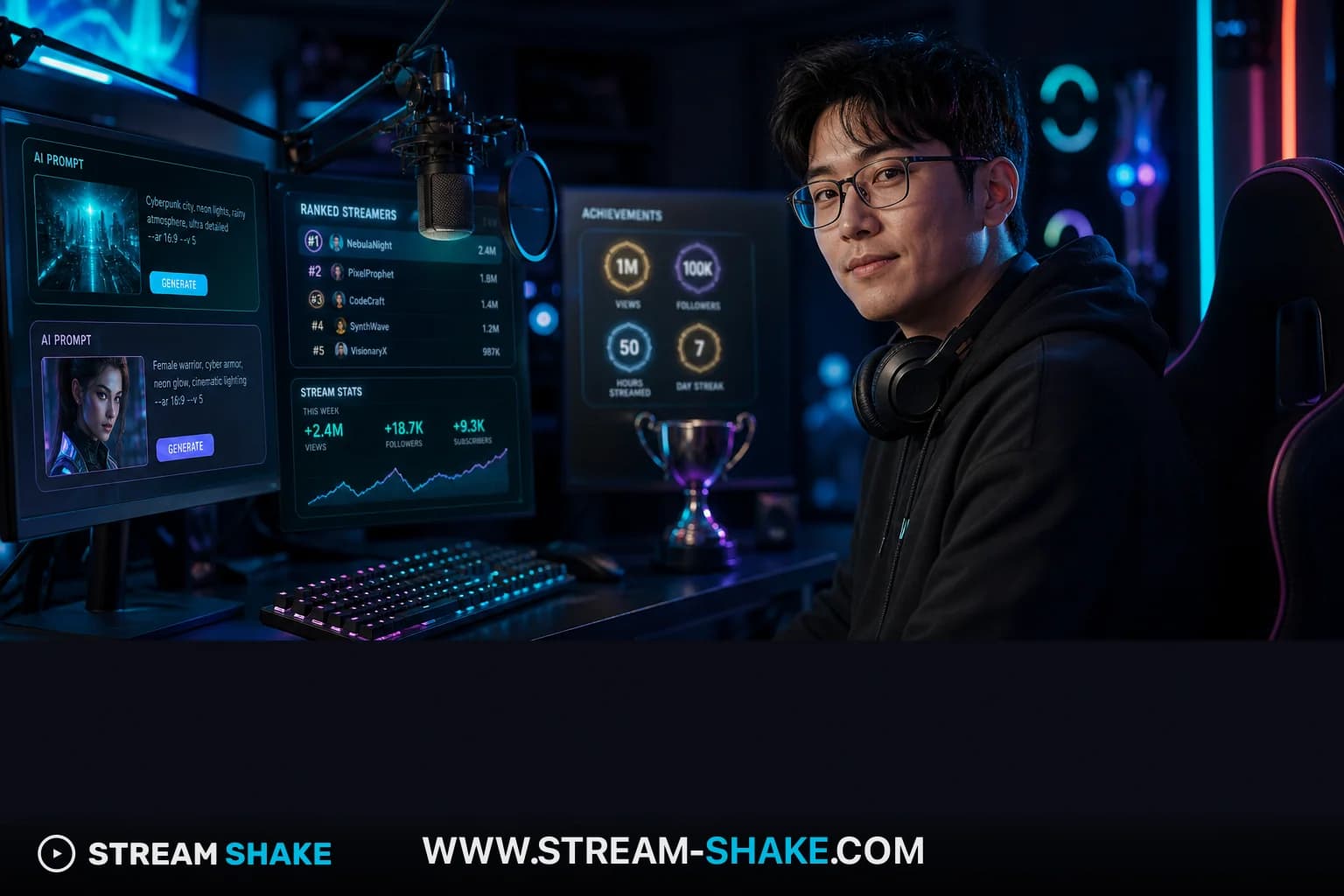
The live-streaming landscape in 2026 is defined by an intense dichotomy between massive, mainstream entertainment spectacles and the grassroots struggle for algorithmic discoverability. As the creator economy continues to mature, the era of relying solely on raw gameplay to build an audience has largely passed. Modern success now requires a hybrid approach: part high-stakes event production, part cross-platform community building, and an absolute adherence to lawful growth tactics.
The Titans of Twitch: Record-Breakers and Cultural Icons in 2026#
To truly understand the mechanics of growth on Twitch, one must first analyze the creators who have successfully conquered the platform's algorithm. The most famous Twitch streamers in 2026 are no longer just individuals playing video games; they are the CEOs of their own media empires, orchestrating massive events, leveraging celebrity collaborations, and pioneering entirely new forms of digital entertainment.
The New Vanguard: Kai Cenat and the Mafiathon Phenomenon
For much of Twitch's history, the title of 'most-followed streamer' was held by Tyler 'Ninja' Blevins, whose meteoric rise during the 2017-2018 Fortnite boom cemented him at over 19 million followers. However, the streaming hierarchy experienced a seismic shift in the mid-2020s. By early 2026, the undisputed king of Twitch became Kai Cenat, an American streamer renowned for his high-energy 'Just Chatting' content, comedic skits, and marathon broadcasts.
Cenat's ascent represents a critical shift from purely skill-based gaming content to personality-driven, always-on entertainment. His defining achievement came during a month-long streaming event known as 'Mafiathon 3,' held in September 2025. This subathon—a format where every user subscription extends a countdown timer, forcing the streamer to remain live indefinitely—became one of the most significant moments in Twitch history.
“Mafiathon 3 blurred the line between internet culture and Hollywood, featuring A-list mainstream celebrities and shattering all-time Twitch subscription records.”
The event featured a rotating cast of A-list mainstream celebrities, completely blurring the line between internet culture and Hollywood. Guests such as Snoop Dogg, Serena Williams, Kim Kardashian, and the Jonas Brothers made appearances, culminating in a viral moment where NBA legend LeBron James cut Cenat's dreadlocks live on stream. By the time Mafiathon 3 concluded, Cenat had shattered the all-time Twitch subscription record, amassing 1,112,947 total active subscribers—a financial and cultural milestone previously thought impossible. With a staggering production budget estimated at $5 million, the event generated an estimated $20 million in total revenue, including roughly $3.6 million from Tier 1 subscriptions alone. As a philanthropic tie-in, Cenat pledged 15% of the proceeds toward building a school in Nigeria.
During this same event, he also surpassed 1 million concurrent viewers and overtook Ibai Llanos to become the most-followed streamer on the platform, eventually crossing the unprecedented 20 million follower threshold in April 2026. Despite stepping back from streaming for several months to focus on his clothing brand and self-improvement following Mafiathon 3, Cenat's cultural impact remains unmatched, frequently generating millions of hours watched even during periods of low activity.
The International Spectacle: Ibai Llanos and the Rise of Spanish Dominance
While Kai Cenat dominates the North American demographic, the international streaming market—particularly the Spanish-speaking community—has demonstrated an unparalleled ability to generate massive, synchronous live viewership. Leading this charge is Ibai Llanos, a former esports commentator from Spain who has transitioned into a globally recognized internet celebrity with nearly 19.8 million followers in 2026.
Ibai's strategy revolves around large-scale sports and entertainment events that require massive production budgets and months of planning. His flagship event, *La Velada del Año* (The Night of the Year), is an annual amateur boxing tournament featuring popular content creators. While *La Velada del Año IV* set a staggering record of 3.8 million concurrent viewers, the 2025 edition, *La Velada del Año V*, fundamentally altered the industry's understanding of scale. The fifth iteration drew in an astonishing 9.33 million concurrent viewers across his main channel—peaking at 14 million across all platforms—smashing all previous platform records and proving that Twitch can rival traditional pay-per-view television broadcasts.
To put this in perspective, Ibai secured multi-million dollar sponsorships from global brands like ALSA (who provided customized transport buses) and Revolut (who launched interactive QR code activations live on stage). The traffic was so immense that Ibai publicly criticized Twitch for experiencing server outages, noting it was a shame that a platform backed by $300 million in server infrastructure struggled to accommodate the traffic. Furthermore, Ibai's involvement in the Kings League—a non-traditional football league co-created with former professional footballer Gerard Piqué—has helped him maintain a commanding long-term viewership presence, averaging over 146,000 concurrent viewers throughout 2025 and generating an estimated monthly revenue of $261,000.
The Evolving Leaderboard: Variety, Esports, and VTubers
The top tier of Twitch in 2026 is highly diverse, proving that there is no single winning formula for content creation. The following list outlines some of the most followed and watched streamers, showcasing the distinct niches that capture global attention. Crucially, executing large-scale, high-impact events has become the baseline expectation for anyone at this tier.
20.2M+
Kai Cenat
Followers, known for Mafiathon 3
19.8M+
Ibai Llanos
Followers, known for La Velada del Año V
19.3M+
Ninja
Followers, historical Fortnite icon
17.0M+
Auronplay
Followers, variety gaming & roleplay
16.4M+
Rubius
Followers, community-driven events
12.4M+
xQc
Followers, chaotic energy & variety
9.4M+
Pokimane
Followers, most-followed female streamer
This data reveals a critical demographic reality: the Latin American (LATAM) and European markets are deeply engaged in live streaming. Creators looking to build massive audiences must recognize that Western English-speaking content is only one piece of the global pie. Furthermore, 2025 and 2026 have seen the meteoric rise of non-traditional broadcasters.
The VTuber Explosion
Virtual YouTubers (VTubers)—creators who use motion-captured digital avatars instead of traditional webcams—have moved from niche internet subculture to mainstream dominance. Ironmouse, one of the most prominent VTubers, consistently ranks among the most-watched creators globally, logging 141 million hours watched in 2025. Even more disruptive is the rise of AI-assisted and hyper-stylized avatars. In early 2026, a creator known as TheBurntPeanut—utilizing a crude, Snapchat-style filter that turns his head into a giant, stretched peanut—surged to 1.8 million followers. Thanks to his chaotic gameplay of *ARC Raiders* and *Escape from Tarkov*, TheBurntPeanut actually became the single most-watched streamer on Twitch in January 2026, besting massive names like HasanAbi, Asmongold, and Caedrel.
Similarly, the AI-powered VTuber Neuro-Sama broke the all-time Hype Train record in January 2026, accumulating over 262,000 subscribers during a single event. These examples prove that high-end camera equipment is no longer a prerequisite for fame; innovation, highly specific personal branding, and technological novelty can bypass traditional streaming aesthetics.
The Evolution of Famous Twitch Streamers: Profiles in Success#
To understand the mechanics of live streaming growth, one must first analyze the individuals who operate at the absolute zenith of the industry. The distribution of followers and viewership on Twitch follows a strict power law, a statistical reality where a microscopic fraction of elite broadcasters commands the vast majority of audience attention and platform revenue. These creators have effectively rewritten the rules of digital entertainment, moving away from simple desktop gaming to high-production reality television and massive event marketing.
The Top Tier: Defining the Modern Broadcasting Titan
The landscape of the most-followed Twitch streamers in 2026 highlights a distinct shift toward international audiences and event-driven content. Examining the statistical leaders provides a clear window into what currently resonates with global viewers.
<ul><li><strong>Kai Cenat (United States):</strong> Sitting at the pinnacle of the platform, Kai Cenat holds the record as the most-followed Twitch streamer with 20.2 million followers. His success is largely attributed to relentless consistency and monumental subathons (subscription marathons where the broadcast remains live continuously). His September 2025 "Mafiathon 3" event, which featured high-profile celebrity guests ranging from LeBron James to Kim Kardashian, pushed him to an unprecedented 1.1 million active subscribers. Cenat exemplifies the "always-on" entertainment model, seamlessly blending gaming, real-life interactions, and light-hearted skits.</li></ul>
<ul><li><strong>Ibai Llanos (Spain):</strong> Closely following with 19.8 million followers, Ibai represents the explosive power of the Spanish-speaking streaming market. Transitioning from an esports commentator to a mainstream digital mogul, Ibai's strategy revolves around massive, stadium-filling events. His annual boxing livestream, <em>La Velada del Año</em>, routinely shatters global records. <em>La Velada del Año 4</em> (2024), held at Santiago Bernabéu with 70,000 live attendees, hit a peak of 3.85 million concurrent viewers. He completely eclipsed this on July 26, 2025, with <em>La Velada del Año 5</em> at La Cartuja Stadium (80,000 attendees), achieving a staggering Twitch record of 9.33 million peak concurrent viewers and pushing his channel to the absolute limits of platform capabilities.</li></ul>
<ul><li><strong>Richard Tyler Blevins / "Ninja" (United States):</strong> A historical icon of the platform, Ninja holds 19.3 million followers. While his explosive growth peaked during the 2018 <em>Fortnite</em> cultural phenomenon—where he set his all-time Twitch concurrent viewer record of 633,138—he remains a legacy giant in the industry. However, current data suggests his channel's growth has stagnated compared to the rapid ascent of newer variety streamers, highlighting how quickly audience tastes can evolve. In late 2025 into 2026, Ninja's metrics stabilized to an average of roughly 4,853 viewers, hitting recent peaks of 7,403 viewers while streaming for an average of 3 hours and 20 minutes a day playing titles like <em>ARC Raiders</em> and <em>Marvel Rivals</em>.</li></ul>
The success of these creators indicates a broader industry trend: the "Just Chatting" and Special Events categories have usurped traditional gaming. As of mid-2025, "Just Chatting" averaged over 250 million hours watched per month, proving that viewers overwhelmingly prioritize a creator's personality, commentary, and environmental 'vibes' over the specific video game being played.
| Streamer | Follower Count | Primary Category / Niche | Key Event Strategy & Peak Metric |
|---|---|---|---|
| <strong>Kai Cenat</strong> | 20.2 Million | Just Chatting / Variety | Multi-week Subathons ("Mafiathon 3"); 1.1M active subs. |
| <strong>Ibai Llanos</strong> | 19.8 Million | Special Events / Sports | Stadium-scale Boxing (<em>La Velada del Año 5</em>); 9.33M peak CCV. |
| <strong>Ninja</strong> | 19.3 Million | FPS / Battle Royale | High-level Competitive Gameplay; 633K all-time peak CCV. |
The 2026 Live Streaming Market: Statistics and Competitor Alternatives#
While Twitch remains a cultural monolith, it is no longer a monopoly. The era of going live and simply waiting to be discovered on a single platform has firmly ended. Creators operating in 2026 must navigate a highly fragmented market, making cross-platform strategies essential for survival and scale.
Twitch's Demographic and Statistical Baseline
Despite facing stiff competition, Twitch maintains a staggering operational scale. It is crucial to understand the platform's baseline metrics to grasp the volume of competition a new streamer faces. As of 2025 and moving into 2026, Twitch boasts over 240 million Monthly Active Users (MAUs), with approximately 35 million daily active users (DAUs). These users consume an immense amount of content, logging over 20.8 billion hours watched throughout 2024.
240M+
Twitch MAUs
Monthly Active Users
7.4
Avg. Viewers
Per Stream, Skewed by Top 5%
54%
Twitch Market Share
Of Total Live Streaming Hours, 2026
131%
Kick YoY Growth
Hours Watched (2025)
The platform hosts approximately 7.2 to 11.4 million active streaming channels per month. However, the average concurrent viewership per stream sits at a mere 7.4 viewers, a number heavily skewed by the top 5% of mega-creators. The platform leans heavily toward younger, male audiences. Roughly 72% to 73% of Twitch users are under the age of 34, and approximately 63% to 65% identify as male. The United States remains the largest single market, accounting for roughly 35 to 37 million users, followed closely by massive growth in Latin America and Spain.
The synthesis of this data reveals a harsh reality for new creators: you are competing against over 7 million other broadcasters for the attention of an audience that, while massive, is predominantly concentrated at the very top of the directory.
The Rise of Competitor Platforms: YouTube Gaming and Kick
The most significant strategic shift for streamers in 2026 is the necessity of multi-platform distribution. Streams Charts data from late 2025 into 2026 indicates that Twitch's share of total live streaming hours watched declined year-over-year to approximately 52.8% to 54%. This audience has not disappeared; rather, it has migrated to emerging and established competitors.
<ul><li><strong>YouTube Gaming:</strong> Ranking as the second most popular live streaming platform, YouTube Gaming captured roughly 24% of the market share, generating a record 8.8 billion hours watched in 2025. YouTube’s primary advantage lies in its superior algorithmic discoverability and Video on Demand (VOD) value. A creator's live stream can be repurposed into highly searchable long-form videos and "Shorts," creating an organic discovery funnel that Twitch natively lacks. Furthermore, YouTube offers the broadest demographic reach, appealing significantly to audiences over the age of 30 and non-endemic brand advertisers.</li></ul>
<ul><li><strong>Kick:</strong> Launching with aggressive financial incentives, Kick has captured roughly 11% to 12.4% of the gaming market, recording 4.5 billion hours watched in 2025 (an explosive 131% year-over-year increase). The platform's defining feature is its highly disruptive 95/5 revenue split. Where Twitch typically takes 50% of a creator's subscription revenue (or 30% for top-tier Partner Plus members), Kick allows creators to keep 95 cents of every dollar. While Kick's overall audience is smaller and skews heavily young and male, this highly favorable monetization threshold makes it an attractive alternative for creators who already possess an established audience they can migrate.</li></ul>
| Platform | Market Share (Approx) | Total Hours Watched (2025) | Base Revenue Split | Target Demographic | Primary Advantage |
|---|---|---|---|---|---|
| <strong>Twitch</strong> | 53% - 54% | 20.8 Billion | 50 / 50 | Under 34, Global | Deep cultural relevance & active chat culture |
| <strong>YouTube Gaming</strong> | 24% | 8.8 Billion | 70 / 30 | Broad, All Ages | Superior algorithmic discovery & VOD lifespan |
| <strong>Kick</strong> | 11% - 12% | 4.5 Billion | 95 / 5 | Young Male, Crypto-Savvy | Disruptive monetization & looser moderation |
Kick's Financial Mechanics and Long-Term Viability
While Kick's 95/5 revenue split is undeniably attractive, creators must critically evaluate the platform's long-term sustainability. Kick is backed by the founders of Stake.com, a massive online cryptocurrency casino. In a 2023 interview, Kick's CEO admitted the platform is not currently profitable on its own merits.
Instead, industry analysts suggest Kick operates heavily as a "loss leader"—a marketing vehicle designed to legally bypass Twitch’s strict gambling bans and funnel younger, crypto-savvy demographics directly toward Stake.com’s highly lucrative betting operations. While the company aims for future ad-based profitability, its current survival relies heavily on the continued injection of crypto-casino capital. Creators moving to Kick must weigh the immediate financial windfall against the moral implications of casino affiliations and the platform's reliance on a single, controversial financial pillar.
Platform Policies and the Dangers of Artificial Engagement#
With discoverability presenting such a monumental hurdle, many desperate creators turn to illicit shortcuts. The most notorious of these is "viewbotting"—the practice of using automated, third-party scripts to artificially inflate a channel's live concurrent viewer count. However, the regulatory environment in 2026 has rendered this practice not only unethical but professionally suicidal.
The Mechanics of Viewbotting and Fake Engagement
Historically, viewbotting allowed a streamer to artificially push their channel to the top of a category's directory, operating under the assumption that fake numbers would attract real, organic viewers scrolling through the platform. This category of Terms of Service (ToS) violation also encompasses "chat bots" designed to mimic human interaction, as well as coordinated "Lurk 4 Lurk" (L4L) or "Follow 4 Follow" (F4F) rings where users mutually inflate statistics without genuine viewing. Twitch explicitly bans all forms of artificial engagement. The platform's guidelines state that using services that promise higher visibility in exchange for lurking in massive numbers of channels, or manipulating embedded streams, constitutes fake engagement. The consequences for such actions have historically been channel suspensions and mass bot purges, such as the removal of 7.5 million bot accounts in 2021.
The 2026 Policy Paradigm Shift: CCV Caps
In May 2026, Twitch CEO Dan Clancy announced the most aggressive step the platform has ever taken against artificial engagement. Recognizing that viewbot companies constantly update their software to evade standard detection, Twitch shifted its enforcement strategy from merely deleting bot accounts to directly punishing the offending channels through algorithmic suppression, a tactic akin to shadow-banning. Under the new 2026 policy, channels identified as persistently using viewbots are subjected to a Concurrent Viewership (CCV) cap. This "Invisible Suppression" operates much like a nightclub bouncer refusing to let the line move forward regardless of how many people show up outside. The mechanics are unyielding:
- Algorithmic Profiling: Twitch algorithms analyze a creator's historical, non-viewbotted traffic. If artificial inflation is detected, the platform places a hard, invisible ceiling on the streamer's public viewer count.
- Platform-Wide Impact: This cap applies across all "Twitch surfaces," ensuring that the inflated numbers do not help the streamer rank higher in category directories or recommended feeds.
- Escalating Penalties: Streamers caught repeatedly utilizing viewbots face escalating durations for these caps, effectively rendering any purchased bot traffic mathematically useless.
<strong>An Illustrative Case Study in Platform Penalties:</strong> Consider "Streamer X," who averages 10 real viewers but purchases a 1,000-viewer bot package to jump to the top of the <em>League of Legends</em> directory. Historically, the channel would display 1,010 viewers. Under the 2026 CCV Cap, Twitch detects the non-human traffic pattern. The algorithm instantly caps Streamer X's public metric at 10. Despite thousands of active bot connections, the directory still ranks the channel at the absolute bottom. Furthermore, because the channel is now flagged, even if Streamer X manages to attract a viral host of 500 <em>real</em> human viewers the next day, the invisible cap may suppress the display, killing any organic algorithmic momentum. Beyond platform penalties, artificial engagement severely damages a creator's reputation. Brands utilizing advanced attribution tooling will quickly recognize wildly fluctuating viewer counts and dead chat rooms, resulting in a loss of sponsor trust and industry blacklisting. Viewbotting in 2026 offers zero sustainable reward against absolute risk.
Lawful Growth Tactics: The Ethical Alternative#
If illicit shortcuts lead to career-ending algorithmic penalties, how does a new streamer overcome the legitimate "cold start problem" (an algorithmic catch-22 where a platform won't recommend a channel because it lacks viewers, but the channel cannot gain viewers without being recommended)? The reality of Twitch is that streaming to zero viewers yields zero algorithmic momentum; the platform's recommendation engine heavily weights schedule regularity, concurrent-viewer stability, and chat-engagement density. To bridge this gap lawfully, creators must utilize a hybrid approach: organic community building coupled with ToS-compliant, ethical mutual promotion networks and aggressive content repurposing.
The Stream Shake Methodology: Human-Verified Mutual Viewing
As an explicit countermeasure to illicit viewbots and passive "Lurk 4 Lurk" automation, platforms like <strong>Stream Shake</strong> have emerged as the premier lawful growth alternative. It serves as an ethical mutual viewing marketplace designed specifically for beginner streamers to generate legitimate social proof and initial algorithmic momentum.
Organic Cross-Platform Pipelines: AI Repurposing Tools
While a mutual viewing network provides the essential initial spark, long-term sustainability requires content distribution outside of Twitch. Modern streaming growth is a discoverability problem disguised as a content problem. Relying solely on Twitch for discovery is mathematically disadvantageous. Successful creators utilize AI clipping tools to instantly transform live stream highlights into vertical short-form videos for TikTok and YouTube Shorts. Two of the premier tools utilized by streamers in 2026 include OpusClip and StreamLadder.
OpusClip Breakdown
OpusClip is an advanced AI video repurposing suite. It ingests long-form video (like VODs or podcasts), analyzes it to find the most engaging moments, automatically reframes the video to vertical, adds dynamic animated captions, and applies a predictive "Virality Score" to each clip. It operates on a credit system, offering a free plan with watermarks and various paid tiers for higher limits and features. This web-based SaaS platform is perfect for podcasters and "Just Chatting" streamers producing hours of dialogue-heavy content who need hands-off volume generation.
StreamLadder Breakdown
StreamLadder is a streamer-centric, web-based utility designed to instantly fetch clips via URL directly from Twitch, YouTube, or Kick. It features an integrated editor tailored for gaming streams (e.g., splitting a facecam and gameplay screen into a vertical format) and utilizes an AI tool called "ClipGPT" for automated highlights and auto-captions. It offers a freemium model with various tiers for enhanced exports and features. StreamLadder provides an extremely fast workflow for gamers looking to grab a highlight immediately after a stream and post it to TikTok within minutes.
Operational Consistency and Niche Selection
Beyond tooling, the Twitch algorithm treats schedule regularity as a prime predictor of returning viewers. A streamer broadcasting three hours a day on fixed, published days (e.g., Monday, Wednesday, Friday) will routinely outperform a creator streaming erratic, 10-hour marathon sessions. Establishing a reliable broadcast time trains both the audience and the algorithm. Furthermore, new streamers must avoid overly saturated categories (like <em>Fortnite</em> or <em>League of Legends</em>) in favor of directories with active viewers but fewer live channels. Variety streaming is a luxury reserved for established personalities like Kai Cenat. Finally, early streams are inherently quiet; professional streamers practice "talking through the silence" by constantly narrating gameplay and utilizing Twitch’s built-in interactivity tools (like Channel Points and polls) to encourage lurking viewers to participate.
Conclusion: Thriving in the 2026 Ecosystem#
The era of effortless, explosive growth in live streaming has passed, replaced by a sophisticated, highly competitive creator economy. The most famous Twitch streamers of 2026—whether executing stadium-sized events like <em>La Velada del Año</em> or hosting massive celebrity subathons—demonstrate that success now demands high-level production, business acumen, and relentless community engagement. For emerging creators, understanding platform policy, embracing lawful growth tactics, and leveraging AI tools for cross-platform distribution are no longer optional, but essential for survival and scale.
Frequently Asked Questions About Famous Twitch Streamers & Growth
What makes a Twitch streamer famous in 2026?
In 2026, famous Twitch streamers typically excel through high-production, event-based content (like Ibai Llanos's boxing events) or relentless subathons blending gaming and real-life interactions (like Kai Cenat). They prioritize personality and engagement over purely gaming content, often leveraging cross-platform strategies for broader reach.
What are the risks of viewbotting on Twitch in 2026?
Twitch's 2026 policy includes severe Concurrent Viewer (CCV) caps, which algorithmically suppress channels detected using viewbots. This renders fake traffic useless, kills organic discoverability, and can permanently damage a streamer's reputation, leading to loss of sponsorships and industry blacklisting. Viewbotting is now considered a career-ending risk.
How can I grow my Twitch channel lawfully?
Lawful growth in 2026 involves a hybrid approach: building genuine community, leveraging ethical mutual viewing networks like Stream Shake for initial momentum, and actively repurposing live stream highlights into short-form content for platforms like TikTok and YouTube Shorts using AI tools (e.g., OpusClip, StreamLadder). Consistency, niche selection, and engaging chat practices are also crucial.
What role do AI tools play in streamer growth?
AI tools like OpusClip and StreamLadder are vital for lawful streamer growth. They automate the process of transforming long-form VODs into engaging, vertical short-form videos with captions, suitable for platforms like TikTok and YouTube Shorts. This helps streamers overcome discoverability challenges outside of Twitch by distributing content to wider audiences.
Should I stream on Kick for its 95/5 split?
Kick's 95/5 revenue split is financially attractive, but its long-term viability is intrinsically tied to its crypto-casino backing (Stake.com). While it offers immediate financial benefits, creators must weigh these against the moral implications of casino affiliations and the platform's reliance on a single, controversial financial pillar, which could pose future ecosystem risks.
Unlock genuine engagement and grow your audience ethically.
Key Terms: Hype Train Explained
Twitch Demographics and Viewership Statistics (2025-2026)#
To effectively strategize a channel's growth, creators must understand the sheer scale—and the intense saturation—of the platform they are operating on. Twitch is a behemoth of digital traffic, but the distribution of that traffic is heavily skewed toward a small fraction of elite broadcasters.
Audience Size and Engagement
As of 2026, Twitch remains the global leader in live streaming, boasting over 240 to 250 million **Monthly Active Users (MAUs)**. Of those, approximately 35 million are categorized as **Daily Active Users (DAUs)**, engaging with the platform on a daily basis. The depth of this engagement is staggering: the average user session lasts approximately 95 minutes, making Twitch one of the most time-consuming platforms in the entire creator economy.
240-250M
Monthly Active Users
Global user base on Twitch
35M
Daily Active Users
Users engaging daily with Twitch
95 mins
Average Session
Per user, outperforming VOD
72-73%
Users Under 34
Youth-oriented demographic
63-65%
Male Audience
Gender split leans male
Demographically, Twitch remains heavily youth-oriented. Approximately 72% to 73% of users are under the age of 34, with the largest segment (41%) falling between the ages of 16 and 24. The gender split leans male, representing about 63% to 65% of the audience compared to 35% female. Geographically, the United States is the primary driver of traffic, accounting for over 35 to 37 million users and roughly 20.6% of global viewership. However, countries like Brazil, Germany, France, and Russia hold massive, highly engaged user bases that often rival North American engagement during specific esports or community events.
The Creator Squeeze: Saturated Markets and Shifting Viewership
While the audience is massive, the competition for their attention has never been fiercer. Throughout 2025 and into 2026, Twitch hosted between 7.3 million and 11.4 million active streamers per month. However, a brutal reality underlines this metric: the top 1% of streamers (roughly 114,000 accounts) completely dominate discovery and monetization, while more than 55% of all creators stream to fewer than five concurrent viewers.
Key Terms: Cold Start Problem Explained
Overall platform engagement also saw a slight contraction recently. In 2024, Twitch accumulated 20.8 billion hours watched, maintaining an average of 2.37 million concurrent viewers. By the end of 2025, that number had dipped by 8.9% to 19.2 billion hours watched. Average concurrent viewership hovered around 2.16 to 2.55 million users at any given time across 2024 and 2025. This contraction is partially attributed to post-pandemic lifestyle normalization, but more significantly, it reflects Twitch's massive algorithmic purges of viewbots and artificial engagement networks, which artificially inflated past metrics.
Additionally, user habits are changing. While desktop viewing remains dominant at 58%, mobile viewership has surged to 41%, altering how creators must design their visual overlays. A cluttered, text-heavy stream overlay that looks fine on a 27-inch monitor is unreadable on a smartphone screen, emphasizing the need for clean, mobile-friendly branding. Content categories are also shifting. While *League of Legends*, *Grand Theft Auto V*, and *Fortnite* remain massive draws, the 'Just Chatting' category is now the undisputed king of Twitch, commanding 3.8 billion hours watched in 2025—nearly double the second-place category. This highlights that viewers are increasingly seeking parasocial connections and community interaction over pure gaming prowess.
The Streaming Wars: Twitch vs. YouTube Gaming vs. Kick#
For the first decade of its existence, 'Twitch' was synonymous with 'live streaming' in the West. By 2025 and 2026, that monopoly fractured. The streaming landscape has evolved into a multi-platform war, giving creators unprecedented leverage in choosing where to build their communities. The 'Big Three' platforms—Twitch, YouTube Gaming, and Kick—each offer distinct advantages regarding discoverability, monetization, and culture.
| Specification | Twitch | YouTube Gaming | Kick |
|---|---|---|---|
| Market Share (Hours Watched) | 52.8% - 54% | 24% - 24.3% | 11% - 12.4% |
| Base Revenue Split (Creator/Platform) | 50/50 | 70/30 | 95/5 |
| VOD Discoverability | Very Poor (Streams die after broadcast) | Excellent (Backed by Google Search Algorithm) | Poor (Limited search infrastructure) |
| Content Culture & Rules | Strict ToS, gaming & interaction-focused | Broad, traditional video-centric | Relaxed ToS, edgy IRL & variety |
Twitch: The Mature Incumbent
Despite losing ground, Twitch remains the largest gaming community and the primary destination for brand advertiser budgets. In 2025, Twitch held a 52.8% to 54% market share in total hours watched. Its deep creator infrastructure, established chat culture (emotes, hype trains), and high fluency for brand sponsorships are significant pros. However, severe algorithmic saturation makes organic discovery almost impossible for new channels. Additionally, Twitch's standard revenue split sits at 50/50 for most affiliates, only climbing to 60/40 or 70/30 for top-performing Plus Program members. The platform is also heavily criticized for its aggressive ad-roll experience, which routinely turns away non-subscribed first-time viewers.
YouTube Gaming: The Discoverability King
YouTube Gaming has quietly emerged as a formidable competitor, largely due to its integration with Google's powerful search algorithm. While live streams may not immediately gain the same concurrent viewer peaks as Twitch, YouTube's unparalleled VOD (Video on Demand) discoverability allows streams to live on indefinitely, attracting new viewers through search long after the broadcast ends. This 'long-tail' effect is a game-changer for content longevity. Furthermore, YouTube offers a superior 70/30 revenue split for creators, making it an attractive option for monetization. Its broad content culture also allows for greater flexibility beyond pure gaming, appealing to a wider audience.
Kick: The Creator-Friendly Upstart
Kick, backed by Stake.com, burst onto the scene with an aggressive 95/5 revenue split—the most creator-friendly in the industry. This radical approach instantly attracted top talent like xQc, who signed a $70 million non-exclusive deal. Kick's content culture is often described as more 'relaxed' or 'edgy,' especially in its IRL (In Real Life) and variety categories, offering a haven for creators seeking fewer restrictions than Twitch. However, its discoverability features are still nascent, and its overall brand perception is often associated with gambling, which can deter some advertisers and family-friendly content creators.
Lawful Growth in 2026: Overcoming the Cold Start Problem#
Given the intense competition and algorithmic hurdles, especially the 'Cold Start Problem' for new streamers, relying solely on organic luck is no longer a viable strategy. Lawful, ToS-compliant growth methods are essential for building a sustainable audience in 2026.
The Impact of Twitch's Anti-Botting Policies
Twitch has drastically tightened its policies against artificial engagement. The May 2026 Concurrent Viewer (CCV) Capping policy, in particular, has made viewbotting virtually obsolete and catastrophically risky. Channels detected using viewbots now face shadowbanning (where their content is suppressed from directories), public CCV suppression (artificially limiting displayed viewer counts), and ultimately, permanent channel deletion. This crackdown reinforces that any form of artificial inflation of metrics is a direct violation of Twitch's Terms of Service.
Strategies for Authentic Discoverability
To legally overcome algorithmic suppression and the Cold Start Problem, creators are increasingly leveraging decentralized mutual viewing platforms. These platforms allow streamers to genuinely support each other by watching and interacting with broadcasts, thereby generating authentic, ToS-compliant concurrent viewership. This initial boost in CCV helps a channel appear higher in directories, making it visible to organic viewers who would otherwise never discover a zero-viewer stream.
Beyond mutual viewing, an optimized AI production stack is crucial for cross-platform content funnels. Tools like OpusClip and StreamLadder use AI to automatically identify highlight moments from long-form streams and reformat them into engaging short-form videos suitable for TikTok, YouTube Shorts, and Instagram Reels. This strategy expands a streamer's reach significantly, converting short-form viewers into long-form live stream audiences without requiring additional manual editing effort.
5 Steps to Lawful Twitch Growth in 2026
- Boost Initial CCV Authentically: Utilize mutual viewing networks to gain genuine concurrent viewers and overcome the 'Cold Start Problem,' ensuring your stream appears in directories.
- Optimize AI Content Workflow: Integrate AI tools (e.g., OpusClip, StreamLadder) to automatically generate short-form content from VODs for cross-platform promotion.
- Simulcast Across Platforms: Stream simultaneously on Twitch, YouTube Gaming, and Kick to maximize reach, leverage unique platform benefits, and diversify audience acquisition.
- Refine Mobile-First Branding: Design stream overlays and visual elements for mobile readability, as a significant portion of the audience views on smartphones.
- Engage & Build Community: Focus on interactive 'Just Chatting' segments and community-driven events, mirroring the success of top streamers who prioritize parasocial connection over pure gameplay.
Frequently Asked Questions#
Who is the most famous streamer on Twitch in 2026?
As of early 2026, Kai Cenat is widely considered the most famous and most-followed streamer on Twitch, surpassing 20 million followers after his record-breaking 'Mafiathon 3' event. Ibai Llanos holds the concurrent viewer record with 9.33 million for 'La Velada del Año V'.
What is the 'Cold Start Problem' for new Twitch streamers?
The 'Cold Start Problem' refers to the challenge new streamers face where their content isn't recommended because it lacks initial engagement. With over 55% of streamers having fewer than five concurrent viewers, organic discovery is severely hindered without an initial boost.
How are Twitch's anti-botting policies changing?
Twitch implemented a Concurrent Viewer (CCV) Capping policy in May 2026, which effectively neutralizes viewbotting. Channels using artificial engagement risk shadowbanning, public CCV suppression, and permanent channel deletion, reinforcing the necessity of lawful growth.
Why are events like Mafiathon and La Velada del Año so successful?
These events succeed due to their massive production budgets, celebrity collaborations, personality-driven entertainment, and ability to generate enormous synchronous live viewership. They blur the lines between internet content and mainstream spectacles, attracting record audiences and sponsorships.
What are the main alternatives to Twitch for streamers?
The main alternatives are YouTube Gaming, offering superior VOD discoverability and a 70/30 revenue split, and Kick, which provides an industry-leading 95/5 revenue split. Many streamers adopt a simulcasting strategy to leverage the unique advantages of each platform.
Connect with an authentic community and boost your channel discoverability.